
Chapter 4
Evolutionary Metaphors in
Discourse on Music
The origin of every life, whether of nation, clan, or individual, becomes its destiny. Hegel defines destiny as ‘the manifestation of the inborn, original predisposition of each individual’.… The fundamental structure shows us how the chord of nature comes to life through a vital natural power. But the primal power of this established motion must grow and live its own full life: that which is born to life strives to fulfil itself with the power of nature. (Schenker, 1979, pp. 3, 25)
4.1 Introduction: Metanarratives in Musical
Scholarship
This chapter continues to move away from the “nature” end of the nature-culture continuum covered in Chapter 1 and Chapter 2 and – the ground having been prepared by the consideration of memetics in Chapter 3 – turns to examine the deployment of evolutionary ideas in academic and scholarly discourse on music. Whereas the focus of Chapter 3 was on finding phenomena and processes in music that are structurally and functionally equivalent to those in biology, the emphasis here is on metaphorical connections between music and evolution. Nevertheless, the force of non-metaphorical connections between music and evolution, understood via memetics, will increasingly be felt – as a tension between metaphor and mechanism – as the chapter progresses.168
Metaphor, considered more fully in §4.2 , has underpinned many of the wider frameworks humans have established in order to understand music, these metanarratives anchoring music historiography, music theory and music analysis to coherent and durable intellectual traditions. As well as being a cultural practice embedded in all human societies – a manifestation of its deep connection with our evolutionary history and identity as a species – music has been a persistent topic of intellectual speculation from the beginning of literate culture (and probably before). Musical metanarratives initially emerged in relation to theoretical issues, in order to explore the raw materials of music and their basis in natural acoustical phenomena. Only gradually – by the seventeenth century, perhaps – did the systemic focus on music theory widen to incorporate a consideration of specific pieces of music, what we would today regard as the beginnings of music analysis. The two domains are closely interconnected, both conceptually and historically. In the former, (general) theoretical models are assembled by means of the analysis of (specific) pieces of music; and pieces of music are analysed by reference to theoretical models. In the latter, analysis was initially motivated by the theoretical demands of compositional pedagogy: to draw on Spitzer’s distinction, theory assumed the analytical study of “generic” (prototypical) exemplars in order to develop the understanding of musical structure necessary to support “generative” processes (2004, pp. 73–75, Fig. 2.8). Inverting Cook’s dichotomy, the latter process represents “composition through analysis” (1996). The preconditions for the development of music analysis as a free-standing discipline would appear to have been the rising importance and systematisation of music notation; the greater permanence of certain (often Austro-German) compositions marking the beginnings of canonicity and the associated notion of the work concept (Goehr, 1992); the growing authorial presence of the composer, itself related to changing economic systems and associated career structures for creative musicians; the nascent aestheticisation of music; and the increasing desire to use analysis as a window into musical structure. The last of these, often achieved by means of composition, inverts its initial motivation and, restoring Cook’s original formulation, affords “analysis through composition”.
Some common threads have linked the pursuit of these two interconnected disciplines over the last two millennia, certainly in the west (Christensen, 2002). Music-theoretical and music-analytical metanarratives might be divided not just into their component disciplines, but also into two “bundles”, one “cosmic”, the other “human”. The cosmic bundle relates to the fact that, for most of our history, we have believed that we are made in the image of a heaven-dwelling deity. As a consequence, music theory was initially conceived as affording an insight – as a metaphor, or a proxy – into the nature of our creator and the secrets, encoded in mathematics, of the cosmos that creator impelled (Clark & Rehding, 2001). This orientation characterises much Ancient Greek (Hagel, 2009; Nowacki, 2020) and Ancient Chinese writings on music theory (Thrasher et al., 2001, sec. II; Fang, 2019), although these are pre-dated by rich bodies of writing from such cultures as the Babylonians (Conner, 2014). From the perspectives of these cultures, the study of music offered a window into understanding the wider universe, the proportions and ratios of the former being a mirror and microcosm of the latter. This relationship between music and cosmology – most clearly evident in, and most intellectually influential via, the notion of the “harmony of the spheres” (Godwin, 1993) (§7.8 ) – persisted into the middle ages, with the seven-fold structuring of the Medieval university curriculum into a number-orientated Quadrivium of arithmetic, geometry, music and astronomy, and a language-orientated Trivium of grammar, logic and rhetoric (Leff, 1992; J. North, 1992).
The human bundle, which supplanted the cosmic during the Renaissance, relates to the use of music theory and analysis as endeavours conducted in order to understand our nature and place in the universe revealed by the cosmic bundle: we make music in our own image – in Jacobus of Liège’s term, it is a mirror (Harne, 2012)169 – so music theory and analysis have probed this simulacrum in order to glean insights into what makes us who we are. Again in the ancient Greek tradition, discussion of the (cosmic-)proportional structure of modes went hand in hand with consideration of their (human-)emotional effect upon us. In the European middle ages and later, theory and analysis were also used a key to understanding discourse, framing music as a form of non-verbal rhetoric partly in an attempt to illuminate the structure of thought and the wielding of influence (Bonds, 1991). In the European Enlightenment and ensuing Romanticism, models drawn from biology, most notably the concept of organicism (§4.4.1 ) – a persistent focus of this chapter – became prevalent, partly as ways to understand ourselves in the context of continuities and discontinuities with other species. Twentieth-century developments in music theory and analysis brought to bear insights from cognitive science (Gjerdingen, 1999; Gjerdingen, 2010) and – in a reinvigoration of its Medieval focus – from linguistics (Lerdahl & Jackendoff, 1983; Patel, 2008) in order to co-illuminate music and its perception and cognition.
The study of music history – what in the UK is often termed “historical musicology” and, in the US, simply “musicology” (Kerman, 1985) – was the latest of the three major domains of “traditional” music scholarship to arise. It started to manifest itself in the early-nineteenth century with biographies of leading composers, such as those of J. S. Bach (by Forkel in 1802 (Forkel, 1920)) and of Haydn (by Griesinger in 1810 (Griesinger, 1810)). These were followed by surveys of musical history that attempted to integrate composers’ biographies with such themes as style analysis (the “Leben und Schaffen” (“life and works”) tradition); the waxing and waning of different chronological and geographical styles, often in relation to their political and socio-economic underpinnings; the development of musical forms and genres; and the aesthetic tenors of different ages. By the end of the nineteenth century, these two broad domains – the historiographic and the theoretical/analytical – had been assimilated into Adler’s (1885) bipartite formulation of musicology as consisting of the “historical” and the “systematic” branches and their subcomponents.
The purpose of briefly rehearsing these well understood metanarratives is to provide some context for the consideration of music in terms of its relationship to the scholarly discourses surrounding it, particularly those that draw upon evolutionary metaphors. If the arguments of Chapter 3 are accepted, then musical style and structure are amenable to a memetic reading that sees them in Universal-Darwinian terms. That is, music can be understood in terms of a myriad of competitively replicating particles whose implementation of the VRS algorithm drives the evolution of musical style over time and gives rise to various higher-level structural archetypes. But music is only one element of culture, coexisting with patterning in the visual and verbal-conceptual domains. This means that musemic replication necessarily takes place in the context of the replication of other memes. There is therefore coevolutionary cooperation and competition (§3.7 ) between musemes/musemeplexes and “non-musemes”/“non-musemeplexes” (i.e., non-sound-based memes/memeplexes), and this interaction between different cultural replicator-types shapes the evolution of music itself and that of discourse about music.
If one accepts Spitzer’s view that “[t]o think, talk, or write about music is to engage with it in terms of something else, metaphorically” (2004, p. 1) – with its implication that non-metaphorical engagement with music is difficult if not impossible – then many of these music-discursive verbal-conceptual memeplexes constitute the cultural-evolutionary foundation of metaphorical writing on music, whether they draw specifically on evolutionary thought or not. In the case of music-evolutionary metaphors, the evolution of the verbal-conceptual memeplexes structuring these metaphors, and the evolution of the musemes to which the metaphors’ verbal-conceptual memeplexes relate, serves as a real/hard exemplification of the process – the operation of the VRS algorithm – articulated virtually/softly via the metaphor.
As with gene-gene and gene-meme coevolution, it is not straightforward to understand how the type of museme/non-museme coevolution (as a subset of meme-meme coevolution) just described operates. For one thing, musemes and non-musemes occupy different domains of thought, so it is unclear how any cross-influence can be identified, either in terms of low-level implementation or higher-level outputs. Despite the hypotheses of §3.8.4 , §3.8.5 and §3.8.6 – i.e., that brain substrates primarily associated with musemes may connect with the syntax- and semantics-implementing brain substrates primarily associated with lexemes – it is by no means straightforward to map how, for instance, a particular phenomenon in verbal syntax or semantics might influence a corresponding one in musical syntax or semantics, or vice versa. A further complication is introduced by incorporating visual culture – and the syntactic-semantic networks it draws upon – as a factor affecting verbal-conceptual memes and musemes. More often than not, influences upon music from the wider culture appear to inhere largely in quite broad-brush aspects, such as the oft-noted connections between imperial/militaristic politics and musical swagger (Rumph, 2004), that are inherently difficult to cross-map with a meaningful level of granularity. In general, music often tends to be seen as an epiphenomenon, not a driver, of culture: in the previous example, ceremonial music is primarily understood to reflect and glorify an extant swagger, even though a feedback loop might be assumed to have operated, whereby the music served further to embolden the swaggerers.
Beyond this general potential for the wider culture to affect the memetic evolution of music, and vice versa, my concern in this chapter is more limited and thus more tractable, being focused, as noted, upon those verbal-conceptual memeplexes constituting the academic/scholarly discussion of music – the metanarrative-underpinned traditions of music history, music theory and music analysis, with their, in Spitzer’s view, unavoidably metaphorical dimensions. The chapter’s threefold focus is thus on the following:
-
Within the domain of verbal-conceptual culture:
-
Within and between the domains of verbal-conceptual and musical culture:
- 3.
- The tripartite coevolution of socio-culture, music, and scholarly discourses on music (§4.7 ).
As will be understood, the difficulty – which this chapter cannot claim to surmount – increases as one proceeds through this sequence: point 1 is tractable to some extent by surveying a sample of relevant literature; point 2 requires a more statistical approach, taking the appearance of certain key terms as phemotypic markers of cultural-evolutionary processes within music scholarship; whereas point 3 requires findings from the second enquiry to be correlated with data on extra-musical cultural evolution. From this it will hopefully be clear that, as noted at the beginning of the chapter, the metaphorical gives way to the mechanical, as the influence of memetics gradually increases over the course of the chapter. As a final point, it is worth noting that there is a dichotomy, on the one hand, between taking into account known influences of evolutionary ideas on the discourses discussed, and, on the other hand, reading into these discourses evolutionary ideas that may not have affected their origin and development. While my primary focus is on the former, there are occasionally cases where the latter can offer a fruitful strategy.
The chapter continues with a review of Spitzer’s theory of metaphor, attempting to relate it specifically to evolutionary metaphors (§4.2 ). It continues with two related sections that examine the use of evolutionary metaphors in music historiography and in music theory and analysis (§4.3 , §4.4 ).170 Another return to the issue of music’s relationships with language explores the use of linguistic tropes – specifically, those that see music as a form of (“universal”) language – in music-scholarly discourse (§4.5 ). The following section moves away from the primarily metaphorical uses of evolutionary ideas in music-scholarly discourse considered hitherto in order to examine the cultural evolution of such discourses themselves (§4.6 ). Finally, the chapter expands the consideration of such cultural evolution to encompass coevolution: not gene-meme, or even meme-meme, but meme(plex)-museme(plex)-meme(plex); that is, between meme(plexe)s in the wider culture, those underpinning music, and those constituting music-scholarly discourses (§4.7 ).
4.2 Metaphor in Evolutionary-Musical Scholarship
Spitzer’s rich overview (2004) argues that metaphor has played a key role in conceptualising music, in both historical and theoretical/analytical terms. He defines musical metaphor as
the relationship between the physical, proximate, and familiar, and the abstract, distal, and unfamiliar. This relationship flows in opposite directions within the two realms of musical reception and production, and involves opposite concepts of ‘the body’. With reception, theorists and listeners conceptualize musical structure by metaphorically mapping from physical bodily experience. With production, the illusion of a musical body emerges through compositional poetics – the rhetorical manipulation of grammatical norms. (Spitzer, 2004, p. 4)
The production-reception binarism here encompasses another dichotomy. The historical evolution of the application and conceptualisation of metaphor has moved from a poetic to a scientific orientation. In its Classical and Renaissance uses in literature and painting, metaphor is a poetic-rhetorical trope. It is linked with cognate tropes – such as metonymy (reference to something via one of its attributes) and synecdoche (the part standing for the whole) – concerned with the connection of two or more separate but related entities to form a nexus in which individual components are difficult to distinguish from each other. In its modern context, metaphor is increasingly understood as a powerful means of understanding perception and cognition, as a key to the operation of the mind (Spitzer, 2004, pp. 4–5). This is because the essential metaphorical act not of seeing or hearing, but of seeing as or hearing as – of comprehending something in terms of something else, in Wittgenstein’s distinction (Spitzer, 2004, p. 9) – can be rationalised first in terms of elisions between psychological states and then, more fundamentally, in terms of interdigitation between neurological substrates (as in that occurring between the hexagon-encompassed triangular arrays theorised in the HCT (§3.8.3 )). This dichotomy is thus a manifestation of that which underpins much of this book: between culture (metaphor as poetic-rhetorical trope) and nature (metaphor as cognitive-evolutionary function).
Spitzer argues that such hearing as allows us to hear music in ways (“modes of listening” or “listening types”) that include the visual (as a quasi-pictorial experience, and motivating such images as a “line” of notes, a “decorative” passage, etc.); the vocal (as a quasi-linguistic utterance, with all the syntactic and semantic implications this entails); and the organic (as a living entity, at various biological-structural levels) (2004, pp. 11–12). Via “cross-domain mapping”, he coordinates the first of these listening types with the musical parameters of harmony and/or counterpoint (on account of the quasi-pictorial tableau generated by a complex harmonic-contrapuntal texture);171 the second with rhythm (on account of the linguistic-syntactic interconnection of notes foregrounded by their alignment with the metrical structure); and the third with melody (on account of the “living” motion of melodic pitches – indeed, slipping from theorising metaphor to being seduced by it, Spitzer argues that in Beethoven’s String Quartet in A minor op. 132, “scale steps … take on a life of their own … as organic motives. Beethoven’s motivic cells seem to generate a life force that flows like blood or spirit through the living work”) (2004, p. 27).
Figure 4.1 (after 2004, p. 59, Fig. 2.7, p. 100, Fig. 3.1) represents how these three listening types and their associated musical parameters fit into Spitzer’s model of metaphor as a whole.172

As mentioned, and as represented by the connecting arrows in the lower left-hand part of Figure 4.1 , the binary alignments posited between key musical parameters and extramusical phenomena are: (i) harmony-counterpoint/painting; (ii) rhythm/language; and (iii) melody/life. Moreover, each pairing is associated, to form a ternary “cluster”, with a foundational image schema, as follows: (i) centre/periphery (articulating notions of two- and three-dimensional space, and of proximity and distance (2004, p. 57, Fig. 2.4)); (ii) part/whole (articulating notions of nested hierarchy and logical interconnection (2004, p. 58, Fig. 2.5)); and (iii) path (articulating notions of directed progression from origin to goal (2004, p. 59, Fig. 2.6)). As an additional set of associations, Spitzer reads an historical dimension to each of these clusters, arguing that in the history of metaphorical writing on music (“the archaeology of musical metaphor” (2004, p. 59)) during the common-practice period, metaphors of: (i) harmony-counterpoint/painting are predominant in the seventeenth century; (ii) rhythm/language are most common in the eighteenth century; and (iii) melody/life are central in the nineteenth century, thus forming a quaternary cluster associated with each mode of listening (visual, vocal, organic) (2004, pp. 59–60). Connected by its image-schematic foundations, the whole structure is partitioned into analytical metaphor (strictly metonymic part-whole relations within music) and cultural metaphor (properly metaphorical cross-domain mappings between music and phenomena in other realms of culture).173
The last of these clusters – (iii) organic: melody/life; path image schema; nineteenth century – figures significantly in the deployment of evolutionary metaphors in discourse on music. As will be argued in §4.3 and §4.4 , attempts to understand music in terms of organic-evolutionary concepts – conceiving music in terms of life-historical and life-structural processes of development and change, of survival and extinction – are primarily focused around the diachronic/horizontal dimension of music (its melodic aspects, and those proxies of melody such as harmonic progression and parametric change over time); they see this linear unfolding as a manifestation of a vital force (music as a form of life, seeking to ensure its ongoing survival); they are concerned with explicating “ontogenetic” and “phylogenetic” progression and change over time in the various dimensions of music (following a continuous path of development, as if the structure of musical works and the historical unfolding of musical style were a form of ongoing melody curving from bar to bar and leaping from work to work); and they are a particularly durable theme in the historiographic and theoretical/analytical literature impelled by the florescence of Darwinian evolutionary thought (from the mid-nineteenth to the early-twentieth centuries).
To understand the foundations of cluster (iii), one must return to Spitzer’s reference to “the body” in the quotation on page 440. This notion draws, in part, on the aforementioned image-schematic coordination between music’s parameters and the phenomenological experiences of individual listeners’ bodies in three-dimensional, gravity-mediated space: the “up”/“rising” and “down”/“falling” of pitch (this up/down schema drawing on the centre/periphery schema), the “fast”/“accelerating” and “slow”/“decelerating” of rhythm, and the “light/thin” and “heavy/thick” of harmony and counterpoint (Spitzer, 2004, pp. 9–10). As mentioned in §2.5.2 , all of these image schemata have aptive motivations, because they arise from survival-related sensitivities to our location and movement in space and to the location and movement of potential environmental benefits and harms. But they are also activated in the perception and conception of art-forms that draw upon the sense modalities of vision and hearing, motivating a constant vigilance to the simulacra, intentional or not, of such benefits and harms in art, as formalised in the “etiological perspective” of Crewdson (2010) discussed in §3.5.4 . Two operations foster the cultural-evolutionary origin and development of evolutionary metaphors of music via such image-schematic embodiment: inversion and pluralisation. First, by inversion, music felt in the body becomes the body felt in music: music and its components are rendered amenable to understanding as the whole and the parts of a living entity. Secondly, and building upon inversion, “the body” can also be understood not only as singular but also as plural, and with the latter the biological is foregrounded: the subjective individual becomes the objective species, and the life-history of its type-exemplars (ontogeny) and the evolutionary history of the wider collective of organisms (phylogeny) can thus be made tangible.
4.3 Evolutionary Metaphors in Music Historiography
When trying to conceive music in evolutionary terms, music historiography, and indeed music theory and analysis, generally frame evolution informally, seeing it as “[a] process of gradual change occurring in a system, institution, subject, artefact, product, etc., esp. from a simpler to a more complex or advanced state”, rather than formally, as “the proposition that all living organisms have undergone a process of alteration and diversification from simple primordial forms during the earth’s history; (in particular) a scientific theory proposing a mechanism for this process, now esp. that based on Darwin’s theory of the natural selection of genetically inherited and adaptive variation” (Simpson & Weiner, 2018, Senses 7a, 8b). Thus, in adopting the informal sense, they generally eschew any explanatory model for this “gradual change”; or (as is explored in §4.3.4 ) they employ a model, but adopt a form of Lamarckism rather than the Darwinism underpinning more recent accounts of cultural evolution. Memetics’ status as a formal model – a mechanism, not a metaphor, to recall the distinction made in §4.1 – will be understood as the reason why it is not itself considered here or in §4.4 , even though it is invoked as a mechanism in §4.6 . As will become apparent, however, the metaphor-mechanism distinction is not hard-and-fast, and discourses – and the accounts of them offered below – often slide, occasionally surreptitiously, from one side to the other.
Four of the key evolutionary metaphor-constellations invoked in music historiography to be considered here – the fourth to some extent encompassing and illuminating the first three – are:174
-
whereby the progression in compositional technique and style (in Meyer’s (1996) sense of idiom; §1.6.2 ) from apprentice to graduate and then to master is understood in terms of life-historical processes of growth, maturation, senescence and death.
-
Ontogenetic Metaphors of Historical Styles, Genres and Formal-Structural Types:
-
whereby the origin, development, perfection and decline of music-historical styles (in Meyer’s (1996) sense of dialect), genres and formal-structural types is understood in terms of individual life-historical processes of growth, maturation, senescence and death.
-
Phylogenetic Metaphors of Historical Styles, Genres and Formal-Structural Types:
-
whereby the origin, development, perfection and decline of music-historical styles, genres and formal-structural types is understood in terms of species-historical evolution.
-
whereby the development of a composer’s style, or that of an historical period, genre, or formal-structural type, is understood as resulting either from intentional/directed processes of improvement (Lamarckism) or from the random operation of the VRS algorithm (Darwinism).
These four constellations are explored, respectively, in the following subsections.
4.3.1 Ontogenetic Metaphors of Composers’ Styles
Section 1.6.2 proposed certain structural-hierarchic analogies between nature and culture, summarised in Table 1.4 . This and the following subsection (§4.3.2 ) cover music-historiographic traditions that draw upon some of the principles articulated in §1.6.2 , but which deviate from the details of Table 1.4 in certain key ways. Table 1.4 hypothesised a broad correspondence between idiom (the level of individual composers’ styles (Meyer, 1996, p. 24)) and the sub-group of organisms at the “Genetic/Memetic-Cultural” level four, because an idiom gives rise to, and is instantiated by, multiple discrete but related works – it implements a token-type relationship (§3.6.3 ). Works, each characterised by their own intraopus style, are equated with individual organisms at the “Genetic/Memetic-Structural” level five, and in this sense are more the province of theory and analysis (§4.4.1 ), or of style analysis, and less that of historiography. Table 1.4 also bundled genre and formal-structural type with idiom on the “culture” side of the analogy, thus also aligning the former two categories with the sub-group of organisms at the “nature” side at level four, on account of their representing, like idiom and the sub-group of organisms, types instantiated by multiple tokens; and it proposed a higher-level correspondence between dialect (the level of chronologically and/or geographically defined styles (Meyer, 1996, p. 23)) and the species – both, again, defined by token-type relationships – at level three.
While the latter analogy (dialect-species, the subject of §4.3.3 ) has often obtained in music historiography, the former (idiom/genre/formal-structural type mapped against the sub-group of organisms) has not acquired much currency. The issue discussed in this subsection – understanding idiom (composers’ style-development) in terms of an individual-organism life-cycle model – has been rather more thoroughly explored. Yet it is clear that this particular trope, individual organism-idiom, misaligns two levels of Table 1.4 , namely level five of nature (individual organism) with level four of culture (idiom); and, moreover, that this misalignment crosses the Genetic/Memetic-Structural-Genetic/Memetic-Cultural boundary. While there is no necessary reason that Table 1.4 is true – it is, as noted in §1.6.2 , merely a hypothesis – it is arguably internally coherent and accords with observed structures in nature and culture. As with all analogies, the acid test is whether mappings between such diverse realms can elucidate meaningful similarities, either in support of “hard” scientific or “soft” music-scholarly inquiry. While the alignment-schema proposed in Table 1.4 appears logical in terms of the dynamics between replication hierarchies and the units of selection, music-scholarly discourse has, perhaps unsurprisingly, found the resemblances between a composer’s life history (the composer as individual organism) and the “life” of that composer’s personal style (his or her idiom as individual “idiom-style-organism”, reified in the corpus of his or her works) to be more compelling.
Such life-history/idiom resemblances often seek to map the tripartite youth-maturity-old age sequence of the composer’s life against corresponding stylistic phases or periods in his or her creative development. Perhaps not uncoincidentally aligning with the Aristotelian “rule of three” (“omne trium perfectum”; everything that comes in threes is perfect), it is common for accounts of composers’ creativity to be framed in terms of notions of early, middle and late styles.175 Commonly, early works are understood as derivative but imbued with a youthful and sometimes reckless audacity; mid-life works represent the consolidation of a distinct personal style in which stability and experimentation are balanced; and late works enter new realms of exploration and reinvention, often suffused with a profoundly spiritual glow.176 In this trope, the life history of the composer is, moreover, understood as motivating the life history of his or her style, in that physical and intellectual development, maturity and decline are understood as in some way causative of analogues in musical style. Indeed, the trope might be understood as “anti-dualistic” (§7.2.2 ), in that mind and body are seen as tightly interconnected, as opposed to the clear separation insisted upon by dualism.
The outputs of the third and final phase have often provoked the most interest (Said, 2006), given the usual pinnacle of technical and creative achievement reached, after a lifetime of experience and practise, towards the end of most composers’ lives. As the body declines in later life, there may be an artistic decline, albeit one sometimes tempered by a slight lag, in that the final period of creativity often benefits from the richness of experience afforded by old age before – as in the case of Gluck and Haydn – its depredations rob the composer of the mental and physical vigour to create. Perhaps more so than the first two phases of the Aristotelian trinity, late style often motivates an additional organic-metaphorical alignment of the (three-stage) life-span of a composer and the associated progress of his or her idiom-style-organism with the (four-stage) passage of a year from spring to winter. Reflected, for instance, in the view of Strauss’s Vier letzte Lieder as “autumnal, luminescent late songs, which contemplate the meaning of death” (Gilliam & Youmans, 2001, sec. 8), late works are often described in terms of a culminating fruitfulness, harvested before the onslaught of winter. Straus (2008) decouples this invernal chill from chronology, understanding it instead in terms of disability – which can, of course, affect composers at any stage of their lives – and arguing that
in the end there may be nothing late about late style in the sense of chronological age, the approach of life’s end, or authorial or historical belatedness. Rather, late style may in some cases be more richly understood as disability style: a perspective composers may adopt at any age, often in response to a personal experience of disability. (Straus, 2008, p. 6, emphases in the original; see also B. Howe et al., 2015)
Even when the ontogeny of the composer – which may be indeed be shaped by acute or chronic disability – is framed as the driver of music-stylistic development, the artistic outcomes are often conceived as existing quasi-independently of their corporeal foundations, as the products of self-contained organic growth processes. That is, the composer’s idiom-style-organism, as the term implies, is depicted an entity in its own right, growing, flourishing and dying. Nevertheless, it should be stressed that the ontogeny of a composer’s idiom-style-organism, like that of the composer as an individual, is not in and of itself evolutionary in the sense understood in this book. Just as Darwinism holds that a single organism cannot itself evolve – only its phenotype can change over time – any changes in a composer’s idiom-style-organism are not strictly Darwinian-evolutionary. Only when an idiom-style-organism is reconciled with the wider dialect – when the former’s musemes are understood to be subject to the operation of the VRS algorithm shaping the latter – can idiom-level change be formalised in terms of mechanism rather than metaphor. In their framing in the music-historiographic literature as metaphorically evolutionary, intra-idiom-style-organism changes align most readily with Lamarckian models (§4.3.4 ). These, as noted in §1.8 and §3.4.3 , assign the heavy lifting work of evolution to the active striving of organisms for betterment. Applied to ontogenetic metaphors of composers’ styles, this approach sees the composer purposively reshaping his or her creative vocabulary, sometimes with and sometimes without the cooperation of their quasi-independent idiom-style-organism.
Of all western composers, Beethoven has perhaps been the most comprehensively discussed in terms of the three-phase life-history model of composer style, even though this division is clearer in some genres (such as the string quartet) than in others (such as the piano sonata), and even though the boundaries between the phases are (as the gradualism of musemic evolution implies) fuzzy rather than distinct.177 The three-phase model in Beethoven has been consistently aligned with the Classical-to-Romantic Zeitgeist-shift encompassed by his life-span (albeit with the inherent problem of dividing three by two), with the early works seen as essentially derivative of the Classicism of Haydn and Mozart, and the second and third-period works understood as increasingly Romantic. Despite these “morphological” changes, Beethoven’s idiom-style-organism is nevertheless usually seen as possessing a unity that transcends the evident changes. As with Stravinsky – the “personality” of whose style is apparent from the Cantata (for the sixtieth birthday of Rimsky-Korsakov) of 1904 to the Requiem canticles of 1966 – the personality of Beethoven’s style is similarly recognisable from the Cantata on the Death of Emperor Joseph II WoO 87 of 1790 to the String Quartet in F major op. 135 of 1826. While it is a supreme challenge to music theory/analysis and music psychology to offer an explanation, the (metaphorical) stylistic “DNA” of his idiom-style-organism appears to remain stable even as its “body” ages.
Naturally any alignment between personal and communal style change in Beethoven presupposes (in a crude tripartition): (i) that the composer’s idiom-style-organism was (wholly) influenced by its environment of the wider culture (as historiographies of Kleinmeister composers generally assume); or (ii) that the converse was the case (a tall order, even for a cultural giant like Beethoven); or (iii) that some combination of the two influences obtained (as would tend to be assumed by most theories of cultural evolution). Again there is a tension here between metaphor and mechanism, in that the former orientation might ascribe disproportionate power to Beethoven’s creative persona (scenario (ii)), whereas the latter might understand the composer as being as much influenced (and thus arguably less (r)evolutionary (R. Jones, 2014)) as influencing (scenario (iii)). In a strikingly ahistorical turn, however, Rosen (1997) attempted to overturn received orthodoxies of style-historical alignment between Beethoven’s idiom-style-organism and its environment. His thesis was that a variously “classicising” and “proto-romantic” first-period style (1997, pp. 380, 381) gave way, at the onset of the middle period, to a return to full-blooded classicism. On this reading, “with the Appassionata he set himself firmly against the squarely organized and yet loose and apparently improvisatory structures of late classicism and early Romanticism, and returned decisively to the closed, concise, and dramatic forms of Haydn and Mozart, expanding these forms and heightening their power without betraying their proportions” (1997, p. 381).
For all its elegance, this interpretation arguably neglects the listener’s phenomenological experience of Beethoven’s music in favour of the analyst’s logical interpretation of its abstract structure, because there is a dissonance between Rosen’s insistence on the recuperation and consolidation of a cool and rational classicism and the increasingly intense and fractured subjectivity of the music. As Said insists, after Adorno (2002), “Beethoven’s late works remain unreconciled, uncoopted by a higher synthesis: they do not fit any scheme, and they cannot be reconciled or resolved, since their irresolution and unsynthesized fragmentariness are constitutive, neither ornamental nor symbolic of something else” (2006, p. 12; see also Spitzer, 2006). Nevertheless, Rosen’s analysis has the advantage of ascribing a quasi-biological unity and coherence to Beethoven’s idiom-style-organism: after youthful Romanticist indiscretions, Classical order prevails in his work, even – contra Adorno – in the third period, where a Classical focus, via the rubric of the primacy of exploration over expression, is maintained. Thus, “Beethoven is perhaps the first composer for whom this exploratory function of music took precedence over every other: pleasure, instruction, and, even, at times, expression” (Rosen, 1997, p. 445). As will be argued in §4.3.2 , this ahistoricism has a deeper motivation: it is the price that must be paid to sustain Rosen’s notion of The Classical Style (capitalisations intentional) as itself an organism – a “dialect-style-organism” – at a higher structural-hierarchic level than the various idiom-style-organisms, including Beethoven’s, that constitute it.
4.3.2 Ontogenetic Metaphors of Historical Styles, Genres and Formal-Structural Types
As implied in point 4.3 of the list on page 447, the concerns of this section represent a macrocosm of those considered in §4.3.1 , in that the waxing and waning of a human life, and its literal and metaphorical connections with the development of a composer’s idiom-style-organism, is writ large in accounts of the origin, development, apotheosis, senescence and death of musical styles, genres and formal-structural types as higher-order dialect-style-organisms. Thus, the definition of an idiom-type (idiom-style-organism) by multiple intraopus-style tokens – Memetic-Cultural/Structural levels four and five, respectively, of Table 1.4 – is replicated, at the higher structural-hierarchic level of a dialect-type (dialect-style-organism), by multiple idiom tokens and also by instances of the categories of genre and form-structure – Memetic-Cultural levels three and four, respectively, of Table 1.4 .
Genre and formal-structural type are themselves partly contingent upon idiom – they exist concretely via intraopus-style instances in composers’ works – and thus, while tokens of dialect, they are also types tokened by specific exemplars.178 Thus, “sonata form” is a type-abstraction derived from a large class of movements of varying (proto)typicality (Gjerdingen, 1988, pp. 94, 103). Nevertheless, unlike idiom-style-organisms, which imply a distinct end-point at the close of the composer’s life,179 historical styles, genres and formal-structural types (as opposed to their tokens) have, as dialect-style-organisms, indistinct beginnings and endings. As with species, these three categories represent, as interlocking types, a “smeary continuum” (§1.7.3 ) and not, unlike their tokens, discrete objects whose existence in time is accurately definable.
Owing to this distinction, ontogenetic models of chronological and geographical styles, genres and formal-structural types are conceptually more problematic than ontogenetic models of composers’s personal styles, even though the former type are represented in the literature, as illustrated by the dialect-style-organism of The Classical Style conceived by Rosen (1997) considered below. Indeed, only the phylogenetic models of these phenomena considered in §4.3.3 possess sufficient coherence to sustain meaningful analogies, this arguably lacking in the ontogenetic orientation outlined in this subsection. Of course, one must remember that the issues considered here and in the previous and following subsections relate to organic-evolutionary metaphors, not to mechanisms, and that the strength – or, indeed, the weakness – of a metaphor is that it need not be grounded (in whole or in part) in scientific facts. Yet there are two further reasons – in addition to the smeary-continuum issue – for preferring a phylogenetic over an ontogenetic interpretation of the three categories of style, genre and formal-structural type. The first is another instance of the problem of misalignment between hierarchic levels in Table 1.4 raised in §4.3.1 . There is a mismatch in the present ontogenetic perspective between nature and culture that also fractures the cultural side of the hierarchy: level five of nature (individual organism) is aligned with both level four (genre and formal-structural type) and with level three (dialect, i.e., style) of culture. The second reason for preferring a phylogenetic interpretation is perhaps the more fundamental: as with an ontogenetic view of a composer’s idiom-style-organism, the ontogenetic perspective applied to these categories as dialect-style-organism is also not in and of itself evolutionary, whereas the phylogenetic view certainly is, both as a foundation of metaphor and – via memetics – in terms of mechanism.
In Rosen (1997), style, genre and formal-structural type are interconnected and seen in terms of a single-entity life-history – that of The Classical Style as dialect-style-organism.180 The style, the genres it sustained, and the formal-structural types that underpinned these genres – principally sonata form – constituted an individual and indivisible unity, in that they were mutually supportive and self-sustaining. This is not to say that there is no trace of the phylogenetic metaphor in Rosen’s narrative; rather, the ontogenetic is overwhelmingly predominant. Rosen’s ascription of dialect-style-organism status to The Classical Style rests on his implication that it had sufficient identity for its attributes to be defined, although the smeary continuum issue means he is unwilling or unable to specify its start- and end-points. Instead, he identifies significant early flowerings (such as Mozart’s Piano Concerto in E♭ major K. 271 (1777) (1997, p. 59)) and late fruitings (such as Schubert’s Symphony no. 9 in C major D. 944 (1828) (1997, p. 521)) of the dialect-style-organism, painting the former, somewhat heroically, as breaking free of the outmoded constraints of the Baroque; and representing the latter, somewhat nostalgically, as resisting the enervating tide of the Romanticism of the 1830s (Rosen, 1995, see also). By such linkages, he implies that the significant differences between such works (certainly in their sound-content), and their very different socio-cultural contexts, are transcended by an overarching stylistic unity. This represents a higher-level manifestation of the unity evident in the early and late works of a single composer (as in the cases of Beethoven and Stravinsky discussed on page 451). Thus, as the works of composers are typical of their parent idiom-style-organism, so a dialect-style-organism can be understood to possess a similarly stable (metaphorical) stylistic “DNA”, even though the sound-world, and the associated socio-cultural contexts, of the works of different composers may differ greatly.
In biology, one of the most important functions an individual organism must perform is to separate itself from its environment: it must draw a clear distinction between that which is part of itself and that which is not, because the regulation of “self”, which is complex and demanding enough, must be distinguished from the regulation of “other”, which, lying outside the boundaries of self, is vastly greater and more intractable. What comes across very strongly in Rosen (1997) is the sense of The Classical Style as a distinct entity with attributes that both defined it and, in doing so, that regulated its separation from those styles – framed as “other” – that bookended it. With this distinction comes identity, and with identity comes agency, in the sense that the dialect-style-organism is presented as regulating its existence, resisting and eliminating those elements that threaten its local chronological and geographical stability and its global unity. Such self-regulation in living organisms – homeostasis – acts when a system in a previously stable state is perturbed in some way. Corrective processes, in the form of negative feedback mechanisms (where movement in one direction is countered by balancing movement in the opposite direction), are initiated, which restore the system to its default, optimal state (Gonzaga, 2020). Homeostasis is an organism’s way of resisting an increase in entropy. Formalised by the Second Law of Thermodynamics, entropy, from the Greek for “transformation”, is a “quantitative expression of the degree of disorder or randomness” of a system (Ligrone, 2019, p. 478), and – as modelled by Information Theory (Shannon, 1948) – is therefore proportional to the amount of information needed to describe it. As a “non-isolated system” (Ligrone, 2019, p. 478), an organism’s homeostatic regulation will eventually fail: the amount of entropy in the system will become too great for homeostatic mechanisms to counteract. Mortality reflects the grim certainty that there eventually comes a point of no return, resulting from a series of unmanageable cascade failures, that ultimately brings about an organism’s death.
In Rosen’s formulation of The Classical Style, the regulatory “quasi-homeostasis” is inscribed in certain musical processes that are taken as constitutive of the style. Specifically, the very survival of the dialect-style-organism is contingent upon its controlled accommodation of a tripartite process of stasis-tension-resolution. Tonal-harmonic tension is the source of the energy that drives the style, but it must be accommodated quasi-homeostatically within a context of stability, lest it break its bounds and give rise to chaos and disorder.181 Stasis-tension-resolution processes operate at several structural-hierarchic levels of the dialect-style-organism, but they are found most axiomatically in sonata form. Perhaps more accurately, the sonata principle (Carter, 1987, p. 89) serves as a kind of container – a cell membrane, as it were – for a number of “music-chemical reactions”. Chief among these is the tonic-dominant modulation found in the exposition of a sonata-form movement and the polarity, coded as both structural and expressive, that ensues. The sonata principle also effects the organismic interconnection between style, genre and formal-structural type intrinsic to this metaphor, in that it underwrites the most important formal scheme of The Classical Style, which is a default in all but a few (Baroque-residual) genres.
This music-chemical reaction – which engenders a music-dramatic “arc of beauty” – serves in Rosen’s model variously as a high-level driver of the style’s philosophical and technical motivations (in a top-down reading) and/or as a low-level generator of those motivations (in a bottom-up reading). The movement from an established tonic (stasis) to an unstable dominant (tension) and then back to the original tonic (resolution) is perhaps the most fundamental gesture of the dialect-style-organism, whether it is encompassed by a short phrase (in which case the music may move, to recall Tovey’s useful prepositional distinction, on(to) the dominant), or whether it governs the unfolding of a whole movement (in which case the movement is generally in(to) the dominant) (2015, p. 17). As the most elegant example of the symmetry underpinning this process, restoration of the tonic is usually associated with the subsequent introduction of the subdominant – the “antidominant”, in Tovey’s phrase (2015, p. 6; see also Rosen, 1988, p. 288; Rosen, 1997, p. 79) – before the final tonic closure, which renders the whole arc a zero-sum process: one step clockwise on the circle of fifths (seven semitones) is undone by one step of the same size anticlockwise, so 0 (stasis) +7 (tension) +0 − 7 + 0 (resolution) = 0. As Tovey puts it, “[s]tepping on to or into the dominant is an active measure like walking towards the vanishing point [of a painting]; subsiding into the subdominant indicates recession and repose” (2015, p. 6).
Even movements written later in the dialect-style-organism’s history, in the early-nineteenth century, and that deviate from this canonical form of the music-dramatic arc, can be understood as fundamentally conformant with it. The first movement of Beethoven’s “Waldstein” Sonata of 1804, for example, modulates in the second subject group (b. 35) not to the then still normative dominant, but to the mediant (E major; four steps away from the tonic on the circle of fifths). Rosen accommodates this seeming anomaly via his concept of the “substitute dominant” – a harmony that, while not the true dominant, fulfils the same structural role as it (1997, p. 33). Owing to their relative remoteness from the tonic, such substitutes – the lexicon in Beethoven is (in major-key movements) III, VI (as in the first movement of the Triple Concerto) and (in minor-key movement) ♭ VI (as in the first movement of the Ninth Symphony) – a more forceful process of resolution is needed.182 In the “Waldstein”, this resolution is accomplished by bringing the opening chorale-like theme of the second subject group (for which it stands metonymically) back initially in A major (b. 196) – a non-metaphorical exaptation of the “−7” V–I move, here from III to VI – before shifts to A minor (b. 200) and then C major (b. 203). The tonic is nailed down, and thus resolution clinched unequivocally, by a final statement of the chorale theme in the coda (b. 284).
Rosen’s extended analysis of Beethoven’s “Hammerklavier” Sonata of 1818 (1997, pp. 404–434), the longest segment in the book dedicated to a single work, identifies another key facet of the style, one intimately bound up with the tonic-(substitute) dominant polarity: its concern with motivic logic. As a general principle of this dialect-style-organism, a work’s tonal-harmonic structure is usually integrated with, indeed impelled by, its motivic content, a phenomenon most clearly evident in the works of Haydn and Beethoven. In the “Hammerklavier”, this integration is represented by a systematic motivic focus on the interval of a third, evident on the most cursory glance at its main themes, its connecting passages and its accompanying figures. Indeed, “the use of descending thirds is almost obsessive, ultimately affecting every detail in the work” (1997, p. 407). Following up the implications of this statement, Rosen goes on to connect the surface-level motivic third-patterns with the deeper tonal-harmonic structure, noting that the key-scheme of each movement is itself governed by sequences of falling thirds.183 In this way, a connection is read between local and global structure that, while taken to its extreme in the “Hammerklavier”, is framed by Rosen as broadly characteristic of the dialect-style-organism as a whole.
This brief summary of Rosen’s account of the “Hammerklavier” Sonata is not to be taken as implying his straying into a narrative of the work as organism (§4.4.1 ), although this is certainly not an untenable interpretation in an entity as rigorously unified and systematic as this sonata. Rather, the intention is to see the “Hammerklavier” as fundamentally typical of (tokening) the style (the type), for all that it represents an extreme point of concentration. While it may not inhabit the same sound-world as a Mozart comic opera or a Haydn piano trio (both subjects of chapters in Rosen (1997)), it stems from the same impulses that sustain the “body”, to adapt Spitzer’s (2004) concept, of the dialect-style-organism more broadly.
As a final point, and just as the late works of composers have often received detailed critical attention, so the late phase of The Classical Style is given a particularly focused treatment by Rosen. He is especially concerned with certain of Beethoven’s works from the middle of the second decade of the nineteenth century, such as the song cycle An die ferne Geliebte (1816) – “a sport among his forms” (1997, p. 379)184 – and the Piano Sonata in A major op. 101 of the same year. To these works, Rosen imputes a quality of improvisatory poetic freedom, “a movement towards the open forms of the Romantic period”, characterised by an “unclassical looseness” (1997, p. 403). Their impact on the Romantic Style (if it truly warrants the same nominalisation Rosen affords The Classical Style) is evidenced, in part, by citations of a melodic fragment from An die ferne Geliebte at key junctures in Schumann’s Fantasie in C major (1838), an iconic work from perhaps the leading figure of the first generation of Romantics (1997, pp. 513–514).
While it adopts the same cyclic, unbroken movement-sequence of An die ferne Geliebte, Beethoven’s String Quartet in C♯ minor op. 131 (1826) represents a kind of purging of the Romantic infection in his works of a decade earlier, although this reading is only hinted at by Rosen (1997, 403, note 1, p. 441). This purification is accomplished – in a virtuosic display of classical symmetry and logic – by relating, “Hammerklavier”-like, the key-scheme of the whole quartet to those tonalities implied by the opening fugue subject and its working out in the first movement. Perhaps such deviations from the architectural rigour of The Classical Style represented by Beethoven’s op. 98An die ferne Geliebte and op. 101 might be understood, apropos Straus (2008), as a form of disability, or at least an illness, caused by the infection of the style with those corrupting forces that would eventually lead to its destruction. As with all living things, this is an entropic inevitability, only temporarily staved off by op. 131 and other late works of Beethoven that, via their concentration and logic, temporarily reassert the youthful vigour of The Classical Style as dialect-style-organism.
4.3.3 Phylogenetic Metaphors of Historical-Geographical Styles, Genres and Formal-Structural Types
As indicated in point 4.3 of the list on page 447, this category frames historical styles, genres and formal-structural types in terms of the multiple interconnected life-cycles constituting a species. That is, whereas the mapping considered in §4.3.2 attempted to understand these cultural entities in terms of the ontogeny of a single, unitary organism, the models considered here see them in terms of the phylogeny of multiple, connected organisms. A species might nevertheless be regarded as a “super-organism” (Hull, 1976): a group of independent agents (individuals) whose genetic and morphological similarities are sufficiently close to bind them together to form a reproductive-ecological community that exists as a higher-order entity. The super-organism that is a biological species may be equated to its musical analogues by virtue of certain mappings between part and whole. In the case of genres and formal-structural types, the parts (individual exemplars) are specific tokens of a particular type, for instance, string quartets or sonata forms. In the case of chronological and geographical styles, the parts may be specific works (intraopus style; themselves instances of particular genres or formal-structural types) and/or the idiom of a composer. In terms of the hierarchical alignments of Table 1.4 , level three of nature (species, the whole whose component parts are the sub-group and the individual organism at levels four and five of nature, respectively) is equated with level three of culture (dialect, the whole whose component parts are the idiom/genre/formal-structural type and the intraopus style at levels four and five of culture, respectively). Thus, on the basis of Table 1.4 , there is greater proximity between metaphor and mechanism when equating a dialect with a species than is the case with the mappings considered in §4.3.1 and §4.3.2 .
As suggested in §4.3.2 , the arguably greater coherence of a phylogenetic over an ontogenetic conception of these phenomena perhaps accounts for the seemingly greater predominance of the former metaphor over the latter in the literature (but see the qualification given in note 170 on page 561). Zon (2016) considers a number of nineteenth-century writers on music influenced by evolutionary thought in general and by the phylogenetic metaphor in particular. After considering Herbert Spencer’s185 speculations on the origin of music – in contrast to the views of Darwin and to the argument of §2.7 , Spencer held that language preceded music evolutionarily (2016, p. 125) – Zon moves on to consider a number of “writers on music influenced by evolution” (2016, p. 126).
While those writers whose work is surveyed – in Zon’s sequence, Edmund Gurney, Joseph Goddard, Hubert Parry, William Wallace and J. Alfred Johnstone – have distinct academic and personal agendas, there are a number of common themes connecting their work that bespeak the influence of an organicist-evolutionary orientation. These themes include the evolutionary precedence of speech versus song (a tradition influenced by Spencer), this being related to the more fundamental question of the distinction between sound/noise and music (2016, p. 127); the origin of the raw materials of music (such as scales and chords), and thus the evolutionary relationship between history and theory (2016, p. 128); the levels at which evolution might be understood to operate in music (2016, p. 132); the evolution of the human aesthetic/emotional faculty for music and its links with perception and cognition, understood in terms of the nature-nurture distinction (2016, p. 141); and, perhaps most pertinent to the concerns of this subsection, the historical evolution of musical styles as driven by the innovations of composers (2016, p. 152). Despite Zon’s framing of their work, it should be stressed that many of these writers are not necessarily intending to pursue a metaphorical strategy; rather, they are often genuinely trying to elucidate music’s production and reception in terms of unmediated evolutionary ideas because, it seems, they recognised the power of these ideas to elucidate the natural and cultural worlds. Perhaps it is because their approach is often largely speculative rather than rigorously scientific – their background is artistic rather than scientific; their methodologies are generally more qualitative than quantitative; and their available data-sets are limited – that their work lends itself to being understood today more as metaphor than as mechanism.
It is the last of the themes discussed in the preceding paragraph – the role of the composer as a semi-autonomous agent within a larger stylistic collective – that taps most clearly into the phylogenetic metaphor. Parry articulates this perspective clearly in offering a corrective to the cult of genius. He held, in Zon’s digest, that
[t]he great composer is … not simply a great individual, to be applauded by his age, but is to be understood as the sum of evolution to that point in time. He does not compose in splendid isolation, but exploits his gifts in the context of influences, antecedents, progressions, and developments. And as such he is in his own personal development, in microcosm, a metaphor for evolution’s historical progress from simplicity to complexity, from limitation to license, from the ‘small and insignificant beginnings’ to the great masterpieces. In this respect the composer also gradually unshackles himself from the prescription of theory and frees his art from the trappings of conservatism, thus preparing the ground for further advances in evolution. (Zon, 2016, p. 152)
There are several interconnected ideas here that warrant a careful unpacking and comparison with their analogues in biology. First, and blending the two columns of Table 1.4 that have in my treatment been kept separate, there is a view of the composer forming part of a larger whole, engendering a super-organism or “cultural species” consisting of a multitude of distinct creative individuals pursuing broadly similar aesthetic goals – as idiom and dialect made flesh. Secondly, in biological evolution it is the appearance of advantageous variations in individuals (as a result of gene mutations) that are seized upon by selection, if aptive, and preserved into the future, leading to gradual evolutionary change. In cultural evolution, by contrast, such advantageous variations are understood here to arise from the innovations of composers, which – unless one adopts a memetic explanation favouring Campbellian blind variation and selective retention (§3.3.2 ) – implies a quasi-Lamarckian striving for improvement (§4.3.4 ). Thirdly, this striving is, in culture, presented by Zon in terms of the virtue of breaking free of certain constraints (variously imposed by tradition or, as discussed further in §4.6 , by the prescriptions of theory), whereas in biology the only immutable virtue is replicator survival, which is enhanced by an ever greater fit of the organism to its environment.
Attendant upon the third point, and alluded to in the above passage, is the issue of simplicity versus complexity (see also the final point in the next paragraph). In biology, there is no intrinsic advantage accruing to the members of a given replicator system in the ever greater complexity of the vehicles they build; indeed, as noted in the discussion of memetic drive (§3.7.1 ), the pressure in favour of greater encephalisation is potentially disadvantageous to genes, even as it is potentially advantageous to memes. In culture, however, the verbal-conceptual memeplexes of post-Enlightenment art tend to favour complexity for its own sake – as an aesthetic virtue – which tends to create an evolutionary arms-race between composer-agents.186
Fourthly, the reference to “preparing the ground for further advances in evolution” represents a (non-memetic) formulation of cumulative selection (§1.7.3 ): by analogy with the incremental variation driving the gradualism of biological evolution, the seeming innovations of composers build upon the achievements of their predecessors, and also lay the foundations for future developments. Finally, in seeing the composer as “in his own personal development, in microcosm, a metaphor for evolution’s historical progress from simplicity to complexity”, Parry’s idea, via Zon (2016), is a paraphrase of the notion advanced by Haeckel that “ontogeny recapitulates phylogeny”. The latter’s “Recapitulation Theory” (§4.4.1.1 ) argues that the development of an organism (ontogeny) replays the evolutionary history (phylogeny) of the species to which it belongs. Put another way, the (ontogenetic) metaphor of the composer’s creative life-history (§4.3.1 ) is itself a metaphor for the (phylogenetic) metaphor of a stylistic community as a cultural species.
While the latter, dialect-species, metaphor is broadly conformant with Table 1.4 and sustains the historiographic traditions to which the nineteenth-century authors identified above contributed, certain difficulties arise – as with the two ontogenetic metaphorical frameworks considered previously – when one moves beyond a merely cursory analogy. In particular, if the metaphor is is to be coherent and illuminating in conceiving a cultural species (as thought and/or as flesh)187 in terms of its life-history (the chronological/diachronic dimension) and its location in a specific cultural-ecological niche (the geographical/synchronic dimension, this to some extent overlapping with the music-theoretical/-analytical issues considered in §4.4.3 ), then it is necessary for the metaphor to account for the circumstances of the cultural species’ origin and demise, and for it to formalise the structural-hierarchic level-mappings of the species’ constituent parts, respectively. In music historiography, these issues have been considered in terms of the rubric of style-periodisation (which has both a diachronic and a synchronic dimension), but they apply more broadly to genre and formal-structural type, and also to related domains such as the historical and geographical specificity of systems of tonal organisation, as dialect-related phenomena (§7.5 ).188 Thus, and notwithstanding the proviso made on page 454 that a metaphor need not be grounded in scientific facts, it is legitimate to ask how phylogenetic metaphors of historical styles, genres and formal-structural types might be enriched by developing connections with phenomena in biology. Perhaps more so than the metaphor-categories considered in §4.3.1 and §4.3.2 , this category gravitates strongly towards its own foundation in science. Indeed, such reification represents the rationalistic advance of mechanism over metaphor.
The issue considered at the end of §4.3.2 – the late phase of The Classical Style – serves as a microcosm of the diachronic and synchronic problems outlined above. When the previous ontogenetic model (the Style as dialect-style-organism) is reformulated in terms of phylogeny, the resulting “dialect-style-species” is just as mortal and transient as the dialect-style-organism, but the (metaphorical) manner of its demise must necessarily be different. Unlike the unequivocal end of an idiom-style-organism, both dialect-style-organisms and dialect-style-species dissolve slowly away, like the vanishing grin of the Cheshire Cat in Alice’s adventures in wonderland (L. Carroll, 1993, p. 88). But whereas The Classical Style as dialect-style-organism might be understood as having metaphorically withered away owing to the entropic depredations of old age, it is not clear how the same entity as dialect-style-species met its fate. In the terms of the dialect-as-cultural-species metaphor (as thought not flesh), three possibilities (at least) suggest themselves. The style may have: (i) come to an end as the result of an extinction event, to be followed by the rapid historical and geographical ingress of a new cultural species (Romanticism) that occupied the same cultural-environmental niche; (ii) been challenged on its own “territory” by the new, external, species and eventually driven to extinction; or (iii) become transformed in response to environmental pressures into the new species through evolution.
Aside from the ever-present smeary-continuum issue, building meaningful phylogenetic metaphors for the diachronic and synchronic dimensions of music requires addressing the fact that there are different approaches to defining a species in biology, and so any metaphor that is parasitic on this concept must attempt, however, imperfectly, to come to terms with the implications of these approaches. In other words, phylogenetic metaphors can be finessed and buttressed by means of an appeal to mechanism, but only when the metaphor remains within the boundaries of a single definition, or is regulated by a coherent alignment of definitions. In Ridley’s formulation, species may be defined in terms of: (i) biology (members of a species are capable of interbreeding with each other but not with members of other species); (ii) ecology (members of a species occupy a specific environmental-ecological niche); or (iii) phenetics (members of a species share certain physical characteristics, these potentially forming the basis of taxonomies; see the list on page 72) (2004, pp. 351–355). Critiquing the three metaphors for the demise of The Classical Style outlined in the previous paragraph – i.e., (i) extinction-replacement; (ii) challenge-extinction; and (iii) mutation – requires at least some mechanistic contextualisation. The following list offers a preliminary framework for this:
-
Biological:
-
there is no direct cultural equivalent to the restricted breeding implied by biological conceptions of speciation. Provided composers have means of accessing others’ works, such as are afforded by publishing and by more recent technologies of dissemination, then interbreeding – which can be coded metaphorically as the influence of often very different styles upon each other, and mechanistically as museme-transmission between individuals – can readily occur across cultural-ecological boundaries.
-
Ecological:
-
the existence of national styles – most notably the Italian, French and German styles in the eighteenth century (Ratner, 1980, p. 335) – suggest that cultural-ecological niches in the form of urban centres and their associated musical infrastructures can sustain different cultural species, understood as schools or traditions of composition. The “migration” of a composer from one tradition-centre to another can create a metaphorical speciation event, such as in the case of those numerous eighteenth-century Italian composers who left their native cities and established stylistic “islands” in foreign lands and amid alien styles. This definition-category is perhaps more contingent than the other two upon socio-cultural and socio-economic factors – upon musico-operational/procedural memes and verbal-conceptual memeplexes mediating the production and reception, respectively, of native and foreign styles.
-
Phenetic:
-
resemblances between the “individuals” of a cultural species depend, of course, upon how one defines these individuals and how one calibrates resemblance. The categories of genre and formal-structural type lend themselves, through the rubric of (proto)typicality, to this comparison; but the nuances intrinsic to music mean that superficial resemblances can often mask more subtle differences, such as the very different practices of composers who ostensibly all employ sonata form. As in biological taxonomy, a phylogenetic/cladistic orientation (§1.7.2 ) may help to finesse this category.
Seen in these terms, the three scenarios for the demise of The Classical Style as dialect-style-species might be understood as drawing on the categories of biology, ecology and phenetics, respectively: (i) extinction-replacement implies the lack of reproductive vigour and the inability to interbreed with, or the capacity to out-breed, insurgent challenger styles; (ii) challenge-extinction implies the ingress of a rival style better adapted to the prevailing cultural-environmental niche; and (iii) mutation implies a gradual in situ stylistic reconfiguration. The received historiographic formulation of the The Classical Style’s late-historical context holds that Vienna, as the locus of the Style, became politically and culturally less important – because of the political and linguistic emancipation of its vassal states (and the associated rise of competing nationalisms), the decline of aristocratic patronage, a general coarsening of public taste resulting from (or leading to) the growth of more “socially” orientated genres, and the absence of a “great” composer based there between the death of Schubert in 1828 and the arrival of Brahms in 1862 – being supplanted in terms of esteem and vibrancy by Paris and by the German centres in which Romanticism flourished (Antonicek et al., 2001, sec. 5(i)). This reading perhaps tends to favour metaphors grounded on a predominantly biological-ecological interpretation: The Classical Style died out – in terms of thought and flesh – and newer, insurgent, traditions successfully filled the cultural niche it left behind.
Perhaps the overriding conclusion here, one relevant to phylogenetic metaphors drawing upon any of the above three species-definitions, is that the level of granularity a metaphor incorporates has a significant effect upon both its structure and the interpretations it motivates. In culture as in nature, what seems to resemble saltationism (single-step selection) when viewed telescopically becomes gradualistic (cumulative selection) when viewed microscopically (§1.7.3 ). Whether conceived in terms of biology, ecology or phenetics, the chronological-stylistic gap between The Classical Style and Romanticism might, on the former perspective, seem to constitute a form of metaphorical punctuated equilibrium; but at a finer level of resolution, the steps connecting these dialect-style-species become individually insignificant.
4.3.4 Lamarckism versus Darwinism in Music Historiography
Parallel distinctions have been made between Lamarckian and Darwinian models of evolution in nature §1.8 and between the same two models of evolution in culture §3.4.3 . To contextualise their applications in music historiography, it is necessary to make a further sub-distinction within the latter (cultural) category, namely between:
- 1.
- the non-metaphorical (i.e., the real/mechanistic) operation of Lamarckian or Darwinian processes driving the observed cultural-evolutionary changes in music-historiographic discourses over time (§3.4.3 ); and
- 2.
- the metaphorical (i.e., the virtual/non-mechanistic) applications of Lamarckian and Darwinian tropes in music historiography in order to illuminate aspects of musical change over time.
The first of these two perspectives will be expanded upon in §4.6 , whereas the second will be explored briefly here, albeit with some appeals to mechanism in order to provide a grounding for metaphorical applications of Darwinism and Lamarckism.
Like the giraffe elongating its neck in Lamarckian accounts of evolution by striving to reach the highest, juiciest leaves on a tree and then passing on this acquired characteristic to its offspring (see page 86), composers have often been understood to have striven to reach new heights of technical and expressive power. Perhaps more realistically – and foregrounding tactics over strategy189 – they have striven to nibble away at specific technical challenges and then passed these acquired characteristics on to those who came after them. In this sense, music historiography, as with historiography more generally, has often adopted a loosely Lamarckian approach, albeit not always explicitly. Exemplified by the passage from Zon (2016) cited on page 462, it has framed the progression of musical styles, genres, and formal-structural types in terms of largely intentional processes of improvement, the fruits of which have then nourished later generations. While the question of agency is important – one cannot deny a desire on the part of composers, certainly those working in Europe after c. 1750, to develop and progress their art – also at issue, for metaphor as for mechanism, is the distinction between replicators and vehicles (§1.6.1 ), and the associated question of the relevant units of selection (§1.6.2 ). While the two evolutionary models often do not exist metaphorically as a stark binarism, the orientation in relation to these three issues – agency (tactical more than strategic) versus “blindness” (in Campbell’s sense), replicators versus vehicles, and the units of selection – determines whether the historiographic account is broadly Lamarckian or whether it is more characteristically Darwinian.
In a mechanistic Darwinian view, there is a clear distinction between a transient vehicle – Weismann’s soma line – and an immortal replicator – his germ line. In a memetic view of musical culture, this devolves to the distinction between a work – which is transient in the sense that the set of elements that comprise its physical manifestation will never again align in exactly the same way – and the musemes (the aforementioned elements) that comprise it – which are immortal in the sense of their surviving across time by inveigling themselves into the brains of composers, often ahead of those with whom they previously collaborated in a work (see also §3.4.3 ). This binarism accounts for both poiesis and progress, in the sense that it encompasses the assemblage of musemes in the former and their evolution, via the VRS algorithm, in the latter. As well as, in effect, ignoring the replicator (memome)-vehicle (phemotype) distinction, attempts to invoke Darwinism metaphorically in music historiography tend concomitantly to sit at an unrealistically high unit-level of selection, whereby works are presented as in some sense surviving in culture en bloc. That is, they are regarded as an irreducible whole influencing later composers owing to the fitness – their aptation to their cultural environment – arising from inherent expressive-stylistic attributes. Moreover, such quasi-Darwinian historiography is sometimes reluctant to make such metaphors more fully conformant with Darwinism’s blindness, by framing the fitness of a work as relying on some degree of intentional (Lamarckian) striving on the part of the composer.
Aside from its certainty over agency, there is in a mechanistic Lamarckian view a confusion – perhaps more so than in metaphorical Darwinism – over the distinction between replicators and vehicles, and an attendant lack of clarity on what constitute the relevant units of selection. Thus, because Lamarck did not fully hypothesise a mechanism for evolution190 there is arguably little substantive difference between mechanistic and metaphorical applications of Lamarckism to culture. In the metaphorical Lamarckism of some traditions of music historiography, the blurring of the replicator/vehicle distinction and the augmentation of the unit of selection is evident in the “body” of the “parent” style, genre, formal-structural type, composer or work itself being assimilated by the “child” generation, not any of the antecedent’s particulate constituents. Indeed, the process is essentially inscrutable and mystical because what is assimilated is less a musical “body” and more its irreducible essence – its “soul” or “spirit” (a Werkgeist). Moreover, and assuming a distinction can indeed be made between tactical agency and blindness, both mechanistic and metaphorical Lamarckism involve a sighted process of intentional striving – either on the part of the composer or mystically impelled by the Werkgeist – not the blind accidents of mechanistic and metaphorical Darwinism.
4.4 Evolutionary Metaphors in Music Theory and Analysis
As implied in §4.1 , music theory constitutes one of the largest bodies of human knowledge, having been pursued continuously for nearly three millennia. It is impossible to give a sense of its scale and breadth here, given that all major human civilisations have contributed to it, some – the ancient Chinese and Greek cultures, the European late-eighteenth to mid-twentieth centuries – with particular determination and rigour. As an implementation of music theory, music analysis is a rather more recent pursuit, coalescing in the mid-eighteenth century as a result of the socio-cultural factors considered in §4.1 .
Three of the key evolutionary metaphor-constellations invoked in music theory and analysis to be considered here – the first itself encompassing three sub-constellations – are:
-
The Work as Organism:
-
whereby (i) the embryological phase of ontogeny is taken as a model for the origin (in Nattiez’s (1990) sense of poiesis) of a movement or work; (ii) the diachronic unfolding of a movement or work is framed as equivalent to ontogenetic processes of growth, maturation, senescence and death; and (iii) the synchronic structure of a movement or work is understood, by means of the principle of division of labour, as functionally analogous to that of a multicellular/multi-organ organism.
-
The Motive as Organism:
-
whereby motivic-thematic development within a movement or work is ascribed agency and read in terms of evolutionary change.
-
Tones and Tonality as Organisms:
-
whereby the governing tonic of a movement or work is seen as being engaged in a struggle for supremacy with other keys as the music unfolds.
These three constellations are explored, respectively, in the following subsections. As noted in §4.3 apropos ontogenetic models, because evolution is a process that connects several organisms in time – in a Darwinian (but not a Lamarckian) view, an individual organism does not evolve; rather, the species of which it is a member does – evolutionary metaphors have perhaps gained more traction in (phylogenetically orientated) music historiography than in music theory and analysis. In the latter two traditions, and particularly in analysis, evolution is often understood in terms of various alignments between ontogeny and phylogeny, and via a particular focus on organicism – and associated ideas of logic and coherence – which is often used metonymically to stand for evolution.
4.4.1 The Work as Organism
Organicism – understanding a movement or work of music (and indeed exemplars of other art-forms) in terms of analogies with or equivalences to living organisms – is a defining literary-critical and music-theoretical/analytical trope of the long nineteenth century, albeit one with roots stretching back to the late-seventeenth century and ultimately to antiquity (Solie, 1980, p. 147). Among its adherents, a fundamental distinction can be made between those who saw artistic works as metaphorically akin to living organisms, and those who regarded them as part of a more fundamental continuity with the world of biological entities. The latter category includes philosophers from the Idealist tradition, which maintained that “reality exists in the ideal realm and not in the finite world of objects.… the point of calling something ‘organic’ was not to describe the arrangement of its physical attributes but, on the contrary, to elevate it to a status transcendent of the physical” (Solie, 1980, pp. 149, 150).191 Thus, while a living organism and a work of art are materially different in the “finite world of objects”, they were held to share certain commonalities in the “ideal realm”, and it is these commonalities – a sense of logical interconnectedness of parts and whole, the (synchronic) indivisibility of the whole, and the (diachronic) rationality of the work’s unfolding in time – that the organicist tradition of criticism seeks to elucidate, particularly those who adopt the “second perspective” on organic unity discussed on page 479 below.
The preconditions for regarding the work as a quasi-living entity were a subset of those listed on page 434 as necessary for the development of music analysis itself, most importantly the appearance of the work concept and the development of the aesthetic perspective it sustained (Dahlhaus, 1982). A corollary to this is that non-notated musics – including folk musics and improvised traditions – have not generally been understood in terms of organicist metaphors. Nevertheless, that we often speak of the performance of non-notated musics, of improvisation, and indeed of non-studio recordings of music as “live” suggests that an ascribed quality of organic agency or potentiality is not restricted to the canonic works of the common-practice period.192 Those works most amenable to an organicist reading arguably first appeared in the mid-eighteenth century, a time when a functionalist view of art was giving way to one based upon the disinterested contemplation of aesthetic objects, each seen as distinct and individual, despite its drawing on common principles of structure and expression (Gjerdingen, 2007a).193 The following Romantic age attempted to relate the organicism of the work to the genius of its creator by seeing the latter as “a kind of vessel for the life forces of art or inspiration” (Solie, 1980, p. 156), rather than as the rational, intentional craftsman of the eighteenth-century conception. While arising from a quite different intellectual tradition, the Romantic view of the artist as conduit is not dissimilar to that advanced by memetics, with its notions of the human brain as a repository for memes, and of human consciousness as itself a meme-product (§7.3 ).
Outside the Ideal realm, there are various issues for criticism generally, and for music theory and analysis specifically, that arise when attempting to understand music in terms of living organisms. First, difficulties often stem from a confusion between, or conflation of, the poietic level – i.e., organicism applied to illuminate the generative processes giving rise to a work of music – and the (for the purposes of this analysis amalgamated) neutral and esthesic levels – i.e., organicism read in the structure of a work in its finished form and the listener’s response to it. Secondly, this poietic-neutral/esthesic dichotomy is sometimes associated with a separate confusion between the diachronic and synchronic dimensions of music. At the poietic level, a piece of music is often not assembled linearly (i.e., quasi-diachronically), because there is usually some input to the generative process of an overall conception or model of the intended work, this often deriving from influences above the level of intraopus style. At the neutral and esthesic levels, musical works can exist diachronically, as real or imagined performances (the latter with or without the aid of a score), and also synchronically, as atemporal impressions (“seeing” the whole conception in one “take”). Thirdly, there are, as discussed in §4.3 , differing views on the hierarchic alignment between nature and culture. Table 1.4 offers one scheme, and while acknowledging that it represents merely a hypothesis, it possesses a certain internal logic that is not always found in music-theoretical/analytical discourse, with its tendency, as with historiography, for often significant misalignments between levels. Examples of such mis-mappings include Schenker’s equation of single notes (level eight of culture in Table 1.4 ) and Reti’s correlation of musical patterns (musemes; level seven of culture) with the individual organism (level five of nature).
These issues, and the subsections below in which they are addressed, might be formalised as follows, which is organised according to the intersecting axes of poietic/neutral-esthesic and synchronic/diachronic. The latter axis is expanded to incorporate the structural-hierarchic; thus, the diachronic equates to the linear/sequential, the synchronic equates to the static/synoptic, and the structural-hierarchic integrates the diachronic and synchronic under the rubric of shallow/deep:
-
- Diachronic: Aside from the case of improvisation (§3.5.3 ), composition is rarely a linear-sequential process (comparable to the real-time unfolding of a twelve-note row), and steps taken can always be reversed; so the generation of a movement is not analogous to the one-way ontogeny of living things (§4.4.1.1 ).
- Synchronic: A composer may plan a movement by (re)conceiving its abstract generalities before (re)formulating its concrete particularities, and may (re)develop its parts non-linearly before (re)assembling them sequentially into a whole; whereas ontogeny presupposes a strict commitment to implementing a pre-established developmental schema (§4.4.1.3 ).
- Structural-Hierarchic: The aetiology of specific pitches and pitch-groupings, and their structural-hierarchic location within a movement, aligns only imperfectly with the ontogenetic interconnection of the structural-functional units of an organism (§4.4.2 , §4.4.3 ).
-
- Diachronic: A movement unfolds perceptually-cognitively in time in a developmental manner that is not directly analogous to the homeostatic stability of a living organism; nor is this unfolding directly analogous to the life-cycle of a living organism. The latter analogy presupposes, among other things, a temporal disparity, whereby an organism’s life-cycle, often measured in decades, is equated with the “life-cycle” of a piece of music, often measured in minutes (§4.4.1.2 ).
- Synchronic: A movement has a synoptic configuration – a set of parts that exist to some extent abstractly and atemporally – that is only imperfectly analogous to the functional/systemic hierarchies of a living organism (§4.4.1.3 ).
- Structural-Hierarchic: The function of specific pitches and pitch-groupings, and their structural-hierarchic location within a movement, aligns only imperfectly with the morphology, physiology or behaviour of an organism (§4.4.2 , §4.4.3 ).
A key tenet of organicism is the notion of (organic) unity, sometimes termed organic coherence. Like many elements of organicism, the concept is not without its complications, given that most works of art attempt to reconcile unity with diversity, lest unremitting one-ness renders the work anodyne. The unity-diversity dichotomy maps loosely onto that between coherence and incoherence, and also that between predictability and unpredictability, the latter two binarisms being as much perceptual-psychological (esthesic), and indeed information-theoretic, as they are artistic-generative (poietic). Of course, these three dichotomies are not restricted to intra-work factors, but are also mediated by extra-work (stylistic) considerations. Indeed, while they arise from the perception and cognition of individual works by natural constraints, the dichotomies are also calibrated with reference to nurtural factors, including those stylistic regularities abstracted through statistical learning of the works constituting a dialect.
As an epiphenomenon of modernism, it is perhaps unsurprising that organicism has come under sustained assault from postmodernism, even while the evolutionary theory upon which organicism is parasitic has, if anything, consolidated its position as the supreme metanarrative of human epistemology. Street notes, apropos music analysis, that “by supposing an organic link with both perception and external reality, [organicists hold that] music … might be understood as capable of converting culture into nature” (1989, p. 82). He offers a postmodern critique of organicism based on the premise that, “ubiquity apart, the unifying urge is by no means immune to doubt. Indeed, far from demonstrating its objectivity in every case, the same ideal constantly succeeds in exposing its own arbitrariness” (1989, p. 80). Morgan, reviewing a selection of analyses of music by a number of scholars whose work advances Street’s “opposition to unity” by “asserting disunity” (2003, pp. 7, 42), attempts to recuperate organicism by arguing that these analyses
draw a common false conclusion: that the compositions they consider contain unbridgeable conflicts and inconsistencies, defying rational explication.… I have attempted to uncover unifying elements that suggest they are wrong. I do not believe, however, that these elements reside ‘objectively’ in the compositions, or that they represent ‘natural’ attributes, but only that they are demonstrably linked to perceptible features of the music. (Morgan, 2003, p. 42)
It seems that many of the complications attendant upon organicism that Street (1989) attempts to unpick – and that Morgan (2003) subsequently tries to restitch – result from what the latter terms “predispositions” (2003, p. 42). That is one might undertake a “unity-oriented analysis” or, by extension, a “disunity-oriented analysis” (2003, p. 42), the multiparametric richness (Morgan’s “perceptible features”) of music sustaining a multitude of “plots” subsumed within these two strategies or situated on a continuum between them (Nattiez, 1985). In this sense, predispositions are verbal-conceptual memeplexes that articulate biases or, frankly, prejudices, of various kinds guiding what music analysis should attempt to “find”. My purpose here is not, however, to assess the truth-content of the organicist claim – even though memetics contends that music, to invert Street’s formulation, converts nature into culture – any more than it is to test the various theoretical and methodological alternatives to organicism that have been proposed by advocates of a more critically motivated musicology. Rather, I explore organicism here in terms of point 1 of the list on page 438. That is, I examine it in order to illuminate the influence evolutionary theory – for which, as noted at the start of this section, organicism serves as a metonym – has had on the conduct of musical scholarship; and not to assess the veracity – insofar as this is a meaningful concept in the arts and humanities – of that scholarship.
Solie (1980) identifies two philosophical perspectives on organic unity. The first – broadly eighteenth-century, Kantian, and bottom-up/inductive/a posteriori – relates to the reconciliation of contradictions within a work, whereby the artist’s aim is “to create not the greatest possible amount of unity but the optimum amount consistent with preserving the separate character of the components – that is, to maintain the creative tension between whole and parts” (1980, p. 148). While first articulated by Coleridge (2014, pp. 210–214) apropos works of literature, this view is well suited to the music of his near contemporary, Beethoven, with its radical discontinuities and tensions between what A. B. Marx termed Satz (closed, regular, periodic phrases) and Gang (open, irregular, developmental passages) (1997, pp. 14, 45; see also note 210 on page 561). The second perspective – broadly nineteenth-century, Hegelian, and top-down/deductive/a priori – was characterised by “[a] gradual reorientation of philosophical and analytical attention … from a consideration of the part-to-whole construction of the world which prevailed in mechanistic pre-Romantic times to a construction in which the whole is primary and its constituent parts derived therefrom” (Solie, 1980, p. 150). This second, holistic perspective, is seemingly more strongly articulated than the first in the music theory of the nineteenth and early-twentieth centuries, perhaps owing to the predominance of the Hegelian over the Kantian during this period.
Key among theorists developing organicist metaphors of music was Heinrich Schenker, discussion of whose work will appear periodically in this section. A locus for a number of intersecting conceptual streams that flowed in nineteenth-century aesthetics, Schenker was instrumental in developing several of the metaphors outlined in the list on page 471 (N. Cook, 2007b; Kassler, 1983; Snarrenberg, 1997; but see Pastille, 1984). Perhaps more rigorously than any other theorist, he not only carried through the implications of Solie’s second perspective on organicism but also infused holism with a mysticism that pervaded all his work.
As identified in point 4.4 of the list on page 471, there are three principal dimensions to the metaphor of the work as organism – namely, poiesis as embryology, diachronic unfolding as ontogeny, and synchronic structure as functional differentiation – and they are considered in turn in the following subsections. As will be understood from the foregoing, the focus here will primarily be upon theorists/analysts from the late-nineteenth and early-twentieth centuries.
4.4.1.1 Poiesis as Embryology
While often taken primarily to encompass the period from fertilisation to the attainment of the mature form of an organism, ontogeny strictly encompasses its whole life-span, including senescence and death. In this metaphor, however, the process of generating a work is aligned essentially with the first, embryological, phase of ontogeny, whereby the birth of the organism is equated with the completion of the work. Developing ideas of others, Haeckel claimed in his Recapitulation Theory that “ontogeny recapitulates phylogeny” (§4.3.3 ). By this he meant that the embryo of organisms of “higher” species passes through a series of stages (ontogeny) in which it resembles the adult forms of organisms of “lower” species, before moving on to attain a more advanced level of development, thus replaying in months the millennia-long evolutionary processes that separate these various species (phylogeny). Recapitulation theory aligns with the Platonic concept of the Great Chain (or Ladder) of Being (Lovejoy, 1976), which was incorporated by Lamarck into his evolutionary theory (§1.8 ). The Great Chain demarcated a graded sequence from the most lowly to the most exalted states of life, which organisms strove to ascend – their ontogeny recapitulating the climb, in Haeckel’s terms – in search of ever greater perfection.
Haeckel’s theory is now discredited – as a foundation for his own exposition of ontogeny and phylogeny, Gould (1977) offers an analysis of the traditions in which it has been misappropriated – and evolutionary theorists nowadays generally draw upon it with care (see, for example, Diogo et al. (2019)). Nevertheless, Recapitulation theory has certain parallels with what is known of the generative processes of some composers. These parallels are most evident in Beethoven, on account of his extensive sketching and the preservation and analysis of a significant body of these documents (Johnson et al., 1985, pp. 3–11). At the risk of being overly speculative, it is certainly possible that the “Haeckelian” processes outlined here might have been evident in composers such as Haydn and Mozart, were they to have sketched as prolifically as Beethoven – they very likely did not – and were such sketches to have been as well preserved as Beethoven’s. Note that here I am referring to a memetic-Haeckelian mechanism – whereby the aetiology of aspects of a musical structure passes through phases that resemble earlier form-historical stages – that may have motivated a recognition, in the form of a metaphorical Haeckelianism, articulated in the literature.
A case in point are the four “continuity drafts” for the exposition of the first movement of the “Eroica” Symphony, found in the “Landsberg 6” sketchbook of 1803–1804 (Nottebohm, 1979, pp. 50–58; Lockwood & Gosman, 2013, Vol. 1, Part 3 (sketchbook transcription), pp. 10–21).194 Here there is a clear sense that the ontogeny of the exposition – significantly longer and more sectionalised than most previous sonata-form expositions – recapitulates the phylogeny of this element of sonata form. The question relevant to the present issue is: do either Nottebohm (1979) or Lockwood and Gosman (2013) draw, implicitly or explicitly, on evolutionary-Haeckelian imagery in their accounts of the sketchbook? The answer is a tentative “yes”, but surprisingly – and despite Nottebohm’s general organicist claim that “[i]f we understand [a work] as an organic formation, we must assume that it arose organically and that it developed outwards into a unified whole” (1979, p. 7, emphases mine) – it is arguably Lockwood and Gosman (2013) (drawing on the support of Tovey) who is the more clearly Haeckelian.
The first continuity draft (Nottebohm, 1979, pp. 50–51; Lockwood & Gosman, 2013, Vol. 1, Part 3, p. 11) appears after several pages of sketches for the movement’s development section (Lockwood & Gosman, 2013, Vol. 1, Part 2, p. 32) and represents Beethoven’s attempts to organise his thoughts for the thematic-tonal sequence of the exposition.195 In a bat’s squeak of Haeckelianism (Waugh, 1962, p. 74), Lockwood and Gosman (2013) note that “[n]ot surprisingly, the initial continuity draft … has the elements of traditional sonata form: a first theme group beginning at st[ave]. 1, m. 3; a second theme group in the dominant key beginning at st. 4; and a closing theme in the dominant key on st. 8” (2013, Vol. 1, Part 2, p. 33). Yet this first draft is problematic, owing to various “untenable thematic assertions” (2013, Vol. 1, Part 2, p. 34) that confuse the received tonal-harmonic and thematic sequence of a “normal” sonata-form exposition. The two most significant of these deviations are (i) a premature statement of the opening theme on the dominant (2013, Vol. 1, Part 3, p. 11, st. 2, bb. 11–14), representative of “a tiresome tendency [in the continuity drafts] of the main theme to appear on the dominant before its proper third statement”, the latter appearing in E♭ starting at b. 37 – still in the first-subject group – of the finished movement (Tovey, in Lockwood & Gosman, 2013, Vol. 1, Part 2, p. 34); and (ii) a return to the opening theme in the tonic key at the end of the exposition (2013, Vol. 1, Part 3, p. 11, st. 10, bb. 11–14), in the manner of a sonata-rondo form’s second entry of the rondo theme.
As the simplest solution, these two statements of the main theme – the “premature dominant” version and the “unwelcome tonic” form – needed to exchange places with each other, but this was not exactly Beethoven’s ultimate solution, nor was it arrived at easily, as Tovey’s impatience suggests.196 The premature dominant statement in the first continuity draft in fact “generate[d] three separate passages for the final version of the first movement” (Lockwood & Gosman, 2013, Vol. 1, Part 2, p. 34, Ex. 6). The third of these passages – the dominant preparation (bb. 424–429) for the triumphant return of the main theme in the recapitulation (bb. 430–433) – represents an ontogenetic expansion of vast scale, whereby a part of the “embryo” is relocated to a different structural “limb”, facilitating a substantive increase in complexity and “strength”. In Tovey’s words, and fusing Haeckelianism with psycho-Lamarckism (discussed below), the premature dominant statement is “quite unworkable in the exposition, but the probable reason why it was so importunate in Beethoven’s consciousness is that it becomes vitally necessary long afterwards in the recapitulation” (in Lockwood & Gosman, 2013, Vol. 1, Part 2, p. 34, emphasis mine; the fate of the late E♭ entries of the main theme is discussed on pp. 34–35).
In this connection, there is what Nottebohm terms a “variant” of the first continuity draft on the page preceding it in the sketchbook (1979, pp. 52–53); Lockwood and Gosman (2013, Vol. 1, Part 2, p. 32, Part 3, p. 10) term it “supplementary” to the first draft. This “variant”/“supplement” is significant because even though “the number and key of the appearances of the exposition’s opening theme entries remain in flux after page 10, [the “variant”/“supplement”] closely corresponds to the final version” (Lockwood & Gosman, 2013, Vol. 1, Part 2, p. 34). The relatively advanced state of development of the page-10 draft therefore raises a question as to its position in the chronological-developmental sequence of the continuity drafts. The issue arises, in part, because Beethoven often started a new phase of work on the recto page of a sketchbook, initially leaving the opposite verso page (and more before it) blank before subsequently returning to fill them at a later stage of sketching, when space became tight (Nottebohm, 1979, pp. 4–5). Thus, “when the page 10 revision of the page 11 [first continuity] draft was made must remain an open question” (Lockwood & Gosman, 2013, Vol. 1, Part 2, p. 34). Indeed, page 10 may not even be a (direct) revision of page 11; on the basis of the occurrences of the premature dominant statement of the main theme – admittedly an impoverished criterion when considered in isolation – the “variant”/“supplement” might even post-date the fourth continuity draft, despite the greater extent and level of development of the latter. On this interpretation, the page-10 sketch would constitute a kind of précis of the exposition, one that implicitly acknowledges the intended translocation of the premature dominant statement to the recapitulation. Given the various advances and retrenchments evident in these drafts, it is nevertheless difficult – perhaps even impossible in principle – to identify a point when the Haeckelian recapitulation of phylogeny ended and its Darwinian-memetic development began.
There is a great deal more one could say about the structure of the four continuity drafts, but moving beyond form-historical echoes in the global outline of the exposition they attempt to crystallise, certain local figuration in the drafts is also amenable to a Haeckelian reading, in that it is itself reminiscent of patterns from earlier styles. That is – to pivot again from metaphor to mechanism – there are musemes in the continuity drafts that seem more typical of – more frequently replicated in – the music of Haydn and Mozart than that of Beethoven. As Beethoven worked further on the exposition, these musemes lost their by-then-generic, galant attributes and were mutated – in a process of micro-Haeckelianism – into more characteristically Beethovenian forms, or were replaced by such musemes. Figure 4.2 offers an example, showing the similarities between a cadential museme in Haydn, Figure 4.1a , and an allele of it from Beethoven’s fourth continuity draft, Figure 4.1b (Nottebohm, 1979, p. 57; Lockwood & Gosman, 2013, Vol. 1, Part 3, p. 20, st. 13, bb. 5–8). By the final version of the exposition, this museme had evolved into the pattern shown in Figure 4.1c , with its more distinctive sforzando and syncopation on the g2 of bb. 893–901.



In another application of the poiesis as embryology metaphor, Schoenberg’s renunciation of tonality in the first decade of the twentieth century led him to rely – even after his development of serialism – upon ever more sophisticated motivic relationships and transformations, these processes being the culmination of tendencies that had existed in music since at least the time of Beethoven (N. Cook, 1994, p. 91). Some theorists have used Schoenberg’s concept of the Grundgestalt – the “basic shape”, from which all details of a composition spring (Schoenberg, 1995; see also Epstein, 1979) – as a rubric for finding coherence in music by relating details at various structural-hierarchic levels and in different parameters to an entity that is variously conceived as a seed or a template. In this version of the metaphor, the embryological dimension inheres in the “germination” of the seed and the concomitant differentiation of its amorphous substrate into the different functional elements of the mature organism.
Drawing on Schoenbergian principles, and Rudolf Reti’s notions of thematic unity (§4.4.2 ), Hans Keller hypothesised a two-level structure for music, consisting of “background” and “foreground” levels and arguing that “[f]unctional analysis” – his term for the analytical methodology arising from his theory – “postulates that contrasts are but different aspects of a single basic idea, a background unity” (H. Keller, 1994, p. 143). While turned to quite different uses by Keller, Schenker anticipates this notion, saying – in one of the “Aphorisms” that appear in the Introduction of Der freie Satz – that “[t]he whole of foreground, which men call chaos, God derives from His cosmos, the background. The eternal harmony of His eternal Being is grounded in this relationship” (Schenker, 1979, p. xxiii).
While assimilating elements of Schenker’s hierarchic model (itself based on ideas of earlier theorists), there is nevertheless a significant difference: Keller’s background formed the locus of the atemporal, synchronic basic idea, whereas Schenker’s background encompassed the temporal, diachronic Ursatz (Fundamental Structure). In this way Keller’s background serves as a kind of Platonic arbiter and guarantor that, however disjointed the sequential unfolding of the foreground appeared, it could always be explicated and validated by reference to the background from which it originated. Thus, Keller asserted that the background (“which boils down to form”) is “both the sum total of the expectations a composer raises in the course of a piece without fulfilling them, and the sum total of those unborn fulfilments”; and that the foreground (“the individual structure”) is “simply, what he does instead – what is actually the score” (1994, pp. 123, 124).
The practical implementation of this theory, Functional Analysis (FA) (H. Keller, 1957; H. Keller, 2001), increasingly moved away from verbal description until the analysis was eventually represented wholly in music notation (starting with H. Keller, 1958; see also O’Hara, 2020). Keller justified this approach, his equivalent of the Schenkerian analytical graph, by arguing that “[a]ll conceptual thought about music is a detour, from music via terms to music, whereas functional analysis proceeds direct from music via music to music” (1994, p. 127). Unlike a Schenkerian graph, however, the FA is intended to be performed, being intercalated between the movements of the subject work. This rendition is intended to prime the listener’s subconscious in order to facilitate the detection of the background coherence underpinning the work’s seeming foreground contradictions (H. Keller, 1985). Keller asserted that from this interplay between the work and its analysis arose “musical logic”, which inheres in the “tension … between what the composer does and what he makes you feel he was expected to do” – that is, between the “contradiction” of the foreground and the “unity” of the background (1994, p. 123).
While Keller did not, to my knowledge, draw an explicit connection between his model and embryology, it is nevertheless possible to see the basic idea as akin to an embryo (or to the genes controlling it), the former’s unfolding over time giving rise to the outward shape of the movement while always maintaining the same underlying “genetic code”, and thus retaining an inner unity. While it is beyond the scope of this chapter to speculate on the memetics of this process (given the primary focus before §4.6 on evolutionary metaphors, not evolutionary mechanisms), it is arguable that the basic idea acts as a kind of memome, regulating the unfolding and differentiation of the composition over time, as the genome of an embryo regulates its “unfolding” and differentiation. Perhaps more accurately, the basic idea is less a memome than a museme (or a musemeplex), because the kinds of patterns Keller sees as germinal to musical works are closer to motives (or to sequences of motives) than to the “form” to which, as noted above, he asserts the background “boils down”. The regulation of musical unfolding and differentiation occurs in several dimensions, including not only the poiesis of the work, but also its esthesis: a work’s embryology is reified by the composer, but it is also recreated by the listener.
Keller’s conception of music also incorporated a strongly Freudian element, as the reference above to the subconscious priming effected by the performance of his analytical scores, and his view that FA supports a listener’s “instinctive understanding” (1985, p. 73), might suggest. Moreover, Keller asserts that “the foreground is that which suppresses the background – often even represses it in the dynamic, psychoanalytic sense, so that the composer is unaware of what has happened and receives the analytic disclosure [afforded by a FA] like a revelation” (1994, p. 123). Keller’s Freudianism inheres in the similarity between the basic idea and the id, the unconscious and instinctual component of the psyche (Freud, 1981, pp. 23–24, Fig. 1). Just as the id drives us in ways the ego sometimes struggles to control and rationalise, so the basic idea drives the composer to create music in ways that sometimes escape his or her conscious oversight.197
Freud maintained a keen interest in evolutionary theory, starting at the time of his medical studies in Vienna during the 1870s (Marcaggi & Guénolé, 2018, p. 3). While familiar with the work of Darwin, Freud was a stronger adherent of Lamarckism and of Haeckel’s Recapitulation Theory, maintaining his belief in their ideas despite the increasing acceptance of Darwinism after the First World War (Marcaggi & Guénolé, 2018, p. 6). It is worth recalling that initial criticism of On the origin of species pushed Darwin to a more Lamarckian position in later editions of the book (§1.8 ), and so to some extent Freud may have been absorbing Lamarckian ideas via Darwin. The influence of Lamarck and of Haeckel on Freud (Gould, 1977, p. 156) led to his development of a “psycho-Lamarckism” – “the evolutionary theory according to which species adapt over generations by the effect on the body of individual will and resulting actions” (Marcaggi & Guénolé, 2018, p. 6).
This theory held, among other things, that: (i) there was “hereditary transmission of certain [ancestrally acquired] emotional complexes”, including taboos, the latter resulting from survival-related pressures (Marcaggi & Guénolé, 2018, p. 4); (ii) in Freud’s words, and offering a driving force for the inheritance of acquired characteristics and thus of his favoured mechanism for biological evolution, “[Lamarck’s] concept of ‘need’ which creates and modifies the organs is nothing other than the power of unconscious ideas on the body” (in Marcaggi & Guénolé, 2018, p. 5); and (iii) in a “a massive recapitulationism, far exceeding the conceptions of Haeckel himself”, Freud argued that the psychological/emotional ontogeny of an individual – the different stages through which he believed we passed as children – replayed the psychological/emotional phylogeny of our species (Marcaggi & Guénolé, 2018, p. 5). As discussed in §1.8 , Lamarckism has been recuperated recently in theories of epigenetic inheritance. To recall, these hypothesise that certain biological changes to an organism acquired (via Lamarckism) during its lifetime are encoded in ways that allow them to “piggyback” the (Darwinian) processes underpinning DNA transmission. Given that epigenetics has also been advanced as a potential mechanism for the transmission of certain acquired psychological states – as in the notion of TTT discussed in §3.4.3 – it might thus additionally account for certain elements of Freud’s psycho-Lamarckism, particularly points (i) and (ii) above.
Keller’s work is suffused with a form of Freudian psycho-Lamarckism applied to music theory, in that not only does the basic idea engender a “need” (point (ii) in the previous paragraph) that “creates and modifies the organs” of the movement’s foreground (which might then be inherited when later composers emulate aspects of the work in question); but certain musical techniques are ontogenetically recapitulated (point (iii) in the previous paragraph), having arisen phylogenetically in the music of earlier periods. An example of the latter principle is Keller’s doubly Freudian concept of “Classical serialism”. By this, Keller is referring to various late-eighteenth- and early-nineteenth-century antecedents of Schoenberg’s practice he discerned in certain works of Mozart and Beethoven, and not to the canonical twelve-tone techniques formulated by Schoenberg in the early 1920s (Schoenberg, 2010, part 5). Binding the First and Second Viennese Schools in a Haeckelian-Freudian nexus, Keller maintained that “Schoenberg was Mozart’s unconscious serial pupil [Haeckelian Recapitulation] …. [yet Schoenberg] repressed his knowledge of classical serialism because it would have injured his narcissism [Freudian repression]” (1955, p. 23).
4.4.1.2 Diachronic Unfolding as Ontogeny
As has been widely discussed in the literature, “Schenker’s theory of Fundamental Structure regards the unified masterpiece as an example of organic growth from background to foreground” (Street, 1989, p. 78). While this statement might be understood in terms of the rubric of §4.4.1.1 – i.e., expansion of the latent, seed-like potentiality of the Ursatz being the driving force of poiesis, as with Keller’s basic idea – it might also be understood in the sense of the present section; namely, that the sequential unfolding of a (completed) movement over time – in performance, through reading the score continuously from start to finish, or in episodic-memory recollection (Snyder, 2009, p. 108) – may be aligned with the post-embryology ontogeny of an organism. This is because to some extent diachrony recapitulates (post-embryological) ontogeny, to paraphrase Haeckel, in the sense that the “conceptual”, top-down movement from background to foreground in poiesis is reified in the “kinetic” movement from beginning to end of a movement at the neutral and esthesic levels, giving, as represented in Figure 4.3 , a curve linking the two dimensions.

Such a view naturally presupposes a hierarchic conception of music, one in which several structural layers exist simultaneously, the distance between them being traversable via – in the case of the theorist – reduction (analysis/esthesis) or – in the case of the composer – accretion (synthesis/poiesis). In converting the atemporal Naturklang (“chord of nature”) (Schenker, 1979, p. 10, Fig. 2) into the temporal Ursatz (1979, p. 4, Fig. 1), there is a need for prolongation that is provided, in the first instance, by the 2/V (in a 3/I–2/V–1/I Ursatz) (Schenker, 1979, Fig. 15). At lower structural-hierarchic levels, a cascade of diminutions leads to ever more complex nested prolongations of prolongations, until, all top-down forces being spent, the foreground in all its detail and richness is arrived at.
The autotelic dimension of this process – i.e., the work striving through its own will to attain a goal – is indicated in Schenker’s assertion that,
[s]ince it is a melodic succession of definite steps of a second, the fundamental line signifies motion, striving toward a goal, and ultimately the completion of this course. In this sense we perceive our own life-impulse in the motion of the fundamental line, a full analogy to our inner life. Similarly, the arpeggiation of the bass signifies movement toward a specific goal, the upper fifth, and the completion of the course with the return to the fundamental tone. (Schenker, 1979, p. 4)
As with similar elements in Keller’s work, it is possible to discern a hint of psycho-Lamarckism in these remarks. To recall Freud’s assertion, cited in §4.4.1.1 , “[Lamarck’s] concept of ‘need’ which creates and modifies the organs is nothing other than the power of unconscious ideas on the body” (in Marcaggi & Guénolé, 2018, p. 5). A mixture of three factors, it is debatable the degrees to which (i) the physical (resulting from a natural law, such as that governing the Naturklang (Schenker, 1979, p. 10)); (ii) the metaphysical (resulting from the forces described by Idealist philosophy, as Schenker acknowledges (1979, p. 3)); and (iii) the psychological (resulting from an innate, biological desire) contribute to make up the driving force – the “need”, “striving” or “life-impulse” – impelling the “body” of the Ursatz. As in similar cases discussed here, resolving this issue depends to some extent upon which of the two main perspectives negotiated in this chapter is adopted. Understood wholly metaphorically – and thus freed of the constraints of scientific grounding – the explanatory force is largely metaphysical, indeed mystical. Understood in terms of mechanism, a solution may be found in a number of factors, already extensively discussed, that relate to the interplay between nature (the acoustic realities of the harmonic series and our innate psychoacoustic sensitivity to them) and nurture (the generation of musemesätze via processes described by the RHSGAP model (§3.5.2 )).
4.4.1.3 Synchronic Structure as Functional Differentiation
In this metaphor, a movement is understood as consisting of several distinct sections or structural units, each of which fulfils a particular function – this necessarily contingent upon sequential-temporal location in a temporal art-form like music – and without which there would be some deprecation of the overall aesthetic effect. The metaphor is grounded in the nature of the eukaryotic cell – the cell-type found in plants and animals – which can differentiate in order to form tissues of widely differing forms and functions. As with such organic division of labour, “a cardinal assumption of organicist criticism [of art] is that the form as given is ‘necessary’ – parts cannot be removed, added, or rearranged without, as Pepper [(Pepper, 1945)] says, ‘marring or even destroying’ the whole” (Solie, 1980, pp. 148–149). This conception relates also to an embryological view (§4.4.1.1 ), given that structural differentiation – the formation of the core tissues of the body – is the primary outcome of this first stage of ontogeny. In the present metaphor, the undifferentiated “germ” of the music gives rise to components that, by virtue of their occupying a particular sequential-temporal location, fulfil a specific structural-functional role (and vice versa).
One means of representing structural-functional differentiation is the (inverted) tree-diagram, where binary or ternary branching underpins a model of strict hierarchic inclusion (Gjerdingen, 1988, 18–22, Ex. 2-6). This type of representation derives in part from the cladograms of cladistic taxonomy (§1.7.2 , §3.6.6 ); and it inspired the sentence-analyses of Chomskyan generative-transformational grammar (§3.8.2 ). In the latter, and in the case of English-language sentences, there is a correlation between sequential position and syntactic-semantic function. In Figure 4.4 (Chomsky, 1965, p. 69, Fig. 6), which replaces Chomsky’s original (abstract) noun “sincerity” with the (proper) noun “Sally”, the sense depends on the first noun-phrase preceding the second, and thereby being understood as the (nominative-case) subject. Were this to be translated into a highly inflected language, like Latin or German, then the two noun-phrases could be inverted and still retain the sense, because case-markers would indicate which noun-phrase constitutes the subject and which the (accusative-case) object, so “den Jungen” (the boy) could precede “Sally”, the former still being understood as accusative, without ambiguity.198

In some respects, music’s structure follows the model of English grammar,
whereby sequential position indicates syntactic, and to some extent semantic,
function.199
In this vein, Schenker assigns structural-functional distinctions to specific
prolongations, attempting to reconcile their synchronic role with the diachronic
forces that impel them towards the closure of the Ursatz. Examples include initial
ascents (Anstieg) to the primary tone (Kopfton) of the Urlinie, interruptions
(Unterbrechung), and any prolongations situated in a movement’s “structural”
coda (i.e., the portion of the movement following the closure of the Ursatz
(Cavett-Dunsby, 1988)). In the case of the interruption, while it can only
occupy a certain diachronic position (i.e., after the first statement of 3/I and
before the restatement of the Kopfton), it also serves a specific synchronic
function, namely the form-generating role of sustaining the development
section.200
Schenker’s schemata for sonata form indicate that the development section
can occupy the span from 3/III –2||/V
 (1979, Fig. 26a), or serve as a
prolongation of 2||/V
(1979, Fig. 26a), or serve as a
prolongation of 2||/V (1979, Fig. 26b). While not made explicit, it
is clear that the penultimate 2/V cannot fulfil the same function – is is
structurally-functionally differentiated from the interruption-generating
2||/V.
(1979, Fig. 26b). While not made explicit, it
is clear that the penultimate 2/V cannot fulfil the same function – is is
structurally-functionally differentiated from the interruption-generating
2||/V.
As branching tree-diagrams, the graphical presentation of analyses conducted according to Lerdahl and Jackendoff’s Generative Theory of Tonal Music (GTTM) (Lerdahl & Jackendoff, 1983; see also Temperley, 2001) resembles the cladograms of taxonomy and the linguistic trees of Chomskyan generative-transformational grammar, upon the latter GTTM being broadly based.201 GTTM’s reductions are of two forms: time-span and prolongational. The former identifies a salient pitch within each grouping-segment, arranging these in a hierarchy by identifying superordinate groups and the subordinate groups they encompass (Lerdahl & Jackendoff, 1983, p. 124); the latter identifies patterns of openness and closure, and thus tension and relaxation, in event-sequences (1983, p. 179). These reductions are guided by a system of well-formedness rules and preference rules. The former dictate what is permissible within the terms of the grammar, thus distinguishing the set of legal from illegal options; the latter take the set of legal options and rank them according to some set of criteria in terms of most- to least-preferred (1983, p. 9). The patterns underpinning prolongational reduction are of six fundamental types, representing the possible relationships that may inhere between two elements (structural nodes), x and y, at various structural-hierarchic levels. Three forms of relaxation-to-tension (y prolongs/repeats or progresses/departs from x), and three forms of tension-to-relaxation (x prolongs/anticipates or arrives/resolves onto y), are theorised, each with their associated linguistic-tree-based symbology (1983, p. 182, Fig. 8.6).202
While these six categories ostensibly derive from the structural descriptors of generative-transformational grammar, they are metaphorically and mechanistically music-evolutionary in the sense that their consequent components (y) arise from the associated antecedent (x) as part of functional differentiation, or division of musical labour: in the first three categories (Lerdahl & Jackendoff, 1983, p. 182, Fig. 8.6 a–c), y evolves from x synchronically (conceptually, structurally-hierarchically) as well as diachronically (intra-work-sequentially and inter-work-historically). Just as a limb requires a torso from which to evolve, so a departure (1983, p. 182, Fig. 8.6 c) needs a foundation from which to arise: the x/torso element (symbolised by a longer line) is often a tonic-orientated node (or, at a lower structural-hierarchic level, a dominant-orientated node); whereas the y/limb element (symbolised by a shorter line) is a dependent, non-tonic (or, at the lower level, non-dominant) node, which might be understood as a structural-evolutionary outgrowth – as it is graphically represented – of x. This principle is illustrated in Figure 4.5 (Lerdahl & Jackendoff, 1983, p. 209, Fig. 8.37), which shows a prolongational reduction of the St Antoni Chorale, used by Brahms as the theme of his Variations on a Theme by J. Haydn op. 56a of 1873.
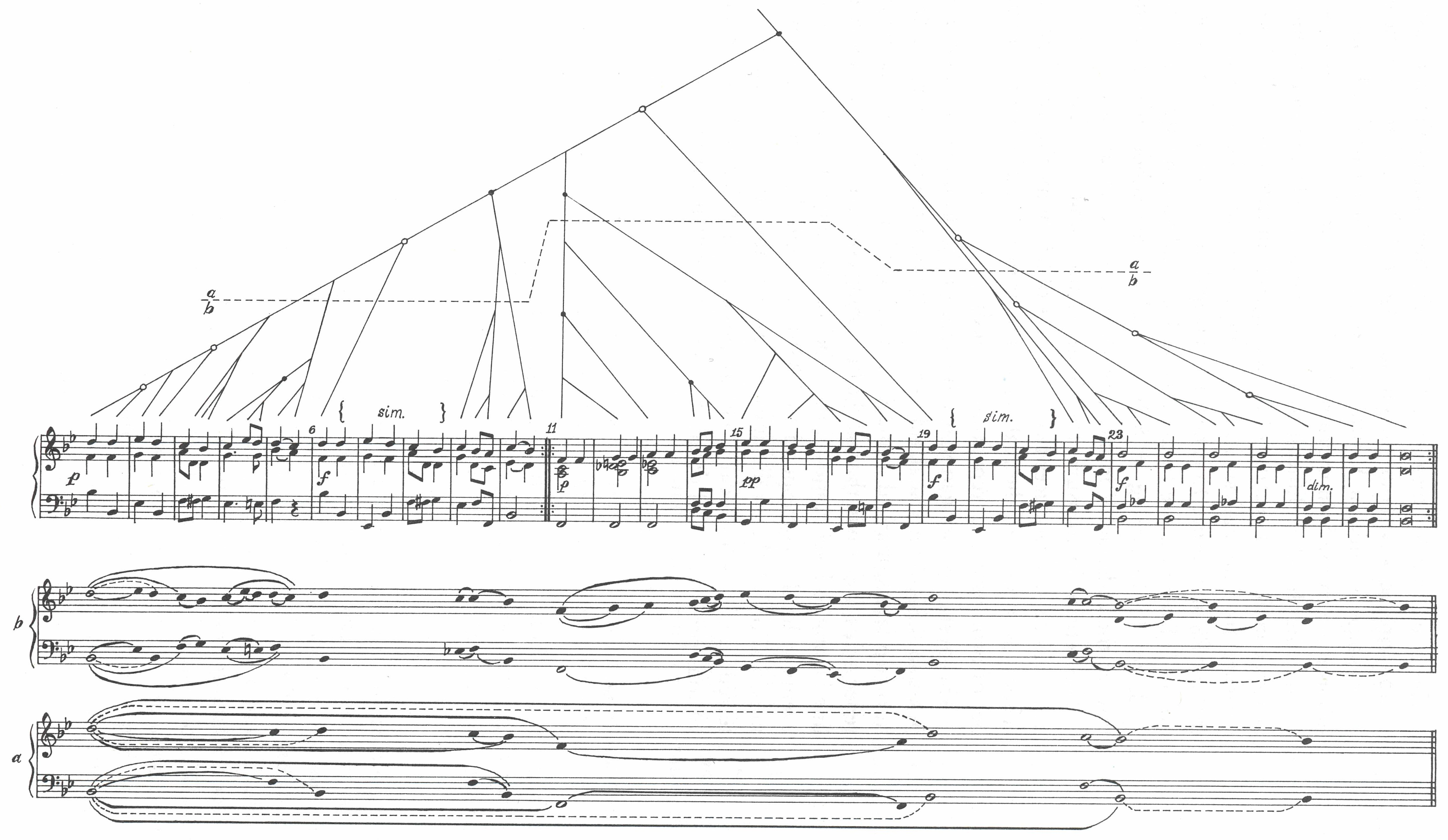
The dominant chord of the imperfect cadence of b. 5 is represented as a local
departure from the tonic chord of b. 1. Analogously, the diminished-seventh
chord over the F pedal in b. 12 is a local departure from the dominant chord of b.
11, the return to which in b. 13 represents a weak prolongation of the chord of b.
11 – it is a return to the same harmony, but with a different upper-voice note
(Lerdahl & Jackendoff, 1983, p. 182, Fig. 8.6 b). While it is the source of the latter
prolongation, the dominant chord of b. 11 occupies a higher structural-hierarchic
level in relation to the tonic of b. 1 than does the dominant chord of b. 5, in that
the later dominant chord initiates the second phrase (bb. 11–18) of this
“three-phrase binary” form theme. This second phrase might thus be
regarded as a dominant-orientated limb growing, as a progression (Lerdahl
& Jackendoff, 1983, p. 182, Fig. 8.6 c), from the tonic-orientated torso
of the first phrase (bb. 1–10). The analysis reminds us that while the
first (relaxation-to-tension) group of three x–y relationships (Lerdahl &
Jackendoff, 1983, p. 182, Fig. 8.6 a–c) might be understood to represent
Darwinian processes of structural-functional evolutionary aptation, the second
(tension-to-relaxation) group (1983, p. 182, Fig. 8.6 d–f) are distinctly
Lamarckian in their goal-directedness. The ii chord of b. 17, for instance,
aspires to realise – i.e., to effect a resolution to (Lerdahl & Jackendoff,
1983, p. 182, Fig. 8.6 f) – the dominant chord of the imperfect cadence
of b. 18, after which appears the third phrase (bb. 19–29) as a strong
prolongation of the first phrase (Lerdahl & Jackendoff, 1983, p. 182, Fig.
8.6 a). Indeed, at the very highest level, the B♭ -major chord of b. 23 (the
structural close of the third phrase and of the theme as a whole, followed
by a coda, bb. 23–29) represents the telos of the whole theme: it is the
superordinate harmony, demarcated by the longest branch of the prolongational
tree, to which every preceding element ultimately strives as part of a
deep-structural (tension-to-relaxation) weak prolongation (1983, p. 182, Fig.
8.6 e).
chord of b. 17, for instance,
aspires to realise – i.e., to effect a resolution to (Lerdahl & Jackendoff,
1983, p. 182, Fig. 8.6 f) – the dominant chord of the imperfect cadence
of b. 18, after which appears the third phrase (bb. 19–29) as a strong
prolongation of the first phrase (Lerdahl & Jackendoff, 1983, p. 182, Fig.
8.6 a). Indeed, at the very highest level, the B♭ -major chord of b. 23 (the
structural close of the third phrase and of the theme as a whole, followed
by a coda, bb. 23–29) represents the telos of the whole theme: it is the
superordinate harmony, demarcated by the longest branch of the prolongational
tree, to which every preceding element ultimately strives as part of a
deep-structural (tension-to-relaxation) weak prolongation (1983, p. 182, Fig.
8.6 e).
As a final point, and returning to the discussion before Figure 4.4 , all such dendrograms – in biological or cultural taxonomy and in music analysis – have a dual nature. They are in one sense structural-diachronic, in that they represent design in terms of the passage of time. This is either the geological-evolutionary time over which a species branches to form offshoots; or the chronological-perceptual time in which a musical work or process unfolds in imagination or performance. But the dendrograms are also structural-synchronic, in that they represent design in terms of hierarchic relationships between elements that are in some sense understood to be related. These relationships are ones of derivation (and thus aetiological, morphological and genetic dependency) that obtain in the case of species that share a common ancestor; or relationships of prolongation and progression (and thus perceptual-cognitive and/or epistemological dependency) that obtain in music’s event-sequences – including, as D. Clarke (2017) argues, in certain non-western musics.
4.4.2 The Motive as Organism
Despite also drawing inspiration from Schoenberg’s concept of the Grundgestalt, Rudolf Reti developed a model of motivic similarity that differs from Keller’s (§4.4.1.1 ) in several significant ways. In Keller’s model, the focus is primarily upon the movement or work as the organism and how its organic unity arises from the overriding control of the basic idea, which functions, by analogy with the genome, as a kind of memome regulating its ontology. In Reti, by contrast, the focus is two-fold. On the one hand, styling the underlying idea of a movement the “prime cell” – Reti sometimes uses the term “prime motif”, both allowing for other units to be identified – implies that it is functioning as a building block of a larger organism, the prime cell carrying the work’s controlling “genetic code”. On the other hand, there is also a metaphor of the motive as the organism, whose journey across a work not only acts as a unifying force but also represents a form of evolution in which, again to paraphrase Haeckel, ontogeny is conflated with phylogeny. That is, the genesis of the movement is interlocked with the evolution of the species of which type the motive is the token. Thus, the thematic elaboration of a work, the “thematic process” in Reti’s phrase (Reti, 1951), is partly an evolutionary one – arguably more Lamarckian than Darwinian – because the prime cell is striving to adapt (or to exapt) to its “environment” in order to survive. Nevertheless, as with others considered previously, there is a hierarchic-level mismatch, indeed several, in the metaphor of the motive as organism. This is because the (prime) cell – which, in its biological form, is not assigned a level in Table 1.4 – is elided, intra-domain, with the organism (level five) on the nature side; and, inter-domain, with the motif/museme (the latter mapped to the gene at level seven) and, via the intra-domain cell-organism mapping, with the work on the culture side (level five).
While there is no formal division between background and foreground levels in Reti’s theory (but see page 509), the hierarchic dimension of Keller’s work – or, perhaps more methodologically, Schenker’s – is also evident, in part, in Reti’s acknowledgement – or, to those critical of his method, his escape clause – that the prime cell may encompass certain non-thematic notes interpolated between the functional motivic pitches. More fundamentally, Reti’s concept of the “thematic pattern” (Reti, 1967) represents a relatively localised structure in which a shallow-middleground-level motive arises from the juxtaposition of several discrete component elements, one of which may be defined as the prime cell and each of which may potentially occur independently of the collection – a musemeplex, in memetic terms (§3.5.2 ). Figure 4.6 (after Reti, 1951, 11, Ex. 1, p. 12, Ex. 2, p. 13, Ex. 3, p. 14, Ex. 5, p. 16, Exx. 7, 8, p. 27, Exx. 31, 32) illustrates these principles, showing Reti’s derivation of material in Beethoven’s Symphony no. 9 from the main theme (bb. 16–27) of the first movement.

Reti divides this theme, or “shape”, into “four motivic elements”, a motif being
defined as “any musical element … which, by being constantly repeated and
varied throughout a work or a section, assumes a role in the compositional
design” (1951, pp. 11–12). As in many of Reti’s analyses, the motivic material he
sees as central in this work consists of short triadic or scalic patterns. Motif I is a
falling D-minor arpeggio; motif II is a 3–2–1 scale-segment, which is inverted (or
retrograded) to d2–e2–f2 in bb. 21–22 and then transposed (in the inverted form)
to g2–a2–b♭ 2 in bb. 23–24; motif III is a V -implying arpeggio; and motif IV is a
filled-in falling diminished seventh, with a distinctive musFlat2. The
second movement presents these four motives in the same order, although
some sleight of hand is needed to accommodate motif III: as the fourth
system of Figure 4.6 shows, whereas the first movement presented the
sequence motif II (original)–motif III–motif II (inverted then transposed), the
Scherzo broadly reverses this three-element structure, presenting the
inverted form d2–e2–f2 first and the original form in third position. Reti
argues that the second-position e2–f2–g2 pattern (b. 11) of the Scherzo
represents motif III, stripped of its a2. While “assuming simultaneously the
shape of a[n] [inverted and] transposed motif II.…, its appearance exactly
between the two occurrences of motif II makes it certain that this E, F, G, is
nevertheless meant as a corresponding substitute for motif III” (1951, p. 13).
Reti’s primary motivation for this reading is to be able to slot motif III
into its proper position in between two forms of motif II, this imperative
trumping any concern for exact intervallic replication. Thus, not only are
inversion and transposition permitted operations, but the internal intervallic
structure of a motif may also be distorted – whether this be understood as
the mis-transposition of the “pseudo-motif II” or as the omission of the
a2 in “motif III”. The following iteration of motif IV evidences another
interval-sequence distortion, containing a b♮ in b. 14 rather than the normative b♭
(marked by the asterisk in the third system of Figure 4.6 ), this adjustment
motivated by constraints arising from the fugal treatment of the Scherzo’s
main theme. Here, the bounding scale degrees (the local ♭ 6 and ♯ 7) and
interval traversed (nine semitones) serve as the guarantor of the motif’s
identity.
-implying arpeggio; and motif IV is a
filled-in falling diminished seventh, with a distinctive musFlat2. The
second movement presents these four motives in the same order, although
some sleight of hand is needed to accommodate motif III: as the fourth
system of Figure 4.6 shows, whereas the first movement presented the
sequence motif II (original)–motif III–motif II (inverted then transposed), the
Scherzo broadly reverses this three-element structure, presenting the
inverted form d2–e2–f2 first and the original form in third position. Reti
argues that the second-position e2–f2–g2 pattern (b. 11) of the Scherzo
represents motif III, stripped of its a2. While “assuming simultaneously the
shape of a[n] [inverted and] transposed motif II.…, its appearance exactly
between the two occurrences of motif II makes it certain that this E, F, G, is
nevertheless meant as a corresponding substitute for motif III” (1951, p. 13).
Reti’s primary motivation for this reading is to be able to slot motif III
into its proper position in between two forms of motif II, this imperative
trumping any concern for exact intervallic replication. Thus, not only are
inversion and transposition permitted operations, but the internal intervallic
structure of a motif may also be distorted – whether this be understood as
the mis-transposition of the “pseudo-motif II” or as the omission of the
a2 in “motif III”. The following iteration of motif IV evidences another
interval-sequence distortion, containing a b♮ in b. 14 rather than the normative b♭
(marked by the asterisk in the third system of Figure 4.6 ), this adjustment
motivated by constraints arising from the fugal treatment of the Scherzo’s
main theme. Here, the bounding scale degrees (the local ♭ 6 and ♯ 7) and
interval traversed (nine semitones) serve as the guarantor of the motif’s
identity.
The third movement’s opening theme is based on an intriguing reworking of motif I that clothes the falling D-minor arpeggio in a B♭ -major garb, although this requires a downplaying of 1 and 4 in the theme (reflected in Reti’s use of grace-note size for these pitches in his Ex. 5); in his formulation, it is a “D-minor theme in B-flat” (1951, p. 27). Indeed, Reti offers this as an example of the “method of transforming a shape from one theme to another which is in a different key, but at the same time letting it sound at original pitch” (1951, p. 15, emphasis in the original).203 This tension between the tonic and submediant major – forged in the first movement’s double statement of the main theme in D minor (b. 16) and B♭ major (b. 50) – erupts at the start of the finale, where Reti derives the opening harmony from a juxtaposition of the two forms (i and ♭ VI) of motif I, “verticalising” what has hitherto been presented horizontally (the second statement of this gesture chord, in b. 208, adds the A-major form of motif I to the D-minor and B♭ -major forms). Reti does not explicitly mark motifs I, II and III in the “joy” theme, identifying only motif IV in bb. 102–103 – which, in a far greater violation than that represented by his analysis of bb. 13–15 of the Scherzo, covers the “wrong” number of semitones on the “wrong” scale degrees. Nevertheless, as Figure 4.6 shows, one can find motifs I, II and III in the first five bars of the melody, conjoined in a dense motivic nexus.
While this is an incomplete account of Reti’s analysis of the Symphony (he finds various interesting derivatives of the first movement’s second theme, bb. 80–87, among other things), it indicates numerous intriguing resemblances that perhaps tilt the scales towards some equilibrium when weighed against certain other, rather more speculative, analyses by Reti. Returning to connections with evolution, and in an echo of Keller’s notion of background and foreground, Reti notes that Beethoven “strives toward homogeneity in the inner essence but at the same time toward variety in the outer appearance”, these phenomena representing the two “form-building forces in music” (1951, pp. 13, 109, emphases in the original). To invoke the metaphor-mechanism distinction again, this binarism can be read in at least two ways. Metaphorically, “homogeneity in the inner essence” represents the persistence of the “personality” of the motive and its survival through the “journey” of the work, this notion drawing upon what I term Spitzer’s “cluster (iii)” – melody as traversing the path of life (page 444). Under the rubric of “thematic evolution”, Reti describes this journey as the process of “how a theme moves by transformation toward a goal …” (1951, p. 139, emphasis in the original), thus making an implicit distinction between motives/themes and the “substrate” (the rest of the music) through which they flow. In this sense, this metaphor invokes the romantic notion of The Wanderer. Exemplified by Friedrich’s painting Der Wanderer über dem Nebelmeer (The wanderer above the sea of fog) (c. 1818) and by Schubert’s songs of this name (D. 489 (1816), D. 649 (1819) and D. 870 (1826)), this trope concerns the journey of the solitary hero through life, confronting various adversities until arriving – to borrow the title of Strauss’ tone poem – at the telos of Tod and, hopefully, Verklärung.
In terms of mechanism, the homogeneity-variety dichotomy can be readily accommodated in terms of the three related concepts of museme alleles, musemeplexes, and musemesätze. For the first of these, the composer, having selected a given museme, is arguably psychologically primed to select further patterns from the same museme allele-class, as opposed to patterns from other allele-classes, inevitably giving rise to various degrees of pattern-recurrence. For the second, the components of real or virtual musemeplexes (page 289) create phrase-level similarity-sequences, stronger (but perhaps less frequent) in the case of real than virtual musemeplexes. For the third, musemeplexes generate the more abstract framework of a musemesatz, which might account for generalised relationships (and perceptions) of similarity between corresponding sections at higher levels of organisation, and thus afford a means of answering Reti’s question – if we accept its premise – “[w]hy is it that we cannot produce a convincing musical composition by taking a group or a section from one work and linking it to that of another …?” (1951, p. 348). Understood in this light, Reti’s metaphorical motivic evolutionism can readily be reconciled with the mechanistic musemic evolutionism of memetics.
4.4.3 Tones and Tonality as Organisms
Schenker’s notion of the “will” or “egotism” of the tone (1980, p. 30; see also Morgan, 2014, Ch. 4) – made explicit in the title, Der Tonwille, of a ten-volume, sole-author periodical he wrote between 1921 and 1924 (Schenker, 2004; Schenker, 2005) – neatly encapsulates the notion covered in this section: that individual pitches (understood as scale-degree-aligned note-classes (Temperley, 2001, p. 115) or, more abstractly, as pitch-classes) are driven by an inner force that compels them to pursue their own advantage at the expense of other, “rival” tones.204 For Schenker, the egotism (or “vitality”) of the tone, as with that of a living organism, is “directly proportionate” to two factors: “the number of relationships” – systemic interconnections, as governed by the attributes of different mode/scale types – within which a tone is implicated and which it can leverage; and “the intensity of the vital forces lavished on [those relationships]” (1980, p. 84). Thus, framing the “biologic foundation of the process of [pitch] combination” in organism-level terms, Schenker asserts that
[i]f the egotism of a tone expresses itself in the desire to dominate its fellow-tones rather than be dominated by them (in this respect, the tone resembles a human being), it is the system which offers to the tone the means to dominate and thus to satisfy its egotistic urge. A tone dominates the others if it subjects them to its superior vital force, within the relationship fixed in the various systems …. (Schenker, 1980, p. 84)
In this equation of a tone with a human being, Schenker, and indeed also Schoenberg, understand the former as “living creatures driven by procreative urges” (Arndt, 2011, pp. 103–104, Fig. 4). Beyond such begetting of offspring of the tone itself, Schenker also believed that, “[o]bviously, every tone is possessed of the same inherent urge to procreate infinite generations of overtones.… [which] appears to be in no way inferior to the procreative urge of a living being” (1980, 28–29, see also p. 84), thus blurring the diachronic/horizontal and the synchronic/vertical dimensions of tone-propagation. While most of these overtones are, by definition, not of the same pitch-class as the fundamental – they are different tones, being implicated in relationships (in Schenker’s sense above) within the system that are different to those that enmesh the fundamental – they were perhaps understood by Schenker as reproduction-enhancing proxies of the fundamental tone.
The organicist implication of the will of the tone is clear: aligning an individual note with an organism – thus mapping level eight of culture to level five of nature in Table 1.4 – sees each note as possessing a life-force that drives it forwards in fulfilment of its teleology. To speak of a tone’s “egotism” is therefore to identify a quasi-Freudian “I” (ego) – this entity not, perhaps, a sexed “he” or “she”, but a more bestial and cunning “it” (id). Beyond this individualistic and static organicism, there is a clear systemic and dynamic evolutionism evident in Schenker’s notion of the self-interested tone. From a Lamarckian perspective, the tone strives for self-augmentation of its power and capacity across the course of its “life”, i.e., its series of occurrences in a single movement or work. From a Darwinian viewpoint (and thus moving from metaphor towards mechanism), the tone fights for survival within a movement or work by engaging in ruthless competition for selection with the other eleven pitch-classes – perhaps by means of system-reconfiguring relationship-variation – in which struggle it is every tone for itself in the quest for system-dominating replication.
More so than by the intercession of the “overtone-proxies” referred to above, this domination, to which Schenker refers in the quotation above, is achieved by a pitch’s achieving tonic-status. It becomes the keynote of a section of a piece of music, subordinating other pitches to its authority and therefore maximising its chances of reproduction – of proliferating within the system via replication. Perhaps one might mutate “dominating” into “dominanting”, given that, very often, a tone forces other pitches to function as components of dominant-functioning harmonies and thus to act as auxiliaries in its service.205 Schenker gives a clear example of this phenomenon, from J. S. Bach’s Italian Concerto of 1735, shown in Figure 4.7 . Here, thanks to its innate powers of agency, “the scale-step in question [B♭ ], without any ceremony, usurps quite directly the rank of the tonic, without bothering about the diatonic system, of which it still forms a part” (1980, 256, Ex. 219).

Shifting theoretical paradigms, we might understand this (metaphorically) in terms of the notion of basins of attraction from chaos theory (Gleick, 1998),206 in the sense that the b♭ 1 in the middle voice of b. 31 bends its local space (Lerdahl, 2001), pulling the upper-voice e(♮ )2 of this bar into its basin and distorting it into e♭ 2. This process serves the “will” of the b♭ 1 – a token of the note-class type – because the e♭ 2, as a local flattened 4, conforms to B♭ ’s key signature and, in conjunction with the middle-voice a1 remembered from b. 30, creates the key-defining tritone a1–e♭ 2 of B♭ ’s diatonic scale. Although fleeting – F reasserts its “will” in b. 32, restoring its servant e♮ 2 and forcing the b♭ 1 to act subserviently as 4 in the F-defining tritone b♭ 1–e(♮ )2 – the attempt at “usurpation” of the “rank of the tonic” is clear, indeed brazen.207
Owing to his preference for mysticism over mechanism, and his essentially static, even Platonic, conception of major-minor tonality, Schenker was not readily inclined to make certain implications of Der Tonwille explicit, whether in metaphorically evolutionary terms or not, but they can be readily extrapolated. Despite the adherence in his mature theory to the notion of monotonality – the intraopus counterpart to his rule-level tonal Platonism contending that the (global) tonic of a movement is sovereign and thus any “modulations” are merely illusory phenomena at sub-background levels (Schoenberg, 1983, see also) – one can understand the will of the tone as a force impelling the breakdown of the diatonic order. This is because unrestrained will (egotism) leads to disorder and so – slipping from metaphor to mechanism – disorder, in the form of the anarchy of self-interested scale degrees increasingly disconnected from diatonicism, inevitably weakens the central authority of the tonic. Much has been written on this topic in the last few decades, often discussed under the rubrics of “extended common-practice” tonality (Kinderman & Krebs, 1996; Tymoczko, 2011) and neo-Riemannian theory (Cohn, 1997; Gollin & Rehding, 2011), although (metaphorically) evolutionary metaphors are, perhaps unsurprisingly, used very sparingly in this literature.
Thus, at a higher hierarchic level – that of the system, not the individual pitch – the will of the tone might be understood to have driven structural changes in the network of which it forms a microscopic part, even though Schenker could not bring himself to acknowledge the implications – whether in (metaphorically) evolutionary terms or otherwise – of this will. He could acknowledge the tone-will’s effect on the diachronic unfolding of a work, as a phenomenon of prolongation, but could not accept an analogous, higher-level, diachrony (via a series of synchronic time-slices) in the structure of the major-minor tonal system itself. Despite Schenker’s reticence to countenance it, there are two ways in which the evolution of tonal systems (broadly understood) has been framed in music-theoretical/analytical discourse – ontogenetically and phylogenetically – although these are not always clearly demarcated. In the former, the system is aligned with an individual organism and its life-cycle – the collective of tonal works constituting a super-organism or, to extend the terminology of §4.3.1 and §4.3.2 , a “rules-style-organism” – thus mapping level three of culture to level five of nature in Table 1.4 . In the latter, the system is aligned, often implicitly, with a species – each tonal work representing an instantiation (token) of that species (type), the whole making, to extend the terminology of §4.3.3 , a “rules-style-species” – thus mapping level three of culture to level three of nature.208
Methodologically, the ontogenetic tradition is as much historiographic as it is music-theoretical/analytical, because charting the life-cycle of major-minor tonality as a rules-style-organism involves documenting its waxing and waning over time as much as – variously metaphorically and mechanistically – explaining the technical processes underpinning this progression. The same is true of the more recent phylogenetic tradition, which, unlike the often case-based methodology of the ontogenetic tradition, often takes corpus-analytical/big-data approaches to track systemic changes in the rules-style-species over time (Huang et al., 2017). Nevertheless, while bringing scientific rigour – and thus mechanism – to bear on the issues involved (Nikolsky, 2015; Nikolsky, 2016), the references to evolution in this tradition are often tenuous and insubstantial, because the mechanisms invoked are generally neither Lamarckian nor (more importantly) Darwinian; rather, they rely on other models, such as those deriving from neuroscience and cognitive psychology, to theorise the processes observed. This is not to say that these other disciplines do not play a significant role in understanding cultural evolution – neuroscience and cognitive psychology certainly do – but without a systematic invocation of the VRS algorithm as a guiding factor in their deployment, such models cannot be genuinely (Darwinian-) evolutionary.
As a final consideration here, it is worth noting that some have recently questioned whether the endeavours of music theory warrant the status of theories in the strict scientific sense of being amenable to verification or to falsification. Wiggins, for instance, argues the “obvious point” that
music theory, as it currently exists, is not a scientific theory. I propose that, instead, it is rooted in what psychologists call a folk theory of mind, or folk psychology, which allows each individual human to share naming of intersubjective phenomena that they see experienced by others; the same idea applies to colours, for example. (Wiggins, 2012, p. 137; see also Wiggins et al., 2010)
Aside from the probability that discrete phenomena in music can be categorised more precisely and in more detail than can colours, music theory arguably warrants the status when one considers its more explicitly mathematical branches (§4.1 ): much of the music theory of the ancient Greeks is largely a restatement of mathematical principles in terms of vibrating strings and columns of air, although their equation of modal scales with emotional states, the basis for later key characterisations, is clearly subjective (H. Keller, 1956; Steblin, 1996). Similarly, developments in late/extended-tonal and atonal theory – such as Babbitt’s and Forte’s pitch-class (PC) set theory (Babbitt, 1961; Forte, 1973; Rahn, 1980; see also §6.6.3 ), Lewin’s interval-transformation model (2011), and Tymoczko’s geometric models (2011) – convert pitches to a numerical representation and then subject them to operations that, to some, are very much more mathematical than musical – even though, in the case of PC set theory, others have questioned the objectivity of the operations the theory supports (McKay, 2015). Similarly, applications to music theory of linguistic models (Lerdahl & Jackendoff, 1983) and frameworks from cognitive psychology (Krumhansl, 1990) represent hypotheses for which there is a body of evidence to support them, or at least a coherent framework for empirical investigation.
But a substantial body of music theory in between these chronological-mathematical “bookends” – such as the phrase-structure assemblage of Koch (Sisman, 1982; Steiner, 2016) and Kirnberger, the voice-leading prolongations of Schenker, and the motivic transformations of Reti – occupies a more problematic status, and would appear vulnerable to Wiggins’ dismissal of it as folk psychology. This does not affect the present discussion, which is focused on the use of evolutionary metaphors within the domains of music theory and analysis, not whether these domains are capable of supporting verifiable or falsifiable theories. Of course, even when a music theory uses evolutionary ideas in a metaphorical sense, as those outlined in this section largely do, this does not necessarily preclude it from being scientific, because the evolutionary metaphor might be a rhetorical device employed to elucidate a scientific mechanism.
4.5 The (Co)evolution of Music and Language III: Linguistic Tropes in Discourse on Music
As argued in §2.7 and §3.8 , music and language are intimately connected across the sweep of hominin evolution. Thus, to understand music implies the need to understand language, and vice versa. Separate from such evolutionarily grounded (mechanistic) alignments – which extend, in music scholarship, to attempts to apply Chomskyan generative-transformational grammar to music (§3.8.2 , §4.4.1.3 ) – there is also a rich stream of discourse that draws metaphorically upon the relationships between music and language, seeing the former as assuming some of the syntactic and semantic attributes of the latter – indeed, seeing music as in some sense parasitic on language. The durability of the “music-as-language” tradition in musical scholarship is perhaps not surprising given the evolutionary relationships between the two domains, hypothesised in §2.7 and §3.8 to be a function of their bifurcation from a musilinguistic precursor. Represented as stages on a continuum in Figure 2.2 , these relationships arguably do not support the notion of evolutionary parasitism of music on language – indeed, the converse (language evolving from musilinguistic song) is more likely to be true – but they readily invite and sustain the formation of cross-domain metaphorical mappings, whether their scientific basis is acknowledged or (as is usual) not. What is perhaps more surprising is the lack of an equally developed parallel tradition in language scholarship that seeks to use music to illuminate language.
As discussed in §2.7.3 , Figure 2.2 indicates that both music and language possess syntax (“propositional” in the former, “pitch-blending” in the latter) and semantics (“referential” in the former, “emotive” in the latter). The rhetorical tradition of music-as-language often inverts these categories, however, imputing to music syntactic propositionality and semantic referentiality: music, it holds, can articulate types of thought by virtue of its syntax; and it can convey often quite precise extra-musical meanings. While an expansion of the scope of musical syntax and semantics beyond that represented in Figure 2.2 is entirely tenable – structural commonalities between the neural implementation of musical and linguistic syntax and semantics that might form a basis for this expansion are discussed in §3.8.5 and §3.8.6 – the music-as-language tradition in musical scholarship draws upon the alignment not as a means of illuminating mechanism but rather as a pedagogical, an analytical, and a hermeneutic device. These approaches were pursued chronologically broadly in this order; indeed, “Ricoeur’s poetics of word, sentence, and work maps onto the history of music poetics: word = baroque, sentence = classical, work = romantic” (Spitzer, 2004, p. 101).
Perhaps the oldest of these traditions is that which attempted to understand music in terms of classical rhetoric. The ancient Greek and Roman tradition of public oratory, formalised by Quintillian after the model of (among others) Cicero and Caesar,209 in which a speech had to follow certain principles of structure and content, was taken as a model for the sequential ordering and expressive-dramatic pacing of a piece of music. As suggested apropos the discussion of the “human bundle” in §4.1 , this modelling was initially synthetic – it was intended to form a pedagogical framework for composers to work within (composition through analysis) – but it later became hermeneutic, as music theory was increasingly turned not only towards providing composers the necessary intellectual frameworks to make new music, but also towards offering listeners (and composers-as-listeners) analytical strategies for the understanding and interpretation of extant, valued music.
Writing in the early-seventeenth century, Joachim Burmeister (1564–1629) represents a high point of this already centuries-old tradition, and his analysis of Lassus’s motet In me transierunt (published 1562), part of Burmeister’s Musica poetica of 1606, both confirms the reliance of seventeenth-century music theory on linguistic models and represents one of the earliest analyses of a complete piece of music (Bent & Pople, 2001, sec. II.1). In this approach, syntax inheres in the combination of short musical “figures” (Figuren; Spitzer, 2004, p. 101) to form longer segments, these basic units serving as “wordless” analogues to the rhetorical tropes that form a longer “oration” (Bonds, 1991). Global structure – essentially an articulation of Agawu’s beginning-middle-ending paradigm (1991) – derives from the functional role each trope fulfils and thus integrates syntax with pragmatics. Burmeister accordingly divides Lassus’s motet into nine “periods” (Bent & Pople, 2001, sec. II.1), each coded with terms from classical rhetoric such as Exordium (introduction) and anadiplosis (repetition of a unit from the end of one section at the start of the next) (Burton, 2007; Ratner, 1980, pp. 91–92), for which equivalences in musical figuration and technique were posited (Ratner, 1980, pp. 92–94). Semantics inheres in the relationship between the global structure and the local Figuren, the latter being not only music-syntactic but also music-semiotic units that render the sense of the associated text through expressive pitch-rhythm contours. The concatenation of Figuren into nested rhetorical-structural hierarchies provides the necessary syntactic sense within which the semantic sensibility is grounded. Implicit in this tradition is the equation of musical with linguistic units – a valid strategy, both metaphorically and mechanistically, in the light of certain of Hockett’s design features of language (page 174) – such that musical figures represent words or short phrases, and longer musical segments are variously understood as more extended linguistic phrase-types, such as periods and sentences.210
A transitional figure linking the seventeenth-century “word” tradition to the eighteenth-century “sentence” tradition (in Ricoeur’s senses referred to on page 520), Johann Mattheson’s (1681–1764) Der vollkommene Capellmeister of 1739 (Mattheson & Harriss, 1981) codified the sequence of music-rhetorical tropes proper to a composition as Exordium-Narratio-Propositio-Confutatio-Confirmatio-Peroratio, in addition to hypothesising various equivalences between linguistic and musical punctuation (Agawu, 1991, p. 52). Both concerns, the former global, the latter local, exemplify the eighteenth century’s interest in techniques for building musical form in terms of syntactic-semantic units understood via the prism of language, the syntactic tradition reaching its zenith with the work of Koch. The logical conclusion of Mattheson’s work was his claim that purely instrumental music was a “language of tones”. That is, he argued that music was capable of the communication of meaning, provided the listener was familiar with its syntax and semantics. This was particularly controversial in the early-eighteenth century because instrumental music was regarded as inferior to that which set or accompanied a text. This tradition assumed that ironic contradictions between text and musical setting were exceptional, so it was held, somewhat tautologically, that what the text said was what the music “meant”. Instrumental music’s “emancipation” from vocal models (Dahlhaus, 1982, p. 24) was only accomplished in the late-eighteenth century – partly thanks to the achievements of the Mannheim and Viennese schools – and consolidated in the early-nineteenth century tradition of “absolute” music (Chua, 1999). This emancipation is evidenced by Hoffmann’s assertion – rooted in Ricoeur’s nineteenth-century “work” tradition – that “instrumental music …, scorning every aid, every admixture of another art (the art of poetry), gives pure expression to music’s specific nature, recognizable in this form alone” (in Strunk et al., 1998, p. 151).
As an adherent of the “doctrine of the affections” – Affektenlehre; broadly analogous to the theory of Figuren, Figurenlehre – Mattheson held the view that localised musical patterns were not only building blocks of syntactic structures at higher levels but were also able to communicate emotion and sketch out more concrete imagery, thus serving as figures of musical “speech”. A memetic reading of Figuren would understand them as musemes whose extra-musical content inhered in the complex dialectic between the natural (image-schematic and Implication-Realisation forces) and the nurtural (“topical” associations between the figure and extra-musical content, underwritten by the identified natural affordances). In terms of image schemata, many Figuren represent “pathways leading to a goal” (Snyder, 2000, p. 110), this equivalent to Spitzer’s “path” schema (§4.2 ). Relying on “motion-linkage-causation” and “linearity: paths and goals” (2000, pp. 113–115), such trajectories – whose arrival at a destination, or circumvention of it, give rise to emotional and/or intellectual satisfaction or frustration, respectively – align closely with structures theorised by the Implication-Realisation model,211 specifically Process (Narmour, 1990, p. 89). The related schema of “‘up’ and ‘down’” (Snyder, 2000, pp. 111–112) aligns most naturally with Reversal (Narmour, 1990, p. 151).
Figure 4.8 illustrates a two-phrase passage of music from Mattheson’s discussion of “melodic invention”, representing an “example of a scornful saying [phrase 1, bb. 1–4] bursting forth in unexpected joy [phrase 2, bb. 5–8]” (1981, p. 299).212

The interaction of natural and nurtural forces referred to above is clearly evident here. On the natural forces, there is a clear series of image-schematic “pathways leading to a goal”, in the form of the rising and falling patterns opening and closing each phrase (bb. 1, 3–4; bb. 5–6, 7–8), these being understandable in terms of the indicated [P] structures. The higher-level rising [P] in bb. 51–63 encompasses, and transcends, the Retrospective Registral Reversal – [(VR)] – in b. 54–6, whereas the [(VR)] at the analogous point of the first phrase, bb. 14–22, returns to the phrase’s starting pitch, a2, giving a less directional Duplication – [D] – in bb. 1–2 at the level equivalent to that of the [P] in bb. 5–6. Indeed, the rising and falling [P]s in the second phrase – essentially ascending from 1–5 then descending from 5–1 – are more strongly goal-orientated than those in the first phrase. Those in the first phrase, although encompassing the same boundary scale degrees (6–1) and interval as those in the second phrase (the minor sixth, b♭ 1–d1 in the first phrase and f2–a1 in the second), are attenuated by the [R] of bb. 23–32, which represents a more strongly disruptive force than the analogous but weaker Intervallic Process – [IP] – of b. 71–3.
On the nurtural forces, there are several incursions here of what Narmour terms “intraopus style” (“os”) and “extraopus style” (“xs”) (1990, p. 38).213 The latter encompasses the general influence of the minor mode, which perhaps augments the assertive effect of the instances of [P] and gives them a bleaker edge. A further artefact of the minor mode are the three occurrences of the 6–5 dyad (bb. 3, 6 and, at a higher level, bb. 1–2), which is an expressive trope – the “Seufzer” (sigh) topic (Caplin, 2005, p. 115, Tab. 1), perhaps best understood as a component of the empfindsamer Stil (style of sensibility) (Ratner, 1980, p. 22) – common in minor-key music of the common-practice period and which possesses an affective/pathetic connotation. Other topical connotations include the “gay and lively” gigue rhythm of the second phrase (Ratner, 1980, p. 15). More broadly, the nurtural dimension encompasses those effects upon the music of the text and vice versa. The former include the emphasis on certain notes engendered (phonetically and semantically) by salient words of the text, such the additional foregrounding of the strong-beat a1 of b. 21–2 and e2 of b. 61–3 by “Bold” (“bold”), and the emphasis on the weak-beat b1 of b. 74–6 by “Gott” (“God”). The latter include the intensifying effect of the minor mode on the “scornful saying” of the first phrase,214 and the converse dampening effect of the minor on the “bursting forth in unexpected joy” of the second phrase.
The late-Baroque tradition of Figurenlehre was recuperated in the 1960s by Cooke, who attempted to ground the intuitions of Baroque Affektenlehre more firmly on music-theoretical and music-psychological principles. By doing so, he ostensibly shifted the centre of gravity of the music-as-language tradition from metaphor towards mechanism, although one empirical study found “only very limited support for the specific details of Cooke’s … theory” (Kaminska & Woolf, 2000, p. 151). Cooke argued that the intrinsic e/motional properties, to recall Levitin’s concept (page 141), of certain musical patterns allowed one to speak with confidence of a “language of music” (1968). A controversial and much critiqued work (Smoliar, 1994) – perhaps because it assumes to be true that which it sets out to prove – Cooke aimed
to discover exactly how music functions as a language, to establish the terms of its vocabulary, and to explain how these terms may legitimately be said to express the emotions they appear to. Beginning with the basic material – notes of definite pitch – … musical works are built out of the tensions between such notes. These tensions can be set up in three dimensions – pitch, time, and volume; and the setting up of such tensions, and the colouring of them by the characterizing agents of tone-colour and texture, constitute the whole apparatus of musical expression (Cooke, 1968, p. 34, emphases in the original)
As befits a mechanistic explanation, Cooke’s three dimensions of pitch, time and volume have broader evolutionary significance, in that they align closely with the “sentic” states – internal e/motional dispositions expressible via a range of output channels – common to humans and other species hypothesised by Clynes (1978). These states result from
a general modulatory system involved in conveying and perceiving the intensity of emotive expression along a continuous scale. It expresses intensity by means of three graded spectra: tempo [time] modulation (slow-fast spectrum), amplitude modulation [volume] (soft-loud spectrum), and register [pitch] selection (low-pitched-high-pitched spectrum). This system appears to be invariant across modalities of expression in humans, such as speech, music, and gesture …. It also appears to function in a similar way in emotive behavior in nonhuman animals …. (Brown, 2000, p. 287, emphasis in the original)
Cooke’s methodology was to hypothesise the likely emotional content of certain figures – “the emotions they appear to [express]” – using various music-theoretical and, implicitly, image-schematic intuitions, this perhaps undertaken in conjunction with consideration of the relevant segments of the texts of vocal music using those figures. Thus identified, such figures – Cooke’s “basic terms of musical vocabulary” (1968, Ch. 3) – occurring in instrumental music allowed him to attach the identified emotion to those passages, in the absence of direct verbal correlation. Understood in terms of memetics, Cooke’s basic terms represent museme allele-classes, defined by their common shallow-middleground-level scale-degree structure. There are clear examples of such vocabulary-items in bb. 5–8 of Figure 4.8 . The pattern in bb. 5–6 is an instance of the “ascending 1–(2)–3–(4)–5 (minor)”, which is “expressive of an outgoing feeling of pain – an assertion of sorrow, a complaint, a protest against misfortune …” (1968, p. 122). It is elided with a second term, the “(5)–6–5 (minor)” – the aforementioned Seufzer – of b. 6, “giving the effect of a burst of anguish” (1968, p. 146). This in turn overlaps with the “descending 5–(4)–3–(2)–1 (minor)” of bb. 6–8, “which has been much used to express an ‘incoming’ painful emotion, in a context of finality …” (1968, p. 133).215 Of course, there is a dissonance here between the deployment of these three particular basic terms and the affirmative content of the text of this phrase, one that does not necessarily require one to assert that Mattheson had any ironic intentions in mind. More broadly, and as Figure 2.2 implies, the further apart two modalities are on the continuum between music and language – or, in this case, where there is evident tension between the explicit “verbal song” of “music’s vehicle mode” and the implicit content of “music’s acoustic mode” – the more problematic the “translation” between them.
4.6 The Evolution of Scholarly Discourses on Music
Nattiez is keen to maintain a separation between the object of musicological enquiry and the discourses that surround it.216 He argues that
[a]n analysis in effect states itself in the form of a discourse – spoken or written – and it is consequently the product of an action; it leaves a trace and gives rise to readings, interpretations, and criticisms. Although we find the tripartite dimension of all symbolic forms in analysis as well, analysis is nonetheless not merely a semiological fact comparable to others discussed so far. Analysis exists because it deals with another object – the musical fact being analyzed. In other words, discourse about music is a metalanguage. Consequently, an epistemological and semiological examination of analysis involves three elements: (a) The object.… (b) The metalanguage.… (c) The methodology of analysis. (Nattiez, 1990, pp. 133–134, emphases in the original)
Here, the object, while mediated by the observer’s “analytical situation”, represents the music under investigation (1990, p. 133). From a memetic perspective, the latter is not only the phemotypic product(s) of the composer’s memome, but also that phemotype reconstituted as memomic neuronal interconnection in the brains of receivers. The metalanguage is, as its name implies, the higher-order (verbal-conceptual) language used to interrogate the lower-order language (musical “language”), which is the medium or substrate of the object. As is often the case with metalanguages, “translation” is needed between the “object language” (1990, 133, Note 1) and the metalanguage. With music this is inherently problematic for, as Keller argued, “the laws of [conceptual thought’s] logic are far removed from the laws of musical logic” (1985, p. 73).217 The methodology is made up of a series of procedures that connect the object to the analysis (Nattiez, 1990, p. 134).
Because scholarly discourses/metalanguages are verbal-conceptual memeplexes (§4.1 ), they are subject to the operation of the VRS algorithm; but they are not fully autonomous evolutionary systems (insofar as any such system can possess full autonomy). This is because they are shaped by an additional selection pressure beyond those generally attendant upon verbal-conceptual memeplexes – the latter including the lower-level pressures of euphony218 and the higher-level pressures of internal coherence. This additional selection pressure is that of perceived alignment with (i.e., explanatory utility for) that which they attempt to model or explicate – hence their only partial autonomy. In other words, most music-theoretical/analytical verbal-conceptual memeplexes “aim” – in the same non-intentional, blindly algorithmic manner that characterises evolution in general – to adapt (or to exapt) to the music with which they coevolve.
The evolution of the verbal-conceptual memeplexes that articulate cultural discourses often lags some way behind the evolution of the music that they are adapted to explicate, and this gap is sometimes particularly pronounced in the case of music theory and analysis. It is seen when certain phenomena that arise in the work of progressive composers often take decades to be assimilated by music theory and formalised by music analysis as valid compositional procedures. As this implies, such modelling, or description, often takes the form of regulations, or prescription, for what is permissible in some pedagogical or critical system. While there are exceptions to this principle of practice-theory asynchrony – perhaps most notably in traditions where continuity and craft are privileged, such as the school of sacred polyphony crowned by Palestrina and codified by Fux (Fux, 1965); and the Italian partimento tradition (Gjerdingen, 2007a; Gjerdingen, 2007b) – for much of post-Renaissance European musical history concerns have been raised by theorists about composers’ perceived deviations from “correct” procedures and their alleged breaking of “rules”.219 In retaliation for this perceived intrusion, some composers have defended what they see as their right to set the terms of reference for their work, articulated perhaps most famously in the statement attributed by Varèse to Debussy, that “works of art make rules but rules do not make works of art” (in Albright, 2004, p. 185).
Perhaps the archetypal example of the initial disjunction between a laggard theory and the fleet-footed practice of composers is Beethoven, whose reception in the music-theoretical/analytical literature, crudely summarised, curves from incomprehension to canonisation over the course of the nineteenth century. This is also a model that aligns in part with much twentieth-century avant-garde music, the disturbances at notorious 1913 performances of Schoenberg’s Chamber Symphony no. 1 (1906) and Stravinsky’s Le sacre du printemps (1913) establishing a durable trope (also evident with Beethoven) of audience alienation.220 While a considerable generalisation, we might in summary invoke Lyotard’s dictum that “a work can become modern only if it is first postmodern” (in J. D. Kramer, 2016, p. 6); that is, it must not only transgress stylistic boundaries (as a result becoming postmodern) but must also become accepted as a contribution to artistic development (thus becoming modern).
The radicalism of such advances in compositional practice has occasionally been matched by paradigm changes/shifts in the verbal-conceptual memeplexes/metalanguages of music scholarship, which to some extent parallel those in the sciences (Kuhn, 2012; see also note 97 on page 430). In these reorientations, one theoretical or methodological model is supplanted by another, such as the movement from positivistic to critical musicology in the 1980s and the incursion of geometric models into music theory and analysis in the 1990s. While such reorientations may – like those in musical style – sometimes appear to be saltational, the logic of Darwinism implies that they in fact arise gradualistically from the operation of numerous interacting “microhistorical” (Herbert, 2003) processes. As in biological evolution, it is the factors of “(time)scale, perspective and granularity” (page 84) that give the illusion of saltation in cultural evolution. As a form of the latter, metalinguistic paradigm shifts appear to operate in accordance with the model to be discussed, apropos music-systemic paradigm shifts, in §7.5 , whereby low-level (microhistorical) musemic changes are understood to feed upwards and cumulatively reshape global systems of tonal organisation.
Figure 4.9 shows Nattiez’s representation of the interplay between music and the scholarly discourses associated with it (1990, p. 135, Fig. 6.1). He hypothesises two parallel trajectories of (evolutionary) development, one of the object (music) and the other of the metalanguage, each strand interacting, as a selective force, with the other.

Here, “P” and “E” represent the poietic and esthesic levels, respectively; and the “work” is located at the neutral level. The “methodology of analysis” represents “a transition, controlled by implicit or explicit procedures, from the work to the analysis” (Nattiez, 1990, p. 134, emphasis in the original). The “influence on the music” represents the closing of the feedback loop, in that certain concepts abstracted from a work (or from several works) and sustained by a metalanguage – which includes pedagogical traditions of composition – may, as noted, go on to influence the practice of later composers. This model is returned to and extended in §6.6.3 , which attempts to formalise more explicitly the operation of the evolutionary processes involved, and to accommodate music produced not only directly by humans (Figure 6.13 ) but also indirectly by means of quasi-autonomous generative computer systems (Figure 6.14 ).
Tracing the evolution of the verbal-conceptual memeplexes constituting music-scholarly discourses is complex. One way to do so is to track citations of certain key terms, as was done in the case of the term “memetic” in §3.4.1 , using them as markers of the wider memeplex encompassing the network of concepts constituting the discourse/metalanguage. Repeating the methodology represented in Figure 3.2 , Figure 4.10 uses CiteSpace to graph co-occurrences of the terms “music” and “gender”221 from publications in Scopus’s Arts and Humanities category, which, at the time of the query, contained 1,538 records. The earliest record in this category of the Scopus database to contain the search terms is an article dating from 1981.222

What does Figure 4.10 reveal about the chronological and conceptual-spatial distribution of the selected literature on music and gender? Before examining the visualisation itself, and by analogy with Figure 3.3 , CiteSpace’s analysis of the number of unique records (of the total 1,242 given in note 222 on page 561) per year, graphed in Figure 4.11 , shows a generally steady and steep increase, indicating fairly rapid dissemination of the “music and gender” verbal-conceptual memeplex.

Turning back to, Figure 4.10 , and subject to the same Borgesian constraints as were articulated in connection with the list on page 257, one might make the following observations:
- 1.
- While there are 254 notional clusters and fifteen clusters graphed in the default layout (#0–#5, #7–#10, #12, #15, #24, #43 and #45), using CiteSpace’s facility to display only the largest of them reduces this number to eleven principal clusters (#0–#5, #7–#10 and #12).
- 2.
- There are two interconnected clusters, #0 and #1, each labelled with the identifier “gay music”. Cluster #0 is associated primarily with Hebdige (1979) and Green (1997) (who examine music and gender in relation to their roles in subcultures and education, respectively); whereas cluster #1 is associated with Butler (1990) and Walser (1993) (the first of these being a seminal text in the field). Both clusters are connected by the widely cited McClary (1991); and cluster #1, via Walser (1993), gives rise in part to cluster #3, with its coverage of issues of gender and sexuality in heavy metal music.
- 3.
- Cluster #4 is centred around Frith (1981) (the node label “Frith S (1981)” is largely obscured by the cluster label “#4 social harmony” in Figure 4.10 ), and while covering similar ground to cluster #3 – both explore subcultural niches articulated by specific popular-music genres, metal in cluster #3 and rock in cluster #4 – the layout of the visualisation suggests a separate aetiology for each cluster. That is, clusters #3 and #4 represent, by definition, coherent bodies of interconnected research, each of which traces a distinct approach to the study of ostensibly similar repertoires and comparable social functions.
- 4.
- While clusters #0, #1, #3 and #4 arguably encompass the main focus of literature orientated around the two search terms – i.e., on questions of individual and group identity and sexuality as they pertain to music and gender – other distinct areas of research exist based upon concepts related to these terms. Cluster #9, for instance, relates to literature that explores them from a psychological perspective,223 even though one of the key nodes identified – Juslin and Laukka (2003); another node in this cluster is Chamorro-Premuzic and Furnham (2007) – uses the word “gender” only once in its main text. The article is concerned, however, with implicitly gender-specific aspects of vocal production, such as frequency and intensity (2003, p. 790, Tab. 6); it also considers evolutionary issues relevant to vocalisation that are pertinent to the discussions in §2.3 and §2.5 .
- 5.
- Another area of music psychology represented in Figure 4.10 grows out of cluster #9. Cluster #2 is concerned with the subject of music and emotion, and includes as key nodes Gabrielsson and Juslin (1996) and A. C. North et al. (2000), both of which consider gender as a factor mediating the emotional affects/effects of music.
- 6.
- While having different antecedents, clusters #8 and #10 concern the relationships between music, gender and education (the title of a text, Green (1997), central to cluster #0). Cluster #8 is centred on Abeles (2009) and Freer (2010), which consider reasons for instrument-choice among young people of relevance to music educators, including socialised associations between instruments and the learner’s sex (Abeles, 2009), and the pursuit of “possible selves” via instrument-choice (Freer, 2010). Cluster #10 is centred on Bandura (1997) and S. G. Nielsen (2004), the latter node examining the effect of gender on the instrument-practise strategies deployed by degree-level music students in terms of the concept of “self efficacy” articulated in the former node. While of separate aetiology, cluster #5 is broadly cognate with clusters #8 and #10. Centred on Barber et al. (2001), it analyses the educational (and general life-success) outcomes of participation in music, among other activities.
- 7.
- Cluster #12 is something of an outlier, perhaps on account of its relative infancy as a research field. In the context of music technology being a field generally regarded as male-dominated, indeed sometimes distinctly sexist, for all but its most recent history, Rodgers (2010) considers the experiences of women in electronic music, in terms of their specific modes of creativity and more broadly in the light of feminism.224
- 8.
- CiteSpace’s narrative summary (see point 2 of the list on page 257) of this network identifies the three most central nodes as (in decreasing order of centrality) Bourdieu (1984), Butler (1990) and McClary (1991). Moreover, the summary identifies, in its citation count ranking, the three most cited nodes as (in decreasing order of citations) Butler (1990), McClary (1991) and Green (1997).
Of course, CiteSpace primarily tracks replication of the verbal-conceptual memeplexes that constitute an academic discourse and that therefore define and “underwrite” its metalanguage. Variation of these memeplexes is implicitly represented by the “speciation” events forming clusters. Selection, while generally regarded as a form of endorsement, can instead be negative, for two reasons. Firstly, as argued in Bloomian intertextuality theory, an “anxiety of influence” may motivate evasion (non-selection) – as part of a “paradoxical ‘including/excluding’ movement” – rather than emulation (Korsyn, 1991, p. 8). In such evasion, the notions articulated by a memeplex are essentially accepted but, in a Freudian sense, repressed. Secondly, writing an article on some academic subject can (in an oversimplistic binarism) be an attempt either to endorse or to refute the precepts of its antecedent literature – the “praise versus bury” dichotomy discussed in §3.4.1 .
The latter is illustrated, at its most extreme, by a recent hoax by Boghossian and Lindsay (2020) against gender studies and, its perpetrators would argue, the subject’s postmodernist, left-wing underpinning. This deception was itself inspired by the “Sokal hoax”, whereby the physicist Alan Sokal had a parody article published (and then, on discovery of the hoax, retracted) by the journal Social Text (Sokal, 1996). Sokal’s article incoherently juxtaposed complex mathematics with an opaque postmodern vocabulary and convoluted writing style. In the view of Boghossian and Lindsay (2020), “[t]he publication of this nonsense paper, in a prestigious journal with a strong postmodernist orientation, delivered a devastating blow to postmodernism’s intellectual legitimacy”.225 The later hoax took the form of “an absurd paper [‘The conceptual penis as a social construct’] loosely composed in the style of post-structuralist discursive gender theory” (Boghossian & Lindsay, 2020), which was published (under pseudonyms) by the journal Cogent Social Sciences (Lindsay & Boyle, 2017). The authors took the view – which they held to have been vindicated by the acceptance of their paper – that “[t]he most potent among the human susceptibilities to corruption by fashionable nonsense is the temptation to uncritically endorse morally fashionable nonsense. That is, we assumed we could publish outright nonsense provided it looked the part and portrayed a moralizing attitude that comported with the editors’ moral convictions” (2020, emphasis in the original).
Amusing as all this might be to those critical of “grievance studies” (Pluckrose et al., 2018), and of the broader “woke” agenda that sustains them, there are important evolutionary points to be made in the light of these hoaxes. For one thing, to parody a metalanguage, the verbal-conceptual memeplex that defines it must, as with all memeplexes, be: (i) sufficiently internally consistent (i.e., conceptually and structurally coherent) to exist as a reasonably stable and durable entity (the replicator attributes of copying-fidelity (§1.6.3.3 ) and longevity (§1.6.3.1 ), respectively); and (ii) sufficiently perceptually-cognitively salient for it to be transmitted widely enough to be recognised as something relatively current and significant in culture (the attribute of fecundity (§1.6.3.2 )). The profusion of literature in the arts and humanities dealing with music and gender visualised in Figure 4.10 – perhaps only a subset of which is concerned with the “post-structuralist discursive gender theory” mocked by Boghossian and Lindsay (2020) – suggests that these two conditions have been met in the case of this particular memeplex. Moreover, as Figure 4.11 indicates, the increasingly rapid acceleration in transmission of the memeplex starting in the early 2000s is perhaps evidence of its growing evolutionary success. Of course, this conquest of intellectual territory, as with any verbal-conceptual memeplex, is not necessarily an index of veracity.
4.7 Culture-Music-Discourse Coevolutionary Models
If cultural evolution is driven by the VRS algorithm (§1.5.1 ), and if the evolution of music is understood as a subset of cultural evolution more broadly, then the question arises as to the relationship between the non-musical and the musical dimensions of cultural evolution.226 Do evolutionary processes in music in some sense follow those of culture more generally – is music a mere epiphenomenon of more powerful cultural forces that buffet and shape it? – or does music have to capacity to feed back into other dimensions of cultural evolution to influence it? Even accepting the possibility of two-way interaction between non-musical culture and musical culture, one would perhaps have to concede that the direction of travel – of the arrow of causation – might be primarily from non-musical to musical culture, and that countervailing pressures would be less substantive; and one would also have to concede that there is an inherent translation problem, because the medium of music (sounds and their associated phemotypic products) is incommensurate with those media through which non-musical culture (verbally expressible concepts, images) is propagated. This is the same issue that Keller identified in §4.4.1.1 , when he asserted that “[a]ll conceptual thought about music is a detour, from music via terms to music …” (1994, p. 127). Perhaps one interface between these domains might lie in discourse on music, scholarly and journalistic, which channels the reception of music through conduits shaped by the Zeitgeist of society, and which – while not claiming that verbalisation about music possesses significant cultural power – affords at least some potential for the reciprocal (re)shaping of non-musical culture. More directly, the texts of popular musics – such as protest songs of various kinds (Friedman, 2013; Martinelli, 2017) – can have powerful effects on non-musical culture, given their capacity to motivate mass-action. These possibilities notwithstanding, my interest here is primarily on less tangible, non-verbal connections between the nature of music and the nature of the wider society of which it forms a part.
In this regard, some of Susan McClary’s most seminal writings explore the possibility that changing socio-economic structures are in some senses inscribed in music – thus considering at least a one-way influence – the latter domain serving variously as avatar, mirror or simulacrum of the cultural and economic forces that gave rise to it (McClary, 1986; McClary, 1993; McClary, 1994). McClary’s focus on the music of the late-eighteenth to the late-nineteenth centuries in several of her writings motivates her to read well understood socio-cultural issues of that century – arguably the most dynamic phase of the transition from a feudal, agrarian and aristocratic system to a bourgeois, industrial and capitalist model – in terms of their effects on music. Several themes recur in the social and cultural history of this period, most notably tensions between masculinity and femininity and the functional roles these imply; and the dialectic between the individual and society. The first of these dichotomies transcends issues of time and place, even though its implications are socially mediated. While McClary does not formalise it in evolutionary terms – the implications of patriarchy, to use her preferred formalism, are not traced back to their evolutionary motivations – the dichotomy might nevertheless be understood in terms of effects resulting from sexual selection (§2.5.3 ). The second dichotomy engages not only the political, economic and legal obligations attendant upon the individual vis-à-vis the collective (the price that must be paid for the benefits afforded by society), but also the individual’s internal trajectories of self-actualisation – their struggles with “problems of identity and alterity” (McClary, 1986, p. 137). This dichotomy is perhaps the more relevant to the concerns of the present section: one of McClary’s most consistent claims in this literature is that individual fulfilment and social coherence were broadly compatible in the late-eighteenth century, but became increasingly irreconcilable in the nineteenth; and that these tensions were played out via certain key features of musical structure and style.
While several facets of McClary’s work have faced often strident criticism – the preface to McClary (2002) and the introduction to McClary (2007) (“The life and times of a renegade musicologist”) take stock of some of the responses to her writings – she hypothesises certain suggestive alignments between social and musical structure that are amenable to an evolutionary reading, despite her not explicitly pursuing this approach. Discussing the second movement of Mozart’s Piano Concerto in G major K. 453 of 1784, perhaps her most thorough working-out of the musical consequences of the second of the above dichotomies, McClary contends that three elements of the movement work to articulate a dialectic of the individual versus society. These elements – tonality, “sonata procedure” (what is termed the sonata principle in §4.3.2 ), and “concerto format” – work synergystically to shape a narrative in which the soloist – understood as a representation of the individual, and possibly of Mozart himself – first opposes and is then reconciled with society. For McClary,
[t]onality emerged in the seventeenth century in direct opposition to a musical language that (like the church and aristocracy that nurtured it) articulated a static worldview in which notions such as radical progress and destabilizing goal-seeking were threats. Likewise the rationality of the eighteenth century was called into question by the nineteenth-century Romantics who rejected what they regarded as ‘instrumental reason’ in their celebrations of the irrational: in music, this rejection was manifested in unconventional narrative plans and in an increasingly individualistic, convoluted, deviant harmonic language. (McClary, 1986, pp. 135–136; see also McClary, 1994, pp. 69–70)
Sonata procedure, she contends, takes the goal-seeking of tonality – the dramatic arc represented by the initial stable tonic, its usurpation by the second key, and its triumphant closing return – and aligns it with a narrative dichotomy of protagonist and antagonist, or Self and Other, represented by the first and second subjects, respectively (1994, pp. 70–73). Appearing in an alien key, the second subject must be forced back into conformity with the tonic in the recapitulation. Not only does McClary present the two subjects as polarised agents but she often reads them as gendered, drawing upon a distinction evident in some of the earliest discussions of sonata form (Marx, 1997, p. 133) and arguably underwritten by image-schematic alignments with stereotypical sex-differences. In this trope, the first subject is coded as “masculine”, by means of a loud dynamic, uneven (thus perhaps “assertive”) rhythms, and a wide pitch-range; and the second subject is coded as “feminine”, by means of a soft dynamic, even (thus perhaps “submissive”) rhythms, and a narrow pitch-range. These various dichotomies encompass a palpable tension, for while
[t]he outcome [of a sonata-form movement] is invariable, predetermined – the first key and its theme have to prevail if this is truly to count as a piece of tonal music – yet the threat must always appear genuine so that we can repeatedly celebrate the triumph of the tonic protagonist and the appropriation of the ‘Other’. And it is, finally, only by virtue of the encounter with the second theme and key that the identity of the first seems able to affirm itself narratively. It depends on its ‘Other’ for extension and self-definition. (McClary, 1986, p. 137, emphasis in the original)
Indeed, this “triumph” is often accomplished ruthlessly, as McClary’s controversial account of the first movement of Beethoven’s Ninth Symphony in terms of sexual violence maintains – for her, the opening of the recapitulation represents “the throttling, murderous rage of a rapist incapable of attaining release” (McClary, 1987, the passage being excised in the article’s reprint in McClary, 2002, p. 128; see also Jan, 2016a). Yet in some cases, the Self-Other dichotomy, whether gendered or not, is a mere foil to the more fundamental quest for identity undertaken by the first subject. Thus, in the case of the first movement of Brahms’s Symphony no. 3 of 1883, the subjugation of the second subject – read by McClary as not only feminine but also alluringly exotic (1993, pp. 337–338) – is relegated to the status of a side-narrative, subordinate to the movement’s fundamental problem of reconciling the personality-defining but tonally deviant A♭ of the first subject (b. 4) with the A♮ required by the social order and represented by the work’s tonic key of F major.227
Combining tonality and sonata procedure with concerto “format” – the third of these being a “subspecies” of the first two (McClary, 1986, pp. 137, 138) – brings in a further dimension, for in its solo-tutti distinction the concerto articulates a dialectic of individual versus society. Inverting the Self/protagonist/tonic-Other/antagonist/non-tonic configuration of sonata form, the opening tonic-key ritornello of a concerto movement (the orchestral exposition) represents not the individual, as in the case of a non-concerto sonata form, but the social group, articulating its shared norms and values. In contrast, the soloist, in its dominant-striving first entry (the solo exposition), represents not just Otherness, as would be expected in the context of sonata procedure, but also individualism and the quest for self-determination. In this way, it
enacts as a spectacle the dramatic tensions between individual and society, surely one of the major problematics of the emerging middle class.… The individualistic ‘violation’ is itself socially encoded. In an eighteenth-century concerto, whatever antagonisms were manifested between individual and society appear to have been resolved by the end: the stable community has withstood the adventures and conflicts of the soloist, and they have been reconciled to co-exist in mutually beneficial bliss. (McClary, 1986, p. 138)
In the second movement of Mozart’s K. 453, this “reconciliation” is cemented by the soloist’s presentation of a consequent phrase (bb. 127–130; outlining the progression IV–I) at the end of the movement that finally completes and, at a great remove, balances the movement’s opening antecedent phrase (bb. 1–5; outlining I–V), a passage McClary terms the “motto”. The antecedent/motto phrase recurs several times in the movement, but its closure is repeatedly deferred until this final serene apotheosis (1986, pp. 154–155). To what extent the alleged utopia represented by the closure of the motto aligned, in Mozart’s case, with the realities of Josephinian Vienna; and how the relationships between the myriad individual experiences and any “aggregated” social reality operated, is difficult to divine. But we nurture an ideal of this particular time and place, perhaps naively, as a golden age in European history, where social stability and individual liberty coexisted happily (Wangerman, 1973). Assuming that the arrival at “mutually beneficial bliss” in both socio-cultural and musical structures and processes is not coincidental, the challenge to an evolutionary view of culture lies in determining the reasons for the observed dialectical convergence. As suggested at the start of this section, the options for the direction in which the causal arrow of influence points are, essentially, non-musical-to-musical, musical-to-non-musical, and two-way interactive. We can rule out the first (musical culture is surely not exclusively influenced by non-musical culture), and the second (non-musical culture is surely not exclusively influenced by musical culture), and admit the existence of the third, albeit highly asymmetric and non-music-to-music dominant.
It is worth stressing that McClary’s alignment between the two domains is not metaphorical: while she does not state it explicitly, she strongly implies that, in such cases, correlation results from causation. For example, she suggests that “[c]onflict and struggles for dominance for purposes of establishing and maintaining all-valued self-identity become essential preoccupations in [late-eighteenth-century] style (and, one might argue, at this moment in history)” (1986, p. 137, emphasis mine). Moreover, while the direction of causation is not specified here, it becomes clear from her assertion that musical style can be “understood as a kind of trace of European ideological history” (1986, p. 136). Expanding upon these purported alignments between socio-culture and the musical styles it motivates, McClary compares aspects of baroque music, specifically that of J. S. Bach, with the tonality-sonata-concerto model of classical music, specifically that of Mozart, in terms of the rubrics of scope (the latter is more expansive and tonally adventurous than the former); melodic material (the former uses a single unifying motivic pattern, the latter two clearly demarcated themes or theme groups); and form (the former encodes unity, the latter diversity) (1986, pp. 136–137). Informing this comparison is the implicit hypothesis that these musical distinctions are the consequence of quite different foundational socio-cultural structures. Nevertheless, while the baroque and classical styles are presented in binary terms, there is also the implication that, just as their associated socio-cultural structures evolved relatively slowly in order to connect one era with the other, the same holds true for the musical structures that somehow “tracked” them over time. For this reason, McClary’s (1993) account of Brahms’s Symphony no. 3 foregrounds the increasing tensions between individual aspiration and social constraints, the former aligned with the chromatic forces rupturing tonality in the late-nineteenth century, the latter with the still-prevailing diatonic order. These tensions, while sustainable in 1780, were not so in 1880: socio-culturally and musically, they had become an “untenable fairytale” (1993, p. 343).
While eschewing metaphor, McClary nevertheless does not offer any mechanism for this hypothesised causation: music internalises society – somehow – but the nature of the causal linkages is not spelled out. This is understandable, given the enormous body of data-points involved in socio-cultural evolution; the complexity of identifying and mapping the arrows of causation between phenomena in non-musical culture and musical culture; and the difficulty in understanding how subconscious and/or conscious processes in musical production and reception, individually and/or collectively, engender the observed correlations. Constraints of space permit the consideration of only one example – correlations between social structure and the evolution of sonata form in eighteenth-century Europe (see also §5.5.2 ) – which might at least shed some light on the mechanisms involved. Understanding baroque binary forms as evolutionary antecedents of sonata forms, a possible mechanism of causation for the observed correlation – a mechanism for “McClaryism” – might be as follows:
- A loose alignment existed between the structure of a simple binary form – the A–B thematic/tonal sequence of the first reprise returning as A–B (thematic)/B–A (tonal) in the second reprise, thereby presenting both theme-clusters in each key – as effect, and the Newtonian world-view of the early-eighteenth century, as cause. Both arguably constitute mechanistic and deterministic systems (perhaps represented in music by the motivic uniformity and consistent rhythmic drive suggested by McClary’s comparison of Baroque and Classical styles on page 550) in which the intercession of free will (perhaps represented in music by the association of tonal and motivic/rhythmic diversity) is restricted (Heylighen, 2006).
- Some binary forms, notably those associated with the minuet genre and eventually becoming the three-phrase type, were “deviant” in relation to the simple binary form archetype. By means of selection-favoured variation, the child forms extended the second reprise to encompass an initial non-tonic area, this already evident in the parent but without its associated restatement of the A thematic material; and, more significantly, they reorganised the second-reprise thematic structure so that the A material of the first reprise returned not only later, but also in the tonic key and not, as in simple binary form, in the second key.
- While the processes discussed in the previous point had proximate memetic causes – the evolution of lower-level musemes gave rise to new modes of parataxis that fed into the emergent structures of musemeplexes and musemesätze (§3.5.2 ) – they were shaped not only by musical but also by socio-cultural (non-musical) selection pressures.
- These selection pressures included a broad criterion of alignment with the perceived Zeitgeist: in an age – the Enlightenment – when technological progress had led to the questioning of authority and the economic emancipation of certain members of society, the nature of individualism (of freedom versus responsibility) was actively discussed and would have been understood by most creative artists of the time. The appositeness of an alignment between human individualism and the individuality and dynamism of musical materials (as avatars of that individualism) would not perhaps have gone unnoticed by composers. Indeed, this recognition characterises the shift between phases (ii; music articulating generalised affective states in a formulaic manner) and (iii; music articulating the affective states of the composer in an increasingly idiosyncratic manner) in note 193 on page 561.
- Whether composers rationalised this reorientation consciously or merely intuited it, there were musical means by which investment in notions of individualism might have fed into music and thus generated positive selection pressures in favour of certain musical-structural/stylistic changes. One of these is via the intercession of musico-operational/procedural memes (page 229), which essentially function as an interface between the domains of music and language: they are verbal-conceptual memeplexes (some feeding into and deriving from music theory, as represented by the “methodology of analysis” and “influence on the music” arrows, respectively, in Figure 4.9 ) articulating and regulating certain operations that can be performed on musemes. The replication of musemes can lead to reconstitution (by inference) of the musico-operational/procedural memes that shaped those musemes and their concatenation.
This account is intrinsically difficult to falsify, and it is subject to the criticism that the key stage (point 4.7 of the list above) is wrapped up in the “black box” – a virtual space in which the operation of an algorithm or process is not directly accessible or observable – of musico-operational/procedural memes; but it might nevertheless be verifiable by means of dual-replicator agent-based computer simulation (§6.5.3.2 ). The process is also potentially reversible, and can therefore account for influences from musical culture to non-musical culture, the aforementioned issue of asymmetry notwithstanding. At the risk of invoking a further deus ex machina, the mechanism for this process might inhere in the “reconstitution (by inference)” (point 4.7 ) of musico-operational/procedural memes via the replication of musemes. While this reconstitution normally facilitates museme replication in relatively circumscribed professional collectives – and indirectly serves the replicative advantages of the associated musico-operational/procedural memes themselves – it might also give rise to less formal ways of understanding musical patterning and processes. In contrast to detailed formulae for mutation and recombination, these more accessible ways of engaging with music – observing and responding to its general ebb and flow, its affective tenor and its internalisation of agency – might be more extensively transmitted to a wider segment of a society and thus might to some extent be consequential on the configuration of the non-musical culture, and potentially the socio-economic direction, of that society.
Note, finally, that this asymmetric-but-bidirectional model of influence further supports my conflation of the psychological and socio-cultural categories of the recursive ontology model (§1.5.5 ) discussed on page 49. As Figure 1.2 indicates, higher categories are emergent from lower ones, this process being driven by the complexity-building engine of evolution (as indicated by the arrow at the left of the figure labelled “complexity”). While the process is not necessarily exclusively bottom-up unidirectional, this is clearly the case between the physical and the biological categories (the actions of living things cannot change the rules of physics), and probably also the case between the biological and the psychological categories (attitudes of mind per se cannot directly change – in Lamarckian fashion – an organism’s biochemistry, physiology or morphology). It is clearly not the case, however, between the psychological and the socio-cultural categories, because the top-down mediation of the former category (specifically, the practice of composers) by forces from the latter proposed by McClary’s thesis is almost indisputable, even if one takes exception to her specific claims regarding the nature, extent and consequences of this mediation.
4.8 Summary of Chapter 4
Chapter 4 has argued that:
- 1.
- Since its foundation in the eighteenth century, modern scholarly discourse on music has been guided by various metanarratives, these often reflecting the prevailing world-view and thus seeing music as a reflection of it.
- 2.
- Underpinning these metanarratives are constellations of metaphors. In Spitzer’s (2004) formulation, one class of metaphor encompasses “organic” alignments between melodic motion and the striving of living beings, but many more such nature-culture associations have been employed in music scholarship. The evolutionary metaphor of music’s changing in ways that mirror the changes in living things has been one of the most persistent and has profoundly affected music historiography and music theory and analysis.
- 3.
- The discourses of music historiography have drawn upon ontogenetic models to account for the progress of individual composers’ styles and for the developmental trajectories of historical styles, genres and formal-structural types; and they have also understood the latter trio of phenomena in phylogenetic terms. The last of these models, the metaphor of the dialect-style-species, is perhaps the closest to biological reality.
- 4.
- The discourses of music theory and analysis have viewed the intricate structures of musical works as reflections of the inner unity and coherence of living beings. In particular, they have understood the aetiology, the dynamic and static aspects, the local and global organisation, and the constituent tones and tonal systems of the work in the light of the structural-hierarchic levels and functional processes of organisms.
- 5.
- In addition to the “mechanical” (evolutionary) relationships between music and language that obtained in our early evolutionary history, there is also a metaphorical alignment between the two domains articulated in the various traditions of music scholarship that (inverting their likely evolutionary sequence) regard music as a form of language.
- 6.
- As verbal-conceptual memeplexes, the discourses of music scholarship, whether they draw upon evolutionary concepts or not, are themselves subject to the VRS algorithm. The resulting evolution may be modelled by citation-analysis software in order to understand the spatiotemporal distribution of discourses as interconnected ecologies of ideas.
- 7.
- Given that musical culture is a subset of human culture more broadly, then just as genes coevolve with other genes, and with memes, so memes in one domain of culture can coevolve with those in another. This results in a three-way coevolutionary dynamic between the verbal-conceptual memeplexes of the parent culture, the musemes and musemeplexes sustained by that culture, and the verbal-conceptual discourse-memeplexes that are contingent upon both. This dynamic is not equally balanced, being skewed by the asymmetric influence of non-musical culture on musical culture.
Chapter 5 will consider to what extent non-human animals possess musicality and music. If these attributes arise in humans from the coevolution of biological/natural and cultural/nurtural forces, to what extent are they also present in certain animal species, and to what extent might animal behaviours and the products of these behaviours be related to human musicality and music? Such a discussion inevitably raises questions as to the uniqueness of human music and the status of our creativity. It will: consider the extent to which animal vocalisations are shaped by sexual selection; examine the two main categories of animal vocalisations, namely those that are primarily innate and those that are primarily learned (the latter via consideration of bird-song and whale-song); explore the relationships between musicality, music and creativity in humans and non-human animals; and revisit the issue of music-language coevolution in the light of insights gained from the study of animal vocalisations.
168 I initially considered using “scare quotes” to indicate metaphorical uses of evolutionary terms (“phylogeny”, “species”, etc.), but decided against this on the grounds that to do so would be cumbersome and visually distracting.
169 The Latin speculum (mirror) is bifocal here, in that it could perhaps refer to the treatise’s reflecting the nature of music; or to music’s reflecting our own nature.
170 I should stress that in these two sections I have not undertaken a comprehensive review of all the scholarly literature in these fields that draws on evolutionary metaphors. Such a survey is well beyond the scope of this chapter, and would require both qualitative and quantitative (corpus-analytical) methodologies.
171 Spitzer initially coordinates the visual listening type with counterpoint, using the opening chorus of Bach’s St John Passion as an example (2004, 16–19, Ex. 1.2); but, in a later figure (that adapted in my Figure 4.1 ), he aligns it with harmony.
172 Spitzer’s theory is “bidirectional” (2004, p. 4), in that it encompasses a conceptual/cognitive dimension (body-to-text; left-hand part of Figure 4.1 ), and a poetic/literary dimension (text-to-body; right-hand part of Figure 4.1 ). Dotted lines connecting elements of the left- and right-hand parts of Figure 4.1 represent connections between analogous components of the two dimensions. For reasons of space and applicability, only the conceptual dimension is considered in detail here. See, however, note 173 on page 561.
173 In brief, the poetic dimension of Spitzer’s model (right-hand part of Figure 4.1 ) is based on Paul Ricoeur’s “tension theory” of metaphor, which “helps us to understand how the force of an aesthetic text impinges on our lives to the same, yet contrary, extent that we project our lives upon aesthetic texts through conceptual metaphor” (Spitzer, 2004, p. 100). Thus, whereas the conceptual dimension of the theory projects image-schematic experience metaphorically onto the “body” of a work of art, the poetic dimension projects various “figures” (often, in language, enacting a “grammatical impertinence” (2004, p. 97); and encompassing, in music, the Figuren of Baroque Affektenlehre) metaphorically onto the body of the reader or listener.
174 For reasons outlined in the Preface, this section, together with §4.4 , is exclusively focused upon the western canon; but a parallel approach could, in principle, be undertaken based upon the historiographic and the music-theoretical/-analytical traditions of other cultures. Moreover, one could track syncretic fusions between western and non-western traditions (see, for example, McClary, 2004), the opposite of the bifurcation occurring in biological speciation (§1.7.3 ).
175 This scheme encompasses the third and fourth (“lover”, “soldier”), the fifth (“justice”’), and the sixth (“pantaloon”) ages, respectively, of the “seven ages of man” outlined in the Melancholy Jaques’ “All the world’s a stage” monologue in Act II, Scene VII of Shakespeare’s As you like it.
176 As Taruskin puts it, “[a]ll composers, even the ones who die in their twenties or thirties, seem to go through the same three periods – early, middle, and late. No prizes for guessing which period always seems to contain the freshest works, the most vigorous, the most profound” (2005, Vol. 1, p. 381).
177Many commentators place the boundary between the first and second periods around 1802–1803 – coinciding with the acknowledgement of the seriousness of his deafness at Heiligenstadt (Solomon, 1998, Ch. 11) – and that between the second and third periods around 1815–1816 – coinciding with a range of personal crises that occurred around the time of the Congress of Vienna (Solomon, 2003, Ch. 17).
178 There is a conceptual problem with this distinction, one I shall skirt, in that whereas a concrete “car-token”, for instance, may capture the abstract type “car” with adequate scope and specificity, an intraopus style-token of idiom, or an idiom-token of dialect, represent only partial (and therefore imperfect) exemplars of the complex higher-order categories they token. Thus, a sonata by Mozart, or Mozart’s oeuvre as a whole, are not necessarily representative of Mozart’s oeuvre or the classical style, respectively.
179 A composer’s idiom-style-organism may nevertheless persist, if later composers succeed in emulating it, as was the case with the Beethovenian gestures that echoed in much of the music of nineteenth-century composers.
180 I should concede that, more so than in any other part of §4.3 and §4.4 , I am to some extent constructing an implicit metaphor, rather than, as elsewhere in these sections, attempting to illuminate ones that are, to a large extent, made explicit by their authors.
181 Moving beyond this metaphorical use of these two concepts, and owing to their applicability to the issue of expectation (and all its structural and expressive correlates), entropy and Information Theory underpin a growing literature in music theory and analysis. See, for example, Knopoff and Hutchinson (1981), Margulis and Beatty (2008) and Febres and Jaffe (2017).
182 All the substitute dominants used by Beethoven are (sub)mediants, being a third, major or minor, above or below the tonic (Rosen, 1997, p. 33). As such, they are early symptoms of the growing importance of third-relationships in the nineteenth century and the concomitant gradual breakdown of diatonic organisation (Cohn, 1996). See also §7.5 .
183 The first movement’s “structural” key-scheme is Exposition: I–VI; Development: IV–ii–♮ I; Recapitulation: ♭ I–♭ VI–♮ I–♭ I. The Fugue moves through the key-scheme I–♭ VI–iv–♮ I–♮ VI–IV–III–♭ I (Rosen, 1997, pp. 430–433). As can be seen by comparing the emboldened Roman numerals, the predominantly falling-third key-scheme gives rise to large-scale semitonal conflicts between B♭ major and B♮ minor. See also Busoni (1894, Appendix 3) and note 182 on page 561.
184 In botany, a sport is a spontaneous morphological variant, as exemplified by the peloric form of the Toadflax flower discussed in §1.8 . As with the metaphorical sport represented by An die ferne Geliebte, true sports sometimes afford aesthetic benefits to our species, as in the case of the origin of the “Chicago Peace” rose as a pink variant discovered in Illinois of the earlier yellow “Peace” variety.
185 As an early Universal Darwinian, Spencer advocated the extension of Darwinism to other domains, most notably human society. He developed the notion of “Social Darwinism”, now widely discredited as racist and eugenicist, which argued that the “survival of the fittest” (a term Spencer himself coined) should apply as much to social organisation as it does to interactions between competing organisms (M. Taylor, 2007).
186 This last point relates to Dahlhaus’s assertion that “[s]ome work of art flawed from the point of view of perfection may be significant from the point of view of greatness” (1982, p. 88). The significance, from an evolutionary perspective, inheres in the “great” work of art’s “unshackling” itself (in the terms of Zon’s account of Parry) from some set of constraints. This violation constitutes a “license” not accessible to the “perfect” work, which, as the price of its perfection, must conform to certain “limitations”.
187 It will be understood that framing a dialect in terms of thought (i.e., the transmission of ideas) gravitates towards a mechanistic (memetic) interpretation; whereas understanding it in terms of flesh (i.e, the actions of composer-agents) aligns more closely with a metaphorical reading.
188 Even when considered without the intercession of (evolutionary) metaphors, periodic views of music history – Adler’s “Geschichte der Musik nach Epochen” (“history of music according to epochs”) (1885, p. 16) – are problematic. They are undermined, for example, by the existence of mutually dissonant parallel categories (contradictory paradigms), such as the galant style’s (Gjerdingen, 2007a) coexistence, in the middle third of the eighteenth century, with the Baroque and the Classical styles (insofar as any of these three styles are discrete entities). Moreover, the tendency of style-periodic views to downgrade certain composers – such as Domenico Scarlatti and C. P. E. Bach – as essentially “transitional” risks skewing our understanding of their significance by subordinating them to an inflexible categorical frame. In the case of Beethoven, this tendency to categorise has the effect of undermining the genuine and powerful transitionality of his style.
189 By this is meant that the composer may have a general sense of the specific technical problem that needs to be solved (akin to the Giraffe’s apprehension of the fugitive leaves), and an idea of how the problem might be tackled (akin to the Giraffe’s instinct or intuition that it must stretch its neck to reach them), but no clear sense of the wider historical-stylistic implications of finding a solution (akin to the Giraffe’s lack of comprehension of the (Lamarckian) effect its exertions might have on its lineage in the future).
190 Darwin, pushed towards a more Lamarckian orientation by criticism of his theory of natural selection (see page 86), hypothesised the Theory of Pangenesis (after the Ancient Greek philosopher Democritus), ascribing a key role to acquired-characteristic-transmitting particles called “gemmules” (J. Miller & Van Loon, 2010, pp. 140–142).
191 See §7.8 and the quotation on page 901 for further discussion of this idea.
192 Perhaps this is to conflate the notion of music’s having organicism with its having agency. While related (§4.4.2 , §4.4.3 ), they are nevertheless distinct concepts.
193 Dahlhaus identifies five phases of European music history since the Renaissance: (i) functionalism (c. 1550-c. 1650); (ii) the doctrine of the affections (Affektenlehre) (c. 1650-c. 1750); (iii) the aesthetics of individual expression (c. 1750-c. 1850); (iv) formalism (c. 1850-c. 1950); and (v) the notion of works documenting the processes that led to their inception (c. 1950-) (1983, pp. 20–23). Associated with stages (iii) and (iv) is a move from musicians’ “scripting performances” – stages (i) and (ii) – to their “composing concepts” (Emily Worthington, personal communication).
194 “Beethoven’s sketchbooks fall into two categories: those in large oblong format, which he used at his desk at home [generally writing in ink], and those in smaller format, either upright or oblong, which he could carry about in his coat pocket [writing in pencil]” (Johnson et al., 1985, p. 12). Continuity drafts, which use sketchbooks of the first category, are extended melodic lines representing the gross structure of a major section of a movement, working out of the fine details occurring at a later stage. In addition to work on the “Eroica”, the Landsberg 6 sketchbook contains sketches for the “Waldstein” Sonata and for Leonore, among other works. An overview of the location of the four continuity drafts in Landsberg 6, and associated shorter sketches, is given in Lockwood and Gosman (2013, Vol. 1, Part 2, p. 33, Fig. 11). The earliest recorded work on the “Eroica”, including an expositional continuity draft for the first movement, is found on pp. 44–45 of the “Wielhorsky” sketchbook of 1802–1803 (Johnson et al., 1985, p. 134; Lockwood & Gosman, 2013, Vol. 1, Part 2, p. 29).
195 Lockwood and Gosman (2013, Vol. 1, Part 2, p. 32) note Wade’s (1977, p. 272) identification of a
striking resemblance between Beethoven’s early ideas for the main theme of the Symphony’s first
movement and the main theme of the finale of Mozart’s Piano Concerto in B♭ major K. 595 (1791)
(2013, Vol. 1, Part 3, p. 5, st. 7b–8a):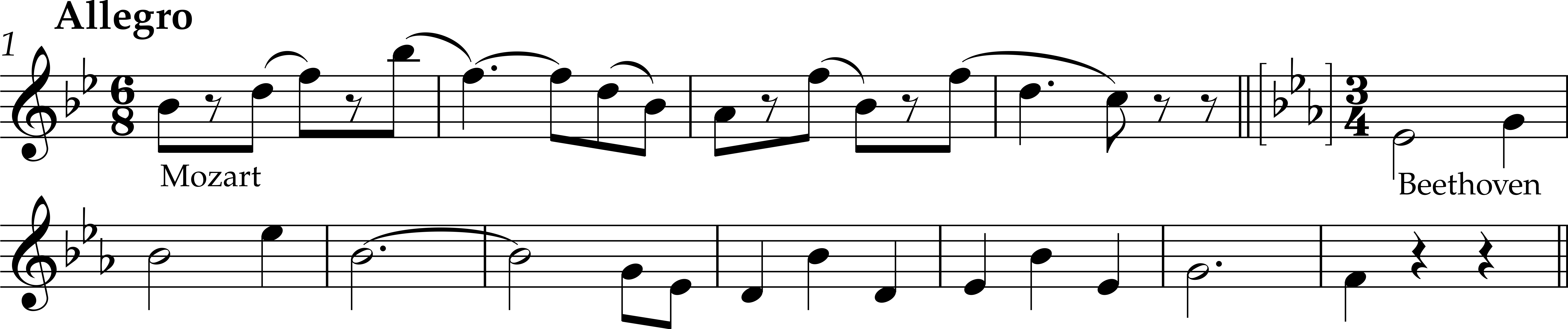
196 Leaving aside the various shorter sketches that are interspersed between the continuity drafts, the second draft (Nottebohm, 1979, pp. 53–54; Lockwood & Gosman, 2013, Vol. 1, Part 3, p. 12) relocates the premature dominant statement to a position after Tovey’s “proper third statement”, in which relative position it returns in the third (Nottebohm, 1979, pp. 55–56; Lockwood & Gosman, 2013, Vol. 1, Part 3, pp. 14–15) and fourth (Nottebohm, 1979, pp. 56–58; Lockwood & Gosman, 2013, Vol. 1, Part 3, pp. 20–21) drafts.
197 There is a large literature, much of it anecdotal and some of it fabricated, discussing this “creative somnambulism” – Campbellian blind variation – of composers. Keller gives a hint of this in noting, somewhat immodestly, that “[w]hen I asked [Britten] what had made him so enthusiastic about my method, he replied that it was the only type of music analysis that interested him, because it confined itself to the composer’s own pre-compositional thought, partly conscious, partly unconscious. He had thus learnt a lot about himself from my FA of his Second Quartet” (1985, p. 73).
198 The situation is complicated in Chomsky’s original, in that “sincerity” imposes restrictions on inverting the sentence because (i) this noun does not normally function as an accusative object in a transitive sentence; and (ii) there are semantic constraints that would render the sentence nonsensical.
199 While music has no case-markers analogous to those of language, certain musical gestures nevertheless have “beginning”, “middle” and “end” functions (Agawu, 1991, pp. 53–54), and so can – as in the opening of the second movement of Haydn’s Symphony no. 100 (“Military”) (1794) with a closing gesture (Meyer, 1996, 26, Ex. 1.3 (a)) – be repositioned for ironic or witty effect. This device was considered on page 260 under the rubric of exaptation.
200 Schenker asserted that “[o]nly the prolongation of a division (interruption) gives rise to sonata form. Herein lies the difference between sonata form and song form: the latter can also result from a mixture or a neighboring note [but the former cannot]” (1979, p. 134).
201 See Matsubara et al. (2018) for attempts to use the computer to automate music analysis according to the GTTM.
202 “Strong prolongations” (harmonic and melodic repetitions and anticipations) are symbolised by an open circle at branch-intersections (1983, p. 182, Fig. 8.6 a, d); “weak prolongations” (harmonic repetitions and anticipations) are symbolised by a closed circle at branch-intersections (1983, p. 182, Fig. 8.6 b, e); and “progressions” (departures and arrivals/resolutions) are symbolised by the absence of a circle at branch-intersections (1983, p. 182, Fig. 8.6 c, f).
203 Strictly, as Reti’s Ex. 1 and Ex. 2 indicate, he means the original pitch-classes here, given that he abstracts the component pitches of motif I an octave lower than it is presented in the Violin I part of the first movement. In addition to this general insensitivity to register, Reti also variously indicates, and ignores, rhythm, as in his treatment of motifs II and III in Ex. 1 and Ex. 3 (1951, pp. 11, 13).
204 One might use the term “the selfish tone”, but this would contradict the precept in memetics that a meme is a network of relationships: a single note cannot make a museme nor, normally, can two (Jan, 2007, pp. 60–61).
205 Joseph Riepel’s socio-spatial(-gendered) model of tonality makes this hierarchy of servitude explicit, styling the tonic as the Meyer, or landowner, lord and master of all those on his estate; and the dominant as the Oberknecht, or chief servant (Riepel, 1755, p. 66).
206 Actually, there is no need for the white-flag defence of metaphor here: as discussed in §3.8.3 , Calvin’s HCT integrates the concept of basins of attraction with the neuronal mechanisms for museme-encoding (Calvin, 1998, p. 68).
207 A memetic mechanism, one not incompatible with that suggested in note 206 on page 561, might assert that musemes associated with – in the case of Figure 4.7 – a B♭ -major harmony would normally have an E♭ and so the force of schematic memory would bend any E♮ in a B♭ -major context to conform with the attributes of the parent museme allele-class. In a related explanation, Schubert and Pearce (2016, p. 358) argue that veridical (“case-based”) memory accounts for the mental representation of music by means of “the chaining together of different, pre-existing veridical segments of music”. On this model, the memory of a similar museme – that is, one from the same allele-class – from a different work might have supervened upon Bach’s initial “intention” for e♮ 2 in b. 31 of the Italian Concerto.
208 The latter mapping is the basis for the memetic explanation for this process, discussed in §7.5 .
209 Quintillian’s Institutio oratoria (c. 95 CE) had been rediscovered in 1416 (Bent & Pople, 2001, sec. II.1).
210 Spitzer distinguishes, perhaps too prescriptively, between periods and sentences by arguing that “[a] period is an eight- or sixteen-measure antecedent-consequent form”, whereas a sentence is “an eight-measure theme characterized by internal development and acceleration of phrase rhythm …” (2004, p. 74). Understood this way, the former is symmetrical and poetic, and is characteristic of Marx’s Satz material-type; and the latter is asymmetrical and prose-like, and characteristic of Gang (§4.4.1 ).
211 For Narmour, frustrated expectations take the form of “tiny cognitive ‘jolts’ to the neuronal electrical system governing our subconscious cognitive expectations” (1990, p. 138).
212 The text here (after Psalm 144 in Luther’s 1545 translation) is: “[phrase 1] Wohl dem Bold dem es also gehet; [phrase 2] aber wohl dem Bold, des der Herr ein Gott ist!” (“[phrase 1] Blessed are the bold of whom this is true; [phrase 2] but blessed are the bold, whose Lord is God!”).
213 The former – broadly equivalent to Meyer’s concept of the same name, save for the latter’s emphasis on the replication of patterning – concerns veridical expectancies set up by the work’s ongoing unfolding. The latter concerns influences on a work imposed by its encompassing culture, understood here in terms of memetics.
214 The scorn is directed towards those three situations abhorred in “that there be no breaking in [invasion], nor going out [captivity]; that there be no complaining [distress] in our streets” (Psalm 144, line 14; King James Version).
215 The first and third of these terms, with their notions of “outgoing” and “incoming”, respectively, draw upon the centre/periphery schema (§4.2 ).
216 While Nattiez uses the term “analysis” in his account, it can readily be generalised to all forms of music-scholarly enquiry, including historical and critical study. Figure 4.9 should be understood in this light.
217 By “musical logic”, and as discussed in §4.4.1.3 , Keller is referring in part to the kinds of motivic relationships he detected in the music of Schoenberg and then extrapolated (as did Reti (Reti, 1951; Reti, 1967)) to the music of other composers. The argument of §3.8.6 is that linguistic and musical syntax (“logic”) are not as “far removed” from each other as Keller implies. See also H. Keller (2001).
218 That is, some music-theoretical/analytical concepts prosper not (just) because of their internal coherence and relevance to the music that is their object, but (also) because their terminology is striking – “GTTM”, Tonnetz, “Meyer [Schema]”, etc. – and memorable. See also the related discussion of “Rule Britannia” on page 196.
219 Conversely, some composers – most notably in the case of Scheibe’s critique of J. S. Bach (Maul, 2013) – have been accused of excessive, stultifying conservatism.
220 There are numerous caveats here, however. For one thing, the two concerts failed, in part, owing to intrigue, not aesthetics. Moreover, some twentieth-century music, perhaps most notably that based on serialism (and, later, “total” serialism), is the product of an antecedent theory, not its precursor, thus foregrounding prescription over description.
221 This is not the place to enter into the increasingly controversial debate over (biological) sex versus (psychological) gender. Suffice to say that the literature in this category generally uses the latter term to encompass concepts related to the former.
222 The report detailing the outcome of CiteSpace’s extraction of data from the .ris bibliographic citation file exported from Scopus states that “1,535 records [were] converted …. Total References [i.e., citations of literature within sources]: 104,247[;] Valid References: 102,943 (98.0%)”. By analogy with the data discussed in note 99 on page 430, elimination of duplicates reduced the number of unique records to 1,242.
223 While there is a separate Psychology category in Scopus (consisting of 150 records containing the present search terms at the time of searching), some psychology literature is included in the Arts and Humanities category.
224 The Scopus used for this analysis does not contain some of the most recent work in this field, such as Dobson (2018), which addresses the specifically educational implications of a “digital audio ecofeminism”.
225 Sokal’s article motivated the development of the Postmodernism generator website (Bulhak, 1996), which assembles random, postmodern-sounding text using recursive grammars.
226 By “non-musical dimensions”, I refer to the interaction between phenomena in the domains of politics, economics, philosophy (broadly defined) and other domains sustaining verbal, graphical and imagistic patterning, whose replication gives rise to memes and memeplexes. While cultural evolution encompasses two domains – crudely, the structural and the ornamental – they are treated as closely related here.
227 A serious critique of McClary’s analytical work is that, despite foregrounding the importance of narrativity in ostensibly absolute music (1994, pp. 66–67), some of her accounts are often highly selective, omitting significant chunks of the “story” in order to focus on those elements that support the overriding hermeneutic agenda. In the case of the discussion of Brahms’s Symphony no. 3 (McClary, 1993), for instance, the second, third and fourth movements do not figure significantly in her account.