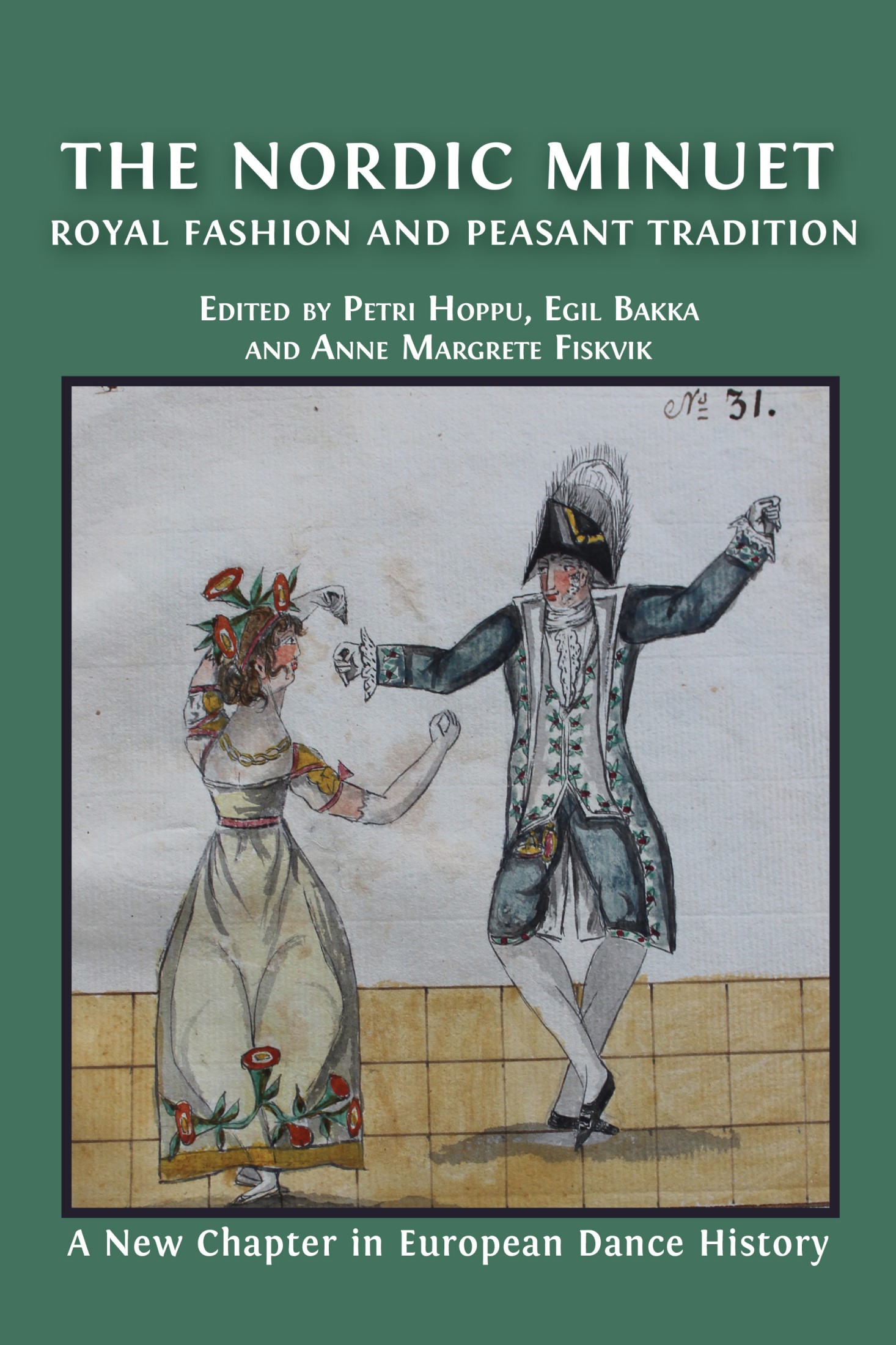
A rich array of minuet references and small narratives appear in Nordic sources. These are found in letters, diaries, memoirs, poems, periodicals, and other genres of writing, which, to date, have not been translated into other languages. Members of our project group, particularly Gunnel Biskop, have spent many years collecting this elusive material. Part Two of this book includes excerpts from these sources. As such, they are accompanied by little advanced or interpretative discourse. Framing the general context of the minuet, the excerpts paint a picture of its situation in a variety of countries. The chapters are mostly organized according to the chronology of their principal sources.1
1 Source material speaking to specific topics will be treated in later chapters, including more interpretive discourse.
4. Nordic Dancing Masters during the Eighteenth Century
©2024 Anne Fiskvik, CC BY-NC 4.0 https://doi.org/10.11647/OBP.0314.04
This chapter investigates the role of the dancing master and their teaching of the minuet in the Nordic countries in the latter part of the eighteenth century and onwards. The primary focus is on the role and the material of these masters as they taught the minuet. Drawing on examples from Norway and the other Nordic countries, the chapter includes short case studies of both female and male dance teachers.
The profession of the dancing master developed in the late Middle Ages and the Renaissance in Italy and France. The first dancing masters who published books on their disciplines worked for private or royal patrons in Italian cities like Firenze and Piacenza. In these countries, dancing masters were typically employed by royalty or wealthy patrons through the centuries. However, during the eighteenth century, with the growing bourgeoisie, the market for dancing masters expanded and gave rise to independent dancing masters. Thus the minuet became a key dance during the eighteenth century, especially for teaching etiquette and gracefulness. Even in Norway, a country without a court or aristocracy, learning how to dance was important for social reasons. In all the Nordic countries, the so-called dancing master taught various forms of dance. These dancing masters who taught the middle and upper lower classes serve as some of the case studies in this chapter.
Dance teachers who worked in the Nordic countries often travelled to serve more limited markets, because, unfortunately, the number of citizens in these places who could afford to take dancing lessons was limited. Subsequently, itinerant male and female dancing masters often also worked as a performer in the places they visited for financial purposes. However, dance teachers also settled and worked in Nordic towns on a more permanent basis. From newspaper sources, it can be deduced that several women and men were offering lessons in Christiania (Oslo) in the early 1770s. With five thousand inhabitants, this was a provincial city just large enough to provide a decent audience and customers for dance classes. Three women and four men were active as teachers at any time, and there was quite a bit of competition for customers. Some of them worked solely with teaching, whereas others were travelling around looking for work also as dancers.1
Sources and Previous Research
Much can be inferred about Nordic itinerant dancing masters and performers from notices and advertisements in Danish, Finnish, Swedish, and Norwegian newspapers. For instance, around 1770, Norwegian papers included advertisements for several dance teachers offering lessons in Christiania. Among other sources are printed and handwritten materials, including posters, copies of applications, theatre records, and entries in church record books.2 Madame Stuart, one of the dance teachers discussed in this chapter, is referred to in Swedish as well as Danish newspapers, suggesting that instructors even worked in different countries. For instance, mentions of her appear in the [Swedish] Götheborgska Nyheter and Hwad Nytt, the [Danish] Hwad Nytt. In Norway, Stuart is referred to in the Christiania newspaper Nordske Intelligenz-Seddeler (1768–74), the Bergens Adressecontoirs Efterretninger (1768–69), and the Trondhiems Adresse-Contoirs Efterretninger (1769–86).3
Little research has been done on dancing masters, and many aspects of their work deserve scrutiny. Questions of interest center around daily life of dancing masters and their performances. I ask how they were treated, and what kind of social status they had. And, especially for this chapter, I looked to see what we know about their methods for teaching the minuet.
The Combined Dance Teacher and Performer
The latter part of the eighteenth century was a prosperous one for itinerant dance performers on the continent and in the Nordic countries. Several artists travelled from city to city, offering a variety of entertainment. Dancers also came from beyond the Nordic countries to try their luck. They belonged to a well-established tradition of travelling artists who worked in smaller or larger groups, a practice that has been common since the birth of theatre itself. Throughout the Early Modern period, musicians, singers, acrobats, actors, and dancers travelled across Europe, often seeking employment at princely courts or asking for permission to perform publicly in market squares or other rented locations. Additionally, teaching dance was included in their practices.4
Repertoire
The decade beginning in 1770 was a prosperous period for this travelling professional in Norway. This can be seen in several advertisements in the few extant newspapers. From these, it is possible to learn the types of dances taught by the masters. Their teaching repertoire was similar to that of contemporaneous teachers who were settled in one city, and the minuet is almost always mentioned as one of the dances offered. As many as seven dancing masters were active in ‘provincial’ Norway at this time, and all of them are also known to have travelled in the other Nordic countries.
Itinerant Dance and Theatre Activity
Itinerant dancing masters and performers have not been a major theme in the work of Nordic scholars, who have been generally more interested in theatre as an institution. Among the exceptions is the Swedish theatre scholar Gunilla Dahlberg, who has conducted extensive research on travelling artists who visited Stockholm in the seventeenth century and later periods. She has written about various theatre and dance activities that were connected to the Swedish court.5 Of particular interest to this chapter is the influence of travelling German itinerant artists, including those who specialized in performing and/or teaching dance.6 The Finnish theatre historian Sven Hirn also offered insight into the types of performance and teachings provided by itinerant artists. In Den gastronomiska hästen (2002), he published some of the many theatre posters he collected related to dancers and dancing masters. Drawing on comments on performers and types of practices, he has created a picture of the sheer variety of itinerant activity seen in the eighteenth and nineteenth centuries. Hirn was fascinated by itinerant circus artists, including dancers and acrobats, and pointed out what he thought were their strengths and weaknesses. His research filled many of the gaps in our knowledge about the numerous travelling teachers and artists who toured the Nordic countries.7
Many sources testify to the activity of itinerant artists outside of larger cities. Claes Rosenqvist and Dag Nordmark’s Att resa var nödvändigt (1990), for example, examines Swedish rural theatre. The two scholars discussed, among other aspects, the itinerant artist’s social and artistic place in society. Their research offers a more balanced perspective on high versus low theatre culture, emphasizing the range of itinerant practices and teachings and how both high and low cultures met the social and cultural needs of spectators from various social classes. Their more inclusive views on theatre and dance have influenced my research.
Itinerant Travelling in the Nordic Countries
European performers travelled not only on the continent, but also in Nordic countries. According to Norwegian historian and conservator Vidar Parmer, source material from around 1600 onwards shows evidence of various itinerant troupes visiting Bergen, Christiania, Fredrikshald (Halden), Christiansand (Kristiansand), Stavanger, and Trondheim. Indeed, German theatre troupes dominated itinerant activity in Sweden, Denmark, and Finland during the seventeenth and eighteenth centuries. Several such troupes stayed and made Sweden their base of operations, including those led by the tightrope dancer Karl Friedrich von Eggenberg, as well as the theatre director Carl Gottfried Seuerling (1727–95), both of whom travelled extensively in the Nordic countries.8
These ensembles generally travelled inland via Sweden or came by boat from Denmark.9 Teaching dance was, as already mentioned, a necessary part of their existence. Therefore, they settled for a variety of lengths of stay in various towns, attempting to attract students while also performing. It would be fair to say that performing mostly taking place outdoors was the primary activity for several dancing masters, but teaching that could take place all year indoors was often the more lucrative pursuit.
Artists’ Obstacle: Permissions to Perform
Many artists travelled due to the difficulty of obtaining performance privileges in other European countries. The British dance historian Marian Hanna Winter, describing the period between 1700 and 1830 in particular, notes that official theatres—ones that had obtained privileges from the king or state—were rare and highly competitive:
Out on the continent, the theatre companies that enjoyed ‘official patronage’ jealously watched their smaller rivals, even down to the eeriest company of marionettes. The patented or government-sponsored theatres might also be called the ‘over-privileged’, and all others the ‘underprivileged’. The former were allocated complete rights for exploitation of certain types of entertainment and prosecuted infringements mercilessly.10
According to Winter, travelling artists would be categorized as underprivileged because it was difficult, if not impossible, for them to be accepted into the privileged theatres. Established European theatres seldom hired artists who were not within their closed circuit, and, consequently, many ensembles were forced to move regularly to find work. Some probably preferred this, but others likely searched for some safer or more stable work environment, which may be what motivated Madame Stuart’s Norwegian adventures.
If we look at the Nordic situation in the second half of the eighteenth century, the privileged theatres in Copenhagen and Stockholm were almost exclusively connected to, or part of, the royal courts. For instance, the Stenborg and Seuerling theatre companies, as Dahlberg notes, had obtained privileges from the Swedish king to perform in Swedish (including Finnish) towns at various times between 1760 and 1780.11
One major challenge faced by itinerant dancing masters/artists was applying for permissions to perform. This seems to have been somewhat more challenging for women, according to the sources describing the Norwegian situation. Itinerant artists who wanted to perform in the Nordic countries had to observe the state laws and any applicable local rules. During the seventeenth and eighteenth centuries, Norway was under Danish rule, and its king and central administration were located in Copenhagen. Privileges allowing performances were granted by the king who enforced various prohibitions—a variety of laws that forbade practices such as the staging of plays, wire-dancing, and acrobatics—that had been passed in Denmark-Norway from 1738 onwards.12 At the same time, local issues were dealt with by Norwegian authorities in each town, rather than by the Danish king. Madame Stuart and her itinerant colleagues should be viewed in light of these conditions, which imposed a variety of restrictions on the artists, even in terms of their repertoire choice.
Legislation on theatre performances was variously applied and enforced during the eighteenth century in all of the Nordic countries, including Denmark and Norway. Laws restricting theatre activity were introduced in the Swedish realm as well, which at this time included Finland.13 The extent of the local restrictions on travelling artists varied, but they all made life more difficult for the itinerant dance performers. However, it was to their benefit that the power to decide who would be allowed to teach and perform was controlled by local authorities, as this meant they did not have to wait for a response from a central governing body. A significant argument underpinning these prohibitions was that money should not be paid to foreigners or be taken out of the country. Of course, most of the time, the travelling artists were barely getting by, and the little income they had would be spent on food and housing in the country in which they were performing. Still, the perception that money was leaving with these performers remained strong and informed the decisions of local authorities.14
The Partnership of the Stuarts and the Nürembachs
In the summer of 1770, the well-known dancing duo Michael Stuart and his wife Madame Stuart arrived in Christiania, Norway.15 The couple had, by then, travelled and worked in the Nordic countries for several years, and in Norway since 1768. They arrived in Bergen in the early fall of 1768 after performing and teaching in Danish cities such as Odense and Copenhagen. Another widely-travelled couple was the Nürenbachs: Martin Nürenbach and his wife Anna Catharina Rancke. The Nürenbachs worked in Sweden, Finland, and, briefly, Norway. The Stuarts and the Nürenbachs performed rope- and wire-dancing and acrobatics. Michael Stuart claimed a particular expertise in these types of dancing that involved balancing on a tightrope (or at times a more slack rope). Such performers were known at the time as equilibrists. Martin Nürenbach was also an equilibrist, well-known and significantly appreciated for his ladder-dancing—a skill that involved dancing and performing acrobatics up and down a ladder while at the same time balancing the ladder itself. Source materials indicate that these men performed what was known as ‘comic’ and ‘grotesque’ dancing styles, both of which incorporated acrobatics as well as rope- or wire-dancing, tumbling, and pantomime.16 According to a textbook on dance from 1762 written by the Italian-British dancing master Giovanni Andrea Gallini, these technically demanding styles were designed to entertain the audience.17 Little is known about where Stuart and Nürenbach acquired their skills, though it was quite common for children born to itinerant artists in the eighteenth century to start training from an early age, learning musical (especially singing) skills as well as acrobatics, tumbling, and rope- or wire-dancing.18
Both couples had several children, and both women were widowed: Michael Stuart died in the summer of 1770 in Christiania, whereas Martin Nürenbach died in Tavastehus (Hämeenlinna), Finland in 1780.19 Madame Stuart continued performed without her late husband in Gothenburg, Sweden in 1773, and then chose to remain in Christiania until 1774, when one of her sons died and was buried.
Madame Stuart continued her partnership with Martin and Madame Nürenbach. They became the first artist group to obtain a royal privilege to stage ‘comedies’ (plays) in the Danish language. For reasons unknown, the theatre enterprise did not last, nor did it keep the Nürenbachs in Norway. After only a few performances, the Nürenbachs left in the early spring of 1772 to resume their itinerant performance careers in Sweden and Finland, which constituted the Eastern part of the Swedish kingdom at that time.20
Teaching Dance and Minuet
In addition to performing, both the Stuart and Nürenbach couples advertised themselves as teachers of dance. Often, they would label themselves ‘dancing masters’ in the advertisements. Usually, whenever travelling artists remained for a more extended period of a few months, they would attempt to sell their services to the general public. The Stuarts, for instance, advertised dancing lessons in the newspapers of Bergen and Christiania. In one such advertisement, the announcement reported the presentation of the minuet by the Stuarts.21 Those teaching dance typically announced classes in the minuet, but this particular advertisement from Bergen is exciting because it supplies detailed information about which types of dances were taught, the costs, and where the teaching took place. Perhaps most importantly, the notice stated that learning the minuet would help students to develop a good sense of rhythm, something which is expressed as a quality needed both for dancing well and for general manners.
Also noteworthy is the fact that men and women could be taught separately. In Christiania, in 1770, an advertisement states that Monseigneur Stuart would teach men, while Madame would teach women.22 The most likely reason for this division was one of practicality. However, it might also address the reputation that Michael Stuart had as a womanizer.23 The implication is that it would be safer to leave female children, teenagers, and adults with a female teacher. This risk mitigation helps to explain why women pedagogues sometimes found work despite dance instruction being a rather male-dominated field.
The Ups and Downs of Being a Female Dance Teacher
Anna Catharina Rancke and her husband Martin Nürenbach moved back to Sweden in the spring of 1773 and continued to perform there.24 They then settled in Finland, where an attempt to create a Finnish theatre ensemble failed.25 Madame Rancke became a widow in 1780, and she then started a career as a dance teacher in the city of Pori (in Swedish: Björneborg).26 A noteworthy account of her teaching, seen from the perspective of a dance student, is given in the autobiography of Pehr Stenberg.27 Stenberg explains that he visited Pori several times as a young apprentice priest, feeling obliged to take lessons to learn the popular dances of the time and be able to take part in social entertainments and balls. However, the twenty-one-year-old was bothered by his dance teacher’s intense interest in him. Stenberg specifies that, at the time when Madame ‘Nyrenbach’ (as he spells her name) had just become a widow, she kept asking him, and not her other students, to dance during all the minuets and contra dances. He felt he had no choice because to reject would have been rude. However, Stenberg did not appreciate the Madame’s attention; he would have preferred to dance with some of the young Mademoiselles:28
It appeared to me that she [Madame ‘Nyrenbach’] had special intentions; that she wanted to win certain favours of me, such favours that an actress has been used to getting. But if this is so, she is miscalculating totally, I thought.29
This rather blunt statement reveals something about Stenberg’s attitudes towards what he calls an actrice, his dance teacher, as an entertainer, would be used to getting male attention and of obtaining ‘certain favours’.
What kind of favours might he have been assumed her to expect? Given that Madame Nürenbach was recently widowed, Stenberg was, first and foremost, worried that she wanted him as a new husband. The attitudes displayed here towards a female dancing teacher were not unusual or even unfounded. While it is widely known inside dance scholarship that female dancers were regarded as sexual objects and that they also had reputations as courtesans inside the court opera ballets, less is known about female dance teachers.30 But according to dance scholar Ivor Guest, female dancers at the French opera were regularly mistresses of wealthy French men during the Enlightenment period. There was even a particular lounge at the opera where the spectators could meet the dancers after the performance and make their ‘arrangements’.31 The same situation occurred in court ballets all over Europe and the Nordic countries. For example, in Sweden, the dancer Carlotta Slottsberg (1760–1800) was a celebrated performer at the royal opera, but she was perhaps better known as the mistress of Count Karl (later King Karl III). Slottsberg openly lived as a courtesan and had other lovers in addition to her more than twenty-year-long relationship with the count.32
Stenberg would likely have been aware of the rather negative notions about female dancers and thus may have jumped to conclusions about Madame Nürenbach’s intentions towards him. Practically, Anna Catharina might have felt vulnerable after her husband’s death and, with children to support, and considered Stenberg good husband material. As a young priest, he would seem the right choice for somebody seeking stability and also a measure of respectability. But it is also possible that Stenberg misread the situation: perhaps his instructor simply wanted to help him to improve his dancing skills. Alternatively, perhaps he struggled to learn the steps and needed extra attention. Nevertheless, Stenberg did not paint her in a positive light.
Summary and Concluding Remarks
The division between high and low culture, art, and entertainment is one that was present two hundred and fifty years ago and continues to be an issue even today. Learning how to dance was, nevertheless, a necessity, at least among the middle and upper classes. Not surprisingly, the minuet continued to be taught well into the nineteenth century, even though it fell out of fashion as a social dance during that century. Dance scholar Elizabeth Svarstad points out that the minuet seems to have served a sort of foundational educational purpose; if one showed sufficient discipline to learn its steps, he or she was likely capable of learning more of the contemporary, modern dances that were evolving.33 As such, the minuet figured in advertisements for dancing lessons almost into the twentieth century in Norway.
According to dance scholar Sherill Dodds, popular forms of entertainment attract audiences with different mechanisms.34 Dancers who combined teaching and performing were popular with audiences all over eighteenth-century Europe. Yet, the artists themselves were not necessarily well respected, especially not among the upper classes. A parallel exists in modern theatre and dance scholarship wherein such popular entertainment forms have been belittled and received far less attention than more highbrow dance forms such as classical ballet. Several of the travelling performers were nevertheless highly skilled in various styles, and there was a market for them, even in the ‘provincial’ towns of Nordic countries. However, the status of combined performer-teachers, in particular, was often low. Dance teachers, perhaps especially women, had a reputation that was not always positive.
References
Archival sources
Kirkebøker [Church books] Kristiansand domprosti [parish]. Regional State Archives in Kristiansand
Kristiansand church book 30 October 1769. SAK/], F/Fa/L0002: Ministerialbok no. A 2, pp. 1755–78, 344–45
Offentlige skuespill & forestillinger [Public plays and performances]. Regional State Archives in Trondheim. Magistraten B, bd 3
Oslo domkirkes kommunikantprotokoll 1767–75
Secondary sources
Att resa var nödvändigt: Äldre svensk landsortsteater, ed. by Claes Rosenqvist and Dag Nordmark (Gideå: Vildros, 1990)
Biskop, Gunnel, ‘Danser i bondsonen Pehr Stenbergs självbiografi i slutet av 1700-talet’, Folkdansforskning i Norden, 40 (2017), 3–13
Bonnet, Jacques François, Histoire générale de la danse sacrée et prophane: Son origine, ses progress & ses revolutions ([1723]; Geneva: Slatkine Reprints, 1969)
Dahlberg, Gunilla, Komediantteatern i 1600-Talets Stockholm (Stockholm: Kommittén för Stockholmsforskning, Ekblad & Co., 1992)
―, ‘Till E.K. Maj:ts aflägsnare undersåtares noje’, in Att resa var nödvändigt, ed. by Claes Rosenqvist (Gideå: Vildros, 1990), pp. 18–48
Dodds, Sherill, Dancing on the Canon: Embodiments of Value in Popular Dance (London: Palgrave, 2011)
Enevig, Anders, Circus og gögl i Odense, 1640–1825 (Odense: Odense Universitetsforlag/Stadsarkivet i Odense, 1998)
Fiskvik, Anne Margrete, ‘Information uti dands i Christiania, 1769–1773’, in lidenskap eller levebrød: Utøvende kunst i endring rundt 1800, ed. by Randi M. Selvik, Ellen Karoline Gjervan, and Svein Gladsø (Bergen: Fagbokforlaget, 2015), pp. 287–313.
Gallini, Giovanni-Andrea, A Treatise on the Art of Dancing ([1762]; London: Dance Books, 2002)
Gladsø, Svein, Teater mellom jus og politikk: Studier i norsk teater fra 1700-Tallet til 1940 (Oslo: Unipub, 2005)
Guest, Ivor, The Ballet of the Enlightenment: The Establishment of the Ballet D’Action in France, 1770–1793 (London: Dance Books, 1996)
Hirn, Sven, Den gastronomiska hästen: Gamla nordiska artistaffischer (Helsingfors: Svenska litteratursällskapet i Finland, 2002)
―, ‘Martin Nyrenbach: teaterpionjär?’, Nordisk Tidskrift, 90 (1967), 261–68
Nordmark, Dag, ‘Med Kongl.Maj:ts allernådigste tillstånd’, in Att resa var nödvändigt: Äldre svensk landsortsteater, ed. by Claes Rosenqvist and Dag Nordmark (Gideå: Vildros, 1990), pp. 49–83
Parmer, Vidar, Teater, pantomime, linedans, ekvilibristikk, menasjeri, vokskabinett, kosmorama etc. på Fredrikshald (Halden: Halden kommune, 1965)
Roempke, Gunilla, Vristens makt: Dansös i mätressernas tidevarv (Stockholm: Fischer & Co., 1994).
Svarstad, Elizabeth, ‘‘Aqquratesse i alt af Dands og Triin og Opførsel’. Dans som Sosial Dannelse i Norge 1750–1820’ (unpublished doctoral dissertation, Norwegian University of Science and Technology, 2017)
Ulvros, Eva Helen, Dansens och tidens virvlar: om dans och lek i Sveriges historia (Lund: Historiska media, 2004)
‘Utdrag af Bref’, Hwad nytt Hwad nytt?, 6 November 1773, pp. 1–2
Winter, Marian Hanna, The Pre-Romantic Ballet (London: Pitman, 1974)
1 For more information about the dancing masters in Christiania, see Anne Margrete Fiskvik, ‘Information uti Dands i Christiania, 1769–1773’, in lidenskap eller levebrød: Utøvende kunst i endring rundt 1800, ed. by Randi M. Selvik, Ellen Karoline Gjervan, and Svein Gladsø (Bergen: Fagbokforlaget, 2015), pp. 287–314.
2 Thanks to the documents preserved at the National Library of Norway in relation to a dancing master called Martin Nürenbach, who travelled in Sweden, Norway, and Finland, we can learn something about attitudes towards itinerant artists among audiences as well as the authorities. Nürenbach’s application for starting a theatre is of special interest.
3 It must be pointed out that Norway was relatively late in establishing newspapers compared to its Nordic neighbours—the Nordske Intelligenz-Seddeler of Christiania did not begin until 1763; it lasted a few years until newspapers came to other towns such as Bergen (the Adressecontoirs Efterretninger) and Trondheim (the Trondhiems Adresse-Contoirs Efterretninger). The earliest versions of Swedish newspapers were published from 1614 and Danish ones from 1634. Finland’s press co-existed with that of Sweden: its first independent newspaper, Åbo Tidningar, was founded in 1771.
4 See Marian Hanna Winter, The Pre-Romantic Ballet (London: Pitman, 1974), pp. 7–18. Winter notes the vital link between the performance traditions of the Commedia Dell’arte and the development of ballet.
5 Gunilla Dahlberg, Komediantteatern i 1600-talets Stockholm (Stockholm: Kommittén för Stockholmsforskning, 1992), p. 14.
6 Ibid.
7 Sven Hirn, Den gastronomiska Hästen: Gamla nordiska artistaffischer (Helsingfors: Svenska litteratursällskapet i Finland, 2002), pp. 2–3.
8 Dahlberg, p. 14; for an overview of the Stenborg and Seuerling theatre companies, see Att resa var nödvändigt: Äldre svensk landsortsteater, ed. by Claes Rosenqvist and Dag Nordmark (Gideå: Vildros, 1990), especially chapters 1–3.
9 See Vidar Parmer, Teater, pantomime, linedans, ekvilibristikk, menasjeri, vokskabinett, kosmorama etc. på Fredrikshald (Halden: Halden kommune, 1965).
10 Winter, p. 30.
11 See Gunilla Dahlberg, ‘Till E.K. Maj:ts aflägsnare undersåtares nöje’, in Att resa var nödvändigt, ed. by Claes Rosenqvist (Gideå: Vildros, 1990), pp. 18–48.
12 It might be added that, like dancers and acrobats, travelling musicians also struggled to perform publicly. For more on the different theatre prohibitions in Denmark-Norway, see Svein Gladsø, Teater Mellom Jus og Politikk: Studier i Norsk Teater Fra 1700-Tallet til 1940 (Oslo: Unipub, 2005), pp. 8–16.
13 For Swedish theatre legislation, see Dag Normark, ‘Med Kongl.Maj:ts allernådigste tilstånd’ in Att Resa Var Nödvändigt: Äldre Svensk Landsortsteater ed. by Claes Rosenqvist and Dag Nordmark (Gideå: Vildros, 1990), pp. 49–83.
14 Many other restrictions could apply. Typically, permission was granted, but in return the ensemble was obliged to donate the income of the last performance in a given city to the local poor.
15 In 1770, Christiania was called ‘Stiftstad’ and had approximately five thousand inhabitants. Norwegian cities have often changed names or spellings. Today’s capital, Oslo, was known as Christiania until 1877, when it became Kristiania. In 1925, the city reinstated its original medieval name, Oslo. Throughout this article, I use the name and spellings of places that were common around 1770.
16 For more info on the role of the equilibrist/dancer-performer, see Jacques François Bonnet, Histoire générale de la danse sacrée et prophane: Son origine, ses progress & ses revolutions ([1723]; Geneva: Slatkine Reprints, 1969) and Anders Enevig, Circus og gögl i Odense, 1640–1825 (Odense: Universitetsforlag/Stadsarkivet i Odense, 1998).
17 Giovanni-Andrea Gallini, A Treatise on the Art of Dancing ([1762]; London: Dance Books, 2002), pp. 84–86.
18 See Winter, p. 34.
19 The Oslo domkirkes kommunikantprotokoll 1767–75 in January 1771 lists the widow ‘Stuart, Christina Dorothea, Enche.’
20 Sven Hirn, ‘Martin Nyrenbach: teaterpionjär?’, Nordisk Tidskrift, 90 (1967), 261–68 (p. 261).
21 See for instance Announement in Efterretninger fra Adresse-Contoiret i Bergen, 12 December 1768.
22 The teaching of dance was announced in local papers. Still, it must be emphasised that likely information about dance lessons, in the same manners as dance performances, were spread thorough pamphlets and flyers that were delivered or posted.
23 Swedish historian Eva Helena Ulvros notes that some male dancing masters were known to be womanizers and heavy drinkers (Dansens och Tidens Virvlar: om dans och lek i Sveriges Historia (Lund: Historiska media, 2004), pp. 24–25.
24 Performances from Humlegården/Stockholm were reviewed in the newspaper Hwad nytt Hwad nytt?: ‘Utdrag af bref’, Hwad nytt Hwad nytt?, 6 November 1773, pp. 1–2.
25 Hirn, ‘Martin Nyrenbach’, p. 261.
26 Ibid.
27 Gunnel Biskop, ‘Danser i bondsonen Pehr Stenbergs självbiografi i slutet av 1700-talet’, Folkdansforskning i Norden, 40 (2017), pp. 3–13.
28 Stenberg was interested in Mademoiselle Eneskjöld, a purportedly beautiful young woman, Biskop, pp. 6–8.
29 Biskop, p. 8.
30 Gunilla Roempke, Vristens makt: Dansös i mätressernas tidevarv (Stockholm: Fischer & Co., 1994), p. 89.
31 Ivor Guest, The Ballet of the Enlightenment: The Establishment of the Ballet D’Action in France, 1770–1793 (London: Dance Books, 1996), p. 24.
32 Gunilla Roempke, Vristens makt: Dansös i Mätressernas Tidevarv (Stockholm: Fischer & Co., 1994), p. 89.
33 Elizabeth Svarstad, Aqquratesse i alt af Dands og Triin og Opførsel.’ Dans som Sosial Dannelse i Norge 1750–1820 (unpublished doctoral dissertation, Norwegian University of Science and Technology, 2017).
34 Sherill Dodds, Dancing on the Canon: Embodiments of Value in Popular Dance (London: Palgrave, 2011), pp. 11–28 and 45–65.