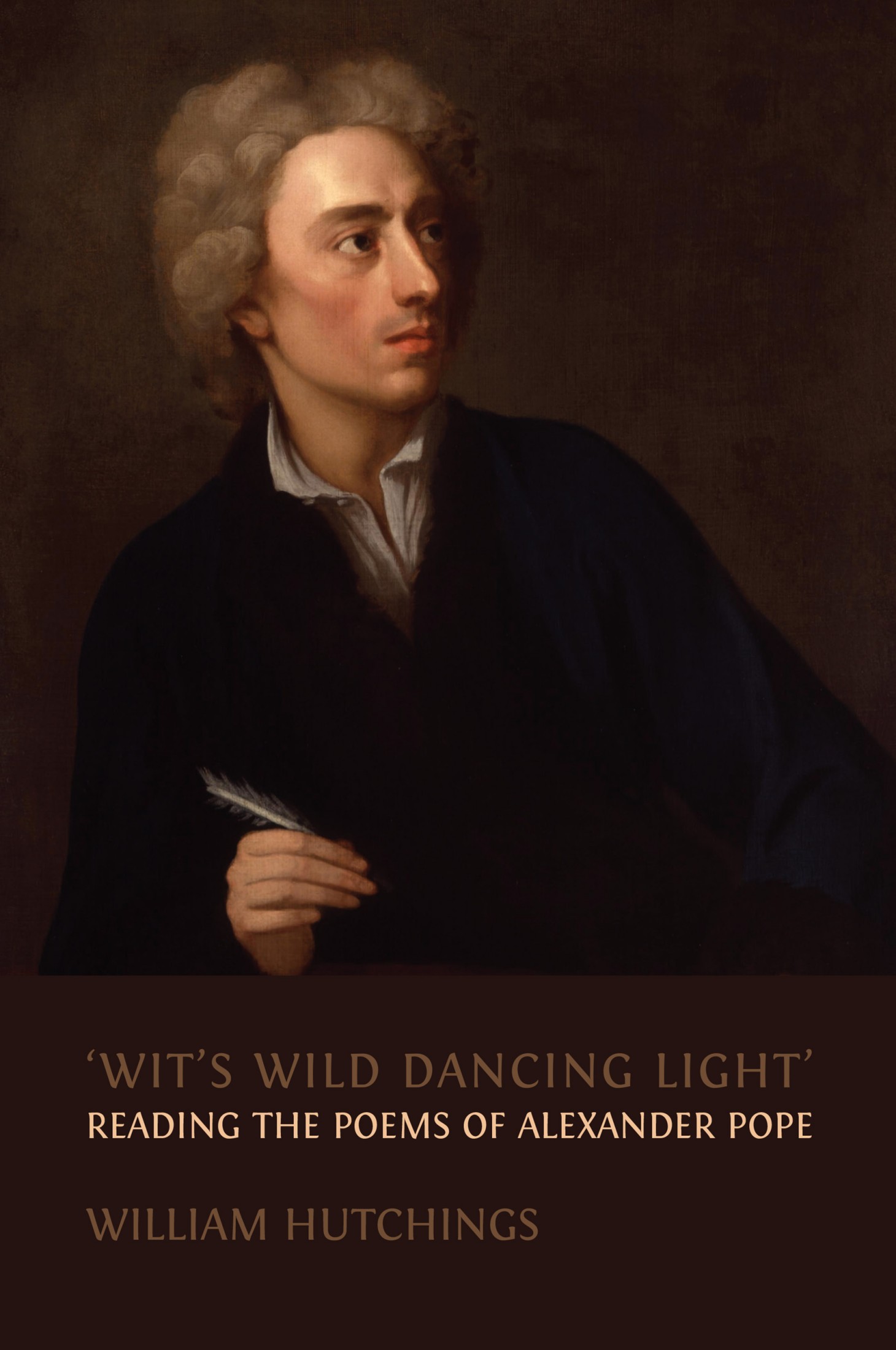
26. The Dunciad
© 2023 William Hutchings, CC BY-NC 4.0 https://doi.org/10.11647/OBP.0372.27
Examples: A-text book 1, lines 27–42, B-text book 1, lines 29–44; A-text, book 1, lines 61–66, B-text book 1, lines 63–68; A-text, book 1, lines 153–54, B-text, book 1, lines 175–76; book 2, lines 1–6; A-text, book 2, lines 57–64, B-text, book 2, lines 61–68; A-text, book 3, lines 59–64, B-text, book 3, lines 67–72; book 4, lines 149–74; book 4, lines 293–334; book 4, lines 421–36; book 4, lines 627–56
In 1725, Pope’s subscription edition of Shakespeare was published by Jacob Tonson, the bookseller who had instigated Pope to take on the project. It was not a success, and it prompted Lewis Theobald, a prolific and versatile writer and translator, to bring out a substantial volume entitled Shakespeare Restored (1725).
Jonathan Swift, close friend of Pope’s from the 1710s and now Dean of St Patrick’s in Dublin, paid two visits to England in 1726 and 1727. He arrived in England trailing clouds of glory from his victory in the affair of ‘Wood’s halfpence’, a proposed minting of copper coins in Ireland under a licence granted by the Walpole government and with Gulliver’s Travels, his own major contribution to the spirit of Scriblerus, ready for publication. Swift’s arrival may well have encouraged Pope to write up satirical materials he had been collecting over time with the working title of ‘The Progress of Dulness’. The Dunciad. An Heroic Poem. In Three Books duly appeared in 1728.
In 1729, Pope re-issued the poem with extensive preliminaries, ‘testimonies of authors’ and the like, large numbers of hoax notes, and many gaps in names filled in. This Dunciad Variorum increased the burlesque of literary and critical pedantry while maintaining the principal satirical message:
Books and the Man I sing, the first who brings
The Smithfield Muses to the ear of Kings.
book 1, lines 1–2
One of Pope’s notes explains: ‘Smithfield is the place where Bartholomew Fair was kept, whose shews, machines, and dramatical entertainments, formerly agreeable only to the taste of the rabble, were, by the hero of this poem and others of equal genius, brought to the theatres of Covent-Garden, Lincolns-inn-Fields, and the Haymarket, to be the reigning pleasures of the court and town.’
The poem celebrates transfer of sovereignty from Elkanah Settle, a poet and dramatist who had charge of the pageants acted on the Lord Mayor’s Day (and who had died in 1724) to Tibbald. Pope is making tacit allusion to the coronation of George II and Queen Caroline after the convenient death of George I in 1727: ‘Still Dunce the second reigns like Dunce the first’ (I, line 6). The mock-heroic framework burlesques the removal of Troy to Latium in Virgil’s Aeneid, parodied in the third book’s vision vouchsafed by Settle to Tibbald in the underworld. The poem triumphantly installs the tastes of squalid quarters in the sites of ‘court and town’.
The Dunciad Variorum of 1729 is denominated Dunciad A by the Twickenham Edition. In 1742, Pope returned to the work to add a fourth book, The New Dunciad. In 1743, the full four-book version appeared, with Colley Cibber replacing Tibbald as king of the dunces. [Cibber had been appointed Poet Laureate in 1730 and published a much-derided Apology for his own life in 1740. ] Amendments were made, some small, some more significant, for this final version, called Dunciad B in the Twickenham Edition. I follow this nomenclature. Pope’s revised fourth book represents a culmination of the vision of the Dunces’ triumph set out in book 3. Various aspects of culture, learning, and science are gathered up around Dulness’s throne. A final paragraph detailing the descent of darkness with which the A-text book 3 ended is transferred to become the finale to the B-text book 4, where its impact is all the stronger for the preceding dramatization of the extinction of knowledge.
A-text book 1, lines 27–42; B-text book 1, lines 29–44
A-text:
Where wave the tattered ensigns of Rag-Fair,
A yawning ruin hangs and nods in air;
Keen, hollow winds howl through the bleak recess,
Emblem of music caused by emptiness:
Here in one bed two shivering sisters lie,
The cave of poverty and poetry.
This, the great mother dearer held than all
The clubs of quidnuncs, or her own guildhall.
Here stood her opium, here she nursed her owls,
And destined here the imperial seat of fools.
Hence springs each weekly muse, the living boast
Of Curl’s chaste press, and Lintot’s rubric post,
Hence hymning Tyburn’s elegiac lay,
Hence the soft sing-song on Cecilia’s day,
Sepulchral lies our holy walls to grace,
And new-year odes, and all the Grub Street race.
Dulness’s place of choice, her natural home, is a ramshackle ruin of a house set in a ramshackle district. Pope takes care to name the area explicitly in the first line of the paragraph; and he enforces the point by supplying his own succinct note: ‘Rag-fair is a place near the Tower of London, where old cloaths and frippery are sold’. This marketplace for the sale of rags, of used and torn linen—all proudly flying in the wind in a mockery of banners of state and dignity—Dulness values more highly than she does the ‘clubs of quidnuncs, or her own guildhall’. This juxtaposition in line 34 contains its own process of belittlement: the City’s house of civic authority (and the place from which the Lord Mayor’s parade traditionally set out) is another of Dulness’s favourite spots (‘her own’), of equivalent value to any tavern or other haunt of gossipy newsmongers. A ‘quidnunc’ was, in recent jargon (OED’s first citation is from Richard Steele’s Tatler in 1709), someone who asked ‘what now?’, that is, an inquisitive seeker after the news of the moment. But Rag Fair beats them both, its torn and frayed scraps and remnants being both the appropriate tatters for its hard-up inhabitants and suitable descriptions of the scraps of paper produced by Grub Street poets. How fitting that Dulness foresaw that it would be the site of the Tower of London: the ‘imperial seat of fools’ is set up ‘at the heart of a notorious hotbed of vice and penury’ (Rogers, 1980, p. 39).
The second half of the paragraph is taken up by a list of the varieties of these poetic torn and tatty creations: weekly journals, elegies for condemned criminals on their way to execution at Tyburn Hill, odes for St Cecilia’s day (the patron saint of music), mendacious epitaphs on tombs, predictable odes for the new year from the poet laureate and pretenders to his throne—in fact, the entire production of what has come to be called ‘Grub Street’, as ‘Fleet Street’ in the twentieth century signified all journalists. These are the works churned out by booksellers’ printing-houses—the traders in second-hand ideas, stories, and other falsehoods (we shall meet Curl and Lintot again in book 2).
Pope’s poetry ironically sets off by contrast the haphazard and chaotic mess of everything to do with Rag Fair—what is for sale, those who sell it, those who make it. This he does in two principal ways: through structure and language. Firstly, this entire verse-paragraph is carefully shaped and measured. It is in two broad but clear parts (place, then products) held together by a succession of correlated adverbs. The opening ‘where’ introduces two groups of organizing words: ‘here’ in lines 31, 35, and 36, and then ‘hence’ in lines 37, 39, and 40. These are clearly delineated, but Pope positions them with an eye to varying the overall structure to allow a sense of freedom within the pattern. So, the ternary set of ‘here’ packed into the single couplet provides particular emphasis at the heart of the passage at a distance from the earlier ‘here’; and the ternary anaphora of ‘hence’ moves from alternate to following lines. Within this structure, phrases and clauses fall naturally into balancing pairs: ‘poverty and poetry’, ‘stood her opium … nursed her owls’, ‘Curl’s chaste press … Lintot’s rubric post’. The subject-matter is disordered; the syntax is ordered.
Secondly, Pope applies to his language a level of euphony which exposes the discordance of what it is describing. ‘Keen, hollow winds howl through the bleak recess’ agreeably sustains long vowels with close shadowing of consonants (‘hollow’, ‘howl’). ‘Poverty and poetry’ phonically suggest themselves as bed-partners, nearly an anagram apart. ‘Springs’ accords creative vitality to the products of the ‘muse’. The ‘soft sing-song’ of the odes to St Cecilia impishly extends alliterative sibilants to near-parodic extremes. It is as if Pope wants to dress his catastrophic cityscape in the language of pastoral. Indeed, the entire paragraph can readily be conceived as a type of anti-pastoral, as the entire poem is a form of mock-epic. A classical form holds barbaric content, with burlesque and derisive results.
B-text:
Close to those walls where Folly holds her throne,
And laughs to think Monroe would take her down,
Where o’er the gates, by his famed father’s hand
Great Cibber’s brazen, brainless brothers stand;
One cell there is, concealed from vulgar eye,
The cave of poverty and poetry.
Keen, hollow winds howl through the bleak recess,
Emblem of music caused by emptiness.
Hence bards, like Proteus long in vain tied down,
Escape in monsters, and amaze the town.
Hence miscellanies spring, the weekly boast
Of Curll’s chaste press, and Lintot’s rubric post:
Hence hymning Tyburn’s elegiac lines,
Hence Journals, Medleys, Merceries, Magazines:
Sepulchral lies, our holy walls to grace,
And New Year odes, and all the Grub Street race.
Between 1729 and 1743, Dulness’s ‘cave of poverty and poetry’ has changed its address. It has moved from Rag Fair, near the Tower of London, to a spot ‘Close to those walls where Folly holds her throne’. This is the Hospital of St Mary of Bethlehem, originally founded as a priory and, after the Dissolution of the Monasteries, granted to the mayor and citizens of London and then incorporated as a foundation for the reception and cure of the mentally deranged. It became popularly called ‘Bedlam’ and was rebuilt in 1676 just outside London Wall at its north side, near the parish of St Giles, Cripplegate (see OED, ‘Bedlam’ sb, sense 2). By happy chance, as Pope’s note on line 31 explains, two statues over the gates of Bedlam were the work of Caius Gabriel Cibber, father of Colley Cibber, poet laureate since 1730. Hence ‘Great Cibber’s brazen, brainless brothers stand’ and take their place in a spectacular outbreak of plosive alliteration. James Monroe (line 30) was then physician to Bedlam hospital.
These lines on Bedlam replace much of the first half of the A-text verse-paragraph. The euphonious ‘cave of poverty and poetry’ and the couplet describing the howling winds survive: the change of address has not resulted in an improvement to home conditions. The references to quidnuncs, the guildhall, and the imperial seat of fools are transferred to a place later in book 1 (lines 269–72). In the second half of the passage, some of the products of what are now called the ‘bards’—the inspired poets—of Dulness’s house remain the same. Others, though, are changed. We now have ‘miscellanies’ (that is, anthologies of poetry) and a new profusion of ‘Journals, Medleys, Merceries, Magazines’. Pope’s explanatory note on these fresh products is relentless in its no-holds-barred way:
Miscellanies in prose and verse, in which at some times new-born nonsense first is taught to cry [an anticipation of line 60]; at others, dead-born Dulness appears in a thousand shapes. These were thrown out weekly and monthly by every miserable scribbler; or picked up piece-meal and stolen from anybody, under the title of papers, essays, queries, verses, epigrams, riddles, etc. equally the disgrace of human wit, morality, and decency.
Good stuff, then.
The concluding couplet of the two texts remains unaltered, so that the paragraphs come to rest on the same place: ‘all the Grub Street race’. Grub Street had long been a general term for poor and hack writers: OED’s first citation is 1630. But now, in the 1743 Dunciad, the street name emerges as literal as well as metaphorical. The actual Grub Street lay in Cripplegate Ward, and so was very close to Bedlam. The grubs have found their natural habitat. The bards live in Grub Street and its environs, infesting an area long known for its poor (in every sense) writers and conveniently located near a hospital ready to receive and treat them. Colley Cibber’s father has shown the way for his son and all his fellow scribblers (see Rogers 1980, pp. 56 ff).
A-text, book 1, lines 61–66; B-text book 1, lines 63–68
Some things never change. Wherever she sets her home, Dulness looks out onto the same ‘chaos dark and deep’ (A-text, line 53; B-text, line 55) and beholds the same confused and garbled verbal universe:
Here one poor word an hundred clenches makes,
And ductile dullness new meanders takes;
There motley images her fancy strike,
Figures ill paired, and similes unlike.
She sees a mob of metaphors advance,
Pleased with the madness of the mazy dance.
The lines establish words as the local habitation for this vision of chaos. The Dunciad does, throughout, have a broad, universal frame of reference, but its centre is always language in its varieties, from literary to journalistic. The context may be macrocosmic, but the focus is the microcosm: the fundamentals from which meaning is constructed.
Here Pope rapidly encompasses types of verbal expression, like stars within a dark background. A ‘clench’ is an archaic term for ‘a play on words, pun, quibble’. OED cites this line among examples of usage from the seventeenth century to the nineteenth. Pope’s couplet connects this with a superficially attractive image of dullness as a river being channelled through various windings. Again, OED cites the line under ‘ductile’.
The second couplet moves to contradiction. Images don the fool’s parti-coloured dress, and similes clash with a contradictory adjective to form a nullifying collision: ‘similes unlike’. In the third couplet, the promiscuity implied in ‘Figures ill paired’ spills over into the chaos of crowds, as metaphors threateningly ‘advance’ in forms of movement well suited to—in the B-text—nearby Bedlam. Throughout, motion spirals into anarchy. Like the meandering stream, dance takes on the form of random, purposeless motion.
A-text, book 1, lines 153–54; B-text, book 1, lines 175–76
And lest we err by wit’s wild dancing light,
Secure us kindly in our native night.
Having built a pyre of dull books and his own vain writings, Tibbald (in the A-text) and Cibber (in the B-text) send up a prayer to the goddess Dulness. This couplet from their lengthy invocations gets to the core of The Dunciad’s central irony. To employ verbal irony is to say something one does not mean, usually in the form of a statement or a word that is the opposite of, or very different from, what one does mean. In The Dunciad as a whole, the creativity at the heart of responsible and imaginative use of language comes disguised in the shape of a triumph of dull, dead, and unimaginative language. But the true subject of ironic writing is that which is implied: the opposite of what is being said. This couplet works by a still further irony. In beseeching one desired outcome, Tibbald and Cibber actually state the contrary, which is, for Pope, the actual truth. In praying for the security of their ‘native night’ as protection from the error of ‘wit’s wild dancing light’, the kings of Grub Street conveniently and accurately define the stark alternatives. They sound the right notes but not in the right order.
The security they seek is the dark chaos of their primitive and natural environment. It represents the safety of obscurity, a return to the pre-natal state of thoughtlessness, even as ‘security’ implies a form of imprisonment. ‘Wit’s wild dancing light’ represents the opposite: a release of the mind’s potential to embrace knowledge and enlightenment. This is not a ‘mazy dance’ but a dance of vitality. The antithesis within the couplet is indeed a matter of life or death.
Pope himself supplies a crucial additional level to the irony. It is not enough simply to state the alternatives: his lines actually breathe the energy that the invocation seeks to suppress. ‘Wit’s wild dancing light’ modulates between short and long vowels: ‘wĭt / wīld / dance / ĭng / līght. The adjective ‘wild’ demands rhythmic stress through its long vowel, giving the half-line extra energy: ‘wít’s wild dancing líght’. ‘Wild’ thus adds its sense of vehemence and freedom—rather than mere lack of control—to the dance of light. The force so established expands into the second line’s ironic ‘kīndly … nīght’ so that the succession of open vowels vigorously plays throughout the couplet. The rhythm of the whole transcends the semantic difference of the parts, pulling the two sides of the antithesis into a single expression of the will to live—the very opposite of Tibbald and Cibber’s purpose. Pope’s poem embodies a riposte to what it is apparently narrating. This is the whole method of The Dunciad: it constitutes its own answer to the ostensible victory of Dulness and the dunces.
A- and B-text, book 2, lines 1–6
High on a gorgeous seat, that far outshone
Henley’s gilt tub, or Flecknoe’s Irish throne,
Or that where on her Curlls the public pours,
All-bounteous, fragrant grains and golden showers,
[A-text:] Great Tibbald sate.
After Virgil’s Aeneid, which provides the model for the narrative framework burlesqued in books 1, 2, and 3, the principal point of The Dunciad’s allusions is Milton’s Paradise Lost (1667). Elemental imagery is the common parlance of that epic’s depiction of cosmological conflict: ‘where eldest Night / And chaos, ancestors of Nature’ (II, 894–5). ‘I sung of Chaos and eternal Night’ (III, 18).
The opening of The Dunciad’s second book offers a particularly specific version of Milton’s beginning of his book 2, in which Satan leads and directs a debate among the fallen angels:
High on a throne of royal state, which far
Outshone the wealth of Ormus and of Ind,
Or where the gorgeous East with richest hand
Showers on her Kings barbaric pearl and gold,
Satan exalted sat.
Pope takes Milton’s words and shifts them around: ‘High on a gorgeous seat’, ‘far outshone’, ‘Flecknoe’s Irish throne’. Within the repetitions, Pope substitutes meaner alternatives to Milton’s splendour. Satan’s ‘exalted’ (high, but with a smack of self-regarding pretentiousness) state outshines the exotic and barbaric forms of idolatry represented by India and Ormus, a town in the Persian Gulf, famous as a jewel market. Tibbald/Cibber are belittled in contrast by being set alongside the vulgar ‘tub’ of ‘Orator’ Henley and the Flecknoe whose ‘son’, MacFlecknoe, provided Dryden with the butt of his satirical poem. Dryden’s MacFlecknoe (written in 1676, first printed in 1682, and given an authorized printing in 1684), in which Thomas Shadwell is invested as successor to Flecknoe as chief dunce, is a smaller-scale version of key aspects of The Dunciad. Pope’s reference is an acknowledgement of his source. Satan’s showers of precious stones and metals are more grotesquely demeaned by the ‘golden showers’ (don’t ask) poured on the pilloried Edmund Curll, a publisher of dubious material whom we shall meet later in book 2. Pope imitates Milton’s characteristic syntactic rhetoric, the retention of the subject and main clause of ‘Satan exalted sat’ until four lines have set out the vainglorious objects of the comparisons. But his downgrading of the content of the first four lines renders the rhetoric hollow. Tibbald and Cibber are exposed as shamefully inadequate pretenders to Satanic status: not so much evil as absurd.
A-text, book 2, lines 57–64; B-text, book 2, lines 61–68
Book 2 is devoted almost entirely to a lengthy, uproarious and frequently scatological parody of the celebratory games in book 5 of the Aeneid. These ‘high, heroic games’ (A-text, line 14; B-text, line 18) are called by Dulness to mark the placement of Tibbald / Cibber on his throne as ‘antichrist of wit’ (A-text, line 12; B-text, line 16). The first game is a race between booksellers (‘stationers’ as the poem has them) to claim as his own a poet as plump as a partridge. The pursuit begins with Edmund Curll (‘dauntless Curll’) quick to take the initiative:
Swift as a bard the bailiff leaves behind,
He left huge Lintot, and out-stripped the wind.
As when a dabchick waddles through the copse
On feet and wings, and flies, and wades, and hops;
So labouring on, with shoulders, hands, and head,
Wide as a windmill all his figure spread,
[A-text:]With legs expanded Bernard urged the race,
And seemed to emulate great Jacob’s pace.
[B-text:] With arms expanded Bernard rows his state,
And left-legged Jacob seems to emulate.
Pope’s description of Bernard Lintot’s halting attempts to keep up with Curll (whose rapid start glances at his reputation for dubious practices and for never giving a rival an even deal) derives from Milton’s account of Satan’s difficult progress across the ‘vast vacuity’ of Chaos on his journey towards Earth:
As when a gryphon through the wilderness
With winged course o’er hill or mossy dale,
Pursues the Arimaspian, who by stealth
Had from his wakeful custody purloined
The guarded gold: so eagerly the fiend
O’er bog or steep, through straight, rough, dense, or rare,
With head, hands, wings or feet pursues his way,
And swims or sinks, or wades, or creeps, or flies.
Paradise Lost, book 2, lines 943–50
Milton’s epic simile, one stretched out over several lines to attain or seek a grandiloquence of scale, takes in a range of allusive significance. The Scythian griffin that keeps guard over a hoard of gold, a legend told by Herodotus and Pliny, is a compound monster—half eagle, half lion—whose eventual subordination to Apollo, the Greek sun god, presages the defeat of Satan (the darkness of evil) by Christ (the bringer of light). Such allusions widen the cultural references way beyond the boundaries of the biblical text and so place Milton’s poem within an expansive and impressive sense of human myth-making. Doing so has, naturally, been a source of controversy among Miltonic commentators. Does the outrageously pagan context open the author to charges of blasphemy, or should it be seen as contributing to a grandeur befitting Milton’s audacious attempt to build a stage fit for the greatest story of all? Milton himself, in his famous exordium to the whole poem, sets out the sheer ambition of his project to write an ‘adventurous song, / That with no middle flight intends to soar / Above the Aonian mount, while it pursues / Things unattempted yet in prose or rhyme’ (Paradise Lost, Book 1, 13–16).
When Pope wrote The Dunciad, Paradise Lost had firmly established itself as the great modern epic: a Christian equivalent of classical epic in its aim to re-define heroism for a new age, an age in which the martial code of Homeric or Virgilian epic has been replaced by a moral code founded on Christ’s sacrifice on behalf of erring humanity. So, Pope’s relegation of a mythical griffin to a comical dabchick—a waddling little grebe—is of a piece with the diminution of Tibbald’s/Cibber’s aspirations to greatness exposed in the opening to book 2. Pope picks up some of Milton’s vocabulary—‘flies’, ‘wades’, ‘hands’, ‘head’—and mixes it up with inapposite and belittling words such as ‘hops’ and ‘shoulders’. Milton’s insistent use of asyndeton and lists of nouns and verbs may risk what Ernst Robert Curtius terms ‘Mannerist’ rhetoric in pursuit of sheer scale and the unparalleled task of venturing through blank chaos (Curtius 1953, chapter 15). But Milton has, at the outset, declared the vast scale of his ‘adventurous song’. By limp contrast, Pope’s Lintot simply reinforces the absurdity of a publishing world willing to descend to ridiculous depths in pursuit of a money-making opportunity. Whatever previous ages, for good or ill, have sought for through the language of ambition, our modern age converts into shameless degradation.
Such debasement takes a further step as the race between the rival booksellers proceeds. In Virgil’s version of the lesser Ajax’s losing his footing on cattle-dung in funeral games for Patroclus (The Iliad, book 23), Nisus, the race-leader, slips on the blood of bullocks that have been sacrificed as part of the funeral rites. Nisus converts his misfortune into an act of comradeship by raising himself into the path of the pursuing Salius and causing his fall, so that Euryalus, Nisus’s friend, can speed ahead. The hero Aeneas, who is presiding over the games, declares Euryalus victor, but honours the unlucky losers by awarding them consolation prizes. It may be difficult for a cynical modern reader to take such ‘heroism’ entirely seriously in the first place, but Virgil’s episode would appear to claim consistency with a code that balances ruthlessness with recognition of honourable actions.
In The Dunciad, Curll’s fate is to slide on the product of all-too-human natural processes and so allow Lintot to beat him. Pope’s mock-serious notes explain at great length how ‘Corinna’, the producer of the ‘lake’ on which Curll slips, was the name adopted by a woman who ‘procured some private letters of Mr Pope’s’, then sold them to Curll, who printed them without consent. The po-faced Scriblerian annotator explains and defends the unedifying account with reference to ‘the natural connection there is between libellers and common nuisances’ and reports that he has ‘heard our author own, that this part of the poem … pleased him least; but that he hoped it was excusable, since levelled at such as understand no delicate satire’. With this, Pope proposes that readers will buy muck so writers are really only giving them what they want. Not for the only time does book 2 of The Dunciad sound a very contemporary note as it depicts a world taken over by literary consumerism emptied of anything but hypocritical excuses.
Well, should we view all this as nothing more than the Scriblerian spirit at its least attractive and most juvenile—Pope’s sniggering version of the excretory obsessions of some of Swift’s writings? Brower, for example, in terms of careful understatement, writes of book 2’s ‘weakness’ in rarely lifting ‘our attention to the large moral and aesthetic concerns that give dignity and meaning to the satire of Book IV’ (1959, p. 335). Is it the age-old satirical problem of the consequences of immersion in a vulgarized world: that the outcome is as vulgar as that which it purports to satirize? Or should we allow ourselves to row along with a ‘sense of high clowning, of an imagination freely frolicking and at times itself entertained, even convulsed, by the rich absurdities to be unveiled when modern dunces are viewed against older traditions they no longer understand or follow’ (Mack 1985, p. 467)?
A-text, book 3, lines 59–64; B-text, book 3, lines 67–72
Ascend this hill, whose cloudy point commands
Her boundless empire over seas and lands.
See, round the poles where keener spangles shine,
Where spices smoke beneath the burning line,
(Earth’s wide extremes) her sable flag displayed,
And all the nations covered in her shade!
This is the opening paragraph in book 3’s main event, Elkanah Settle’s vision of the future progress of Dulness vouchsafed to Tibbald/Cibber. The scene is an extended parody of the prophecy granted to Aeneas in book 6 of Virgil’s Aeneid. He will establish himself in Latium and so initiate the process that will lead to the Roman state and empire, and the reign of the gens Iulus (that of Augustus Caesar).
The satire works by playing off the exalted, politically charged manner of Virgil’s original against its inverse. Vocatives set the exclamatory tone: ‘Ascend’, ‘See’. Grandeur is maintained in ‘commands’—hence the opening line is powerful in its beginning and end—and in ‘boundless empire’, ‘Earth’s wide extremes’ and ‘all the nations’. Doubts are, at first, subtly and ambiguously introduced. The top of the commanding hill is ‘cloudy’: high up in the clouds is the ostensible meaning; but ‘cloudy’ in the sense of ‘obscure’ uneasily picks up on the kind of language associated with Dulness and her chosen king. For example, book 3 has opened with his head resting on the goddess’s lap, where ‘Him close she curtains round with vapours blue’ (B-text, line 3). Right back at the beginning of book 1, Dulness holds court in ‘clouded majesty’ (B-text, line 45).
By the third couplet, the scene has darkened. As Pope’s note tersely observes, ‘Almost the whole Southern and Northern continent wrapped in ignorance’. ‘Sable’ and ‘shade’ are now the tones, the latter playing off the ‘shine’ that is the rhyme-word in the middle couplet, where even the bright warmth of the equator is attended by an ambivalent verb, ‘smoke’. This range of language points inexorably towards the fulfilment of the entire prophecy, the ‘now’ of today, the ‘here’ of the entire world of British letters. But first, in 1742 and 1743, as he re-visits the Scriblerian context of the A-text in the brave new world of book 4, Pope takes his final review of the system of learning to which he has devoted his major poems of the 1730s. The result is more ambiguous than might at first appear.
***
The 1729 text concludes with the fulfilment of Elkanah Settle’s vision (A-text, lines 335–56): the descent of universal darkness. Pope’s decision to add a fourth book after a decade may be viewed as a confession that all the work of those years (An Essay on Man, the Epistles, the Imitations of Horace) has met with failure, despite its best endeavours to articulate a reasoned response to the key philosophical question of what constitutes the good personal and social life. The old Scriblerian satire of a culturally benighted nation returns with renewed force. Pope’s Enlightenment project is back where it started. Such a conclusion does, however, overlook the massive achievement represented by the 1730s poems, both as individual works and as a mutually enhancing entity of progressive thought and expression. It also, arguably, embodies a limited reading of the complex and powerful New Dunciad.
The fourth book raises the level of the whole Dunciad to that of a small-scale epic. It is worth recalling that Milton’s immediate response to the publication of the first edition of Paradise Lost was the rapid composition of his four-book Paradise Regained (1671). All was not lost. It is also perhaps instructive that the public context for this project was failure: the Restoration had put an end to the English Revolution in which Milton had played a minor but not insignificant part. By the time of the New Dunciad, the Opposition to Walpole had signally failed in its mission. ‘Dunce the Second’ still reigned ‘like Dunce the First’. Of course, Pope’s brief epic, if such we may call the 1743 text, is of a very different kind. If it is, in some ways, a triumph, it is so in ironic and satirical terms conducive to Pope’s restless interplay between ethical assurance and relentless questioning.
The structure of book 4 is that Dulness on her throne, head in a cloud and her laureate son (Colley Cibber) reclining softly on her lap, summons all her children to converge around her. A parade of the nation’s great is drawn to her in a vortex. Prominent are those who, by virtue of their roles within the education system, ensure that young people adhere to the poem’s central proposition: that words should be ruthlessly kept apart from any kind of meaningful action. Later, a series of ‘projectors’ from the sciences and philosophy come to demonstrate the inverse: that any kind of action should be kept apart from any rational purpose or purport. Both these aims achieved, Dulness can close down the poem and the world. There is, however, a deeper irony, which follows through on that established in the earlier books: that the poem, the Dunciad itself, in its own vigour, imagination, and sheer creative energy, embodies a riposte to what it narrates.
Book 4, lines 149–74
Dr Richard Busby (1605–1695), the well-known, strict, and long-enduring Master of Westminster School, is the man to whom is entrusted the key-note speech in the first part of The Dunciad’s fourth book. He enters the poem as a ‘spectre’ (line 139), garlanded with a mock victor’s wreath made of birch rather than laurel, and dripping ‘infant’s blood and mother’s tears’ (line 142) rather than abundant leaves. He is number one for inflicting pain and punishment, for causing grief and gashes: the principal purpose of education. To what end? His speech clarifies everything and leaves nothing to be said. He begins with three end-stopped couplets setting out his principles and practice:
Then thus: ‘Since man from beast by words is known,
Words are man’s province, words we teach alone.
When reason doubtful, like the Samian letter,
Points him two ways, the narrower is the better.
Placed at the door of learning, youth to guide,
We never suffer it to stand too wide.
Each of the couplets works by setting out a premise in the first line followed by a perfect non-sequitur in the second, thereby demonstrating the triumph of logic in the realm of Dulness. Concluding half-lines initiate the process. So, the principle that humans are distinguished from other animals by their possession of words, of articulate and complex modes of creating and storing knowledge, leads to the conclusion that ‘words we teach alone’. That words are signs of ideas and objects—a principle most fully explained for the eighteenth century in John Locke’s Essay Concerning Human Understanding (1689)—dangerously connects words with things. Busby’s educational theory depends on separating words from things, lest one thing should lead to another—a desperately progressive danger. The Pythagorean letter ‘Y’, emblematic of choice between vice and virtue, necessitates steering pupils down the ‘narrower’ path. The third couplet employs the full weight of a caesura-free second line to develop to illustrate the full meaning of this vital decision: keep the door of learning as narrowly open, as close to closure, as possible in order to restrict access to learning and its perilous fruits. The ‘Samian letter’, or Pythagorean ‘Y’, is an appropriate symbol, as it not only implies an ethical dimension to the notion of choice but it also fits with words as the domain of inquiry: ‘why’.
The perils of inquiry are at the heart of the following six lines, this time forming one larger sentence unit:
To ask, to guess, to know, as they commence,
As fancy opens the quick springs of sense,
We ply the memory, we load the brain,
Bind rebel wit, and double chain on chain,
Confine the thought, to exercise the breath;
And keep them in the pale of words till death.
The couplets enact a complex process of building up. This begins with three verbal infinitives, which rapidly, monosyllabically, define stages of human growth to knowledge: by asking questions, by hazarding possible answers, and then by coming to some kind of knowledge. The purpose of Busby’s education is to cut off that growth at the very beginning, at the moment when the young imagination (‘fancy’) tries to push open that door, to release the sources (‘springs’) of understanding: the engagement of a child’s senses with the external world of experience and the internal responses that constitute the mind’s reception of experience. These are the means by which we, as human beings, come to life (‘the quick’). The prospect of rising in this way—as a river rises from its source, as the mind leaps upwards—is cut off by weighting the child’s mind down with the lifeless bones of learning, mere objects to memorize rather than experiences to meet. ‘Wit’—that is, thinking, knowledge, the source meaning of the word, together with all the connotations which the word has itself accumulated by growth in our language, such as liveliness, vitality, humour—must be bound up, imprisoned. The importance of this in the scheme of education is signified by the linguistic variants defining it: ‘ply’, ‘load’, ‘Bind’, ‘chain’, ‘Confine’, ‘pale’. Children are left with one sole marker of existence remaining: ‘breath’, the physical actuality of being, only just, not dead. In practical educational terms, as the text’s straight-faced, sardonic note spells out, this means making pupils memorize ‘the classic poets by heart, which furnishes them with endless matter for conversation, and verbal amusement for their whole lives’ (line 159n). That word ‘classic’ will be picked up later, in a passage about the Grand Tour, where the young man (one who has unfortunately not passed through the rigorous hands of the redoubtable Busby, but somehow has been allowed access to forbidden fruits) will lose ‘all classic learning … on classic ground’ (line 321). He will finally turn air (line 322), meaning, in Pope’s parodic conception of Italianate operatic arias (‘airs’), he will make meaningless sounds. The young man thereby reverts to the state in which the properly educated pupils of Busby’s school are bred to remain. By making the classic poets—the ‘quick springs’ of modern literature—mere breath, Busby drains them of meaning and significance in order to shortcut any need for later re-education. It is indeed an Orwellian world, in which learning is converted from active process to static state:
Whate’er the talents, or howe’er designed,
We hang one jingling padlock on the mind:
A poet the first day, he dips his quill;
And what the last? a very poet still.
lines 161–64
Busby is under no illusion about the challenges of his task. Westminster School, unlike other contemporary temples of education, such as Eton or Winchester, is dangerously near to ‘yonder house or hall’ (line 166)—Westminster Hall and the Houses of Parliament. There, it may be, an occasional product of Busby’s care finds an outlet for fruitful action in the body politic, the application of learning to engagement for the public good. Pope’s sardonic treatment of Busby is maintained in such deft details as describing Sir William Wyndham, one such escapee from Busby’s clutches, as ‘truant’ (line 167), and lamenting how many Martials—that is, how many masters of the epigram, the shortest form of verse—have been lost when William Pulteney entered the House of Commons and was a principal mover in the opposition to Sir Robert Walpole.
The Dunciad is, of course, so much more—or, at least, so much longer—than an epigram. However, Pope himself was no slouch when it came to the art of turning an epigram; and, to a considerable extent, his couplet art is founded on the capacity of short forms of poetry to resound with intense significance and ‘wit’. And, after all, Pope’s own artistic relationship with, at any rate, one master of Italianate opera, Handel, makes it clear that the apparent critique of contemporary arts implied in the satiric, inverted world of The Dunciad does not tell the whole story. Like an aphorism, itself a form of epigrammatic expression, the ultimately fragmented nature of all expression (according to Francis Bacon—see Chapter 11) acts as a spur to further thought, further investigation. Poetry, however great, must acknowledge its incompleteness. At the heart of even the bitterest satire there must be a grain, or more, of humility.
At the same time as implicitly acknowledging its own inadequacy, Pope’s satire is replete with a much more positive message. By allowing Dr Busby to explain his principles and practice in such a clear and well-developed manner, Pope ensures that an alternative vision is equally clearly presented. Busby’s intelligence and grasp of the essence of his argument are predicated on confident knowledge of, and respect for, the forces ranged against him. That he should conclude his speech by drawing attention to those dangerous truants and their like gives away his doubts. His capacity to articulate what is ranged against him is impressive:
To ask, to guess, to know, as they commence,
As fancy opens the quick springs of sense.
The couplet is worth repeating and reconsidering. The first line, we have seen, is a wonderfully concise enactment of the living process of mental growth. Its syntactic inversion—putting the infinitives before the full verb at the end of the line—highlights that process. This inversion also enables the couplet to take on a chiastic shape. The two parallel subordinate clauses, of time and of causation, ‘as they commence, / As fancy opens’ occupy the middle ground of the chiasmus. Their grammatical subjects—‘they’, ‘fancy’—bring into parallel the human subjects (the pupils of the school) and the force that infuses them (fancy, imagination: the terms are virtually synonymous in this pre-Coleridgean context). The wings of the chiasmus mirror each other in a combined expression of what that imaginative power can do. The rapid rise from questions to answers in the trio of infinitives is marvellously described in the couplet’s concluding phrase with its concentration of vitality and rising, its association of living with the source of a river. Learning is acknowledged by Busby to be a natural force, which can only be stopped by application of extreme and relentless effort, a process that ends with ‘death’ (line 160). Yes, Busby does represent such a death-force, but he also vividly expresses its opposite. His speech is thus a microcosm of the wider triumph of the whole Dunciad. The poem narrates the triumph of Dulness, the return of the world to primeval darkness, but does so in a manner that is comically magnificent, a testimony to Pope’s living poetry.
Book 4, lines 293–334
Pope was particularly pleased with his depiction of a young man who has completed his education by a Grand Tour of Europe. According to Spence, he thought his ‘travelling governor’s speech one of the best things in my new addition to the Dunciad’ (cited in Spence, I, 1966, p. 150). The governor proudly presents to Dulness the youth whom he has escorted with an oration, which describes places visited (Paris, Rome, Venice) as now emptied of their former cultural values, and proceeds to celebrate his charge’s active contribution to their decline. The mutual relationship between Europe and the tourist is summed up in a single couplet:
Intrepid then, o’er seas and lands he flew:
Europe he saw, and Europe saw him too.
lines 293–94
‘Intrepid’ sets up heroic expectations, which soon begin to slide into a downward spiral, the result of which is a perfectly groomed anti-hero. The intimate connection between the youth himself and the continent where he shows himself to such advantage is demonstrated in the second line. Syntactic inversion (‘Europe he saw’: object/subject/verb) is followed by usual syntactic order (subject/verb/object), so completing a concise reciprocal action. An experience which should enhance both visitor and lands visited is comically transformed into a shared voyeuristic display of shame.
For example, convents, sites of southern Europe’s religious orthodoxy, have sunk into wine-soaked sleep:
To happy convents, bosomed deep in vines,
Where slumber abbots, purple as their wines
lines 301–02
Pope’s pictorial and pastoral language, common to much eighteenth-century landscape poetry, embraces the abbots as easily and effortlessly as falling asleep. Their complexion merges gracefully into their landscape, offering a perfect harmony of colouring and, at the same time, emptying convents of any religious or monastic value. As for the tourist,
Led by my hand, he sauntered Europe round,
And gathered every vice on Christian ground
lines 311–12
The ease, indeed nonchalance, of the entire ceremony is precisely captured in the verb ‘sauntered’: motion emptied of commitment, purpose, and order. Everywhere the youth goes, he enthusiastically declines into one individual and egregious product of modern manners and morals:
The stews and palace equally explored,
Intrigued with glory, and with spirit whored;
Tried all hors-d’oeuvres, all liqueurs defined,
Judicious drank, and greatly-daring dined.
lines 315–18
Here the chiastic first couplet—topped and tailed by ‘stews’ and ‘whored’—takes its place in the speech’s inexorable accretion of sexual innuendo and corruption, which culminates in the presentation of the ‘glorious youth’ where his companion ‘Venus’ ensures that Dulness’s reign will be peopled by ‘sons of sons of sons of whores’ (lines 330–32): a demeaned aristocratic succession is established with the banality of the dull repetition of ‘sons’. At the same time, the hero’s intrepidity is directed towards his own immersion within carefree sensual indulgence, a process encapsulated in the sarcastic ‘greatly-daring dined’.
Pope, meanwhile, is throughout demonstrating his commitment to language as a precisely shaped and expressive means of exposing such emptiness. His speaker, the young man’s tutor, ironically skewers his own charge, the supposed object of his educational care, on the spike of exact phrasing. The result is a revelation of the gap between expressive language and that which sinks to the level of the cultural low being satirized. Thus, the poetry replicates the youth’s experience: the destruction of cultural values on the very historical site of those values. The youth
Dropped the dull lumber of the Latin store,
Spoiled his own language, and acquired no more.
lines 319–20
The goods accumulated over centuries, from the days of the classical language to the present, and stored in the historical transmission that education shares with a sense of place, the genius loci, are turned into ‘lumber’: useless, redundant, and meaningless material fit only for rapid disposal. Pope’s verb ‘Dropped’ captures in its monosyllabic, plosive disdain the youth’s thoughtless disregard for what he is losing. ‘Spoiled’ follows up and is re-emphasised by ‘acquired no more’: he has given up any attempt at renovation, and so empties his store.
Book 4, lines 421–36
Of all the enamelled race, whose silvery wing
Waves to the tepid zephyrs of the spring,
Or swims along the fluid atmosphere,
Once brightest shined this child of heat and air.
I saw, and started from its vernal bower
The rising game, and chased from flower to flower.
It fled, I followed; now in hope, now pain;
It stopped, I stopped; it moved, I moved again.
At last it fixed, ’twas on what plant it pleased,
And where it fixed, the beauteous bird I seized:
Rose or carnation was below my care;
I meddle, Goddess! only in my sphere.
I tell the naked fact without disguise,
And, to excuse it, need but show the prize;
Whose spoils this paper offers to your eye,
Fair even in death! this peerless butterfly.
A butterfly collector—could there be a more harmless fellow?—presents himself and his great achievement to the goddess Dulness. Consistent with his inoffensive, light being (as light as a butterfly, even) is the pastoral language with which he begins. ‘Enamelled’ (in the sense of adorned, beautified with extra colours, e. g. , Milton, Arcades (1634), line 84: ‘O’er the smooth enamelled green’), ‘silvery wing’, ‘zephyrs’, ‘vernal bower’—these are the very words and phrases of that innocent genre. Characteristic, too, is the continuing anthropomorphism of ‘race’, ‘swims’, ‘child’. Human-centred language used to describe another creature is at the heart of a common eighteenth-century vision of the inter-connectedness of the various parts of creation. Pope himself had, in earlier days, availed himself of this vein of expression, as in the pheasant passage in Windsor Forest, where a ‘whirring pheasant springs’ (line 111) before feeling ‘the fiery wound’ (line 113). Like that pheasant, the butterfly as it moves is ‘rising game’.
However, the truest pastorals are not that simple. Pope’s set of Pastorals, we have seen, follows precedents by exposing more complex emotions, including sorrow. Here, the verse soon descends from circumlocutions into something close to outright comedy. In the lines 427–28 couplet, the collector’s reiterative short, sharp clauses (‘It fled, I followed’; ‘It stopped, I stopped’; ‘it moved, I moved again’) imitate the butterfly’s jerky, sudden, and seemingly random movements. His being led in a merry dance by the object of his chase humorously enacts his unthinking enthralment to his quarry and his obsessive submission to the single object of his attention. Dedication to his task, yes; but at what cost to his dignity and supposedly superior place in the chain of creation?
Far from feeling a tinge of shame, or even self-consciousness, the collector glories in his reduction to one singular and isolated task. He does not even distinguish between the flowers on which the butterfly settles. ‘Rose or carnation was beneath my care’, he boasts, oblivious to the teasing ambiguity of ‘care’. The suggestion is, both, ‘no, it was no concern of mine’ and ‘no, such inferior elements of creation’—plants being below animals in the standard lists of the chain of creation—‘were of no interest to me, and, indeed, did not merit the same degree of care which I dedicated to my work’. The collector has his own ‘sphere’ of thought and action. He is what we would call a specialist, as a modern academic may proudly speak of his or her ‘field’: a handy and seemingly incontrovertible defence of ignorance elsewhere. Such limitations of endeavour fail, fatally, to contextualize, to see the wider picture which alone gives shape and scale to its parts. The butterfly collector is, in his own way, the natural history equivalent of the literary critic exemplified by Aristarchus earlier in book 4. There, Aristarchus vaunted his reduction of vision to the minutiae of literary texts, to ‘disputes of me or te, of aut or at’ in orthography (line 220). Such endeavours are part of his life’s work, the scholiast’s unwearied task of making ‘Horace dull’—just as Dulness herself would, of course, want. It is a triumph of pedantry, of the kind that makes us would-be literary critics wake in a cold sweat. ‘Turn what they [poets such as Horace and Milton] will to verse, their toil is vain, / Critics like me shall make it prose again’ (lines 213–14).
And where does it all end? In the ‘prize’, like that proposed for victors in the singing games so loved by rustic inhabitants of pastoral poetry: the ‘spoils this paper offers to your eye, / Fair even in death! this peerless butterfly’. The harsh recurrent lesson of true pastoral is ‘Et in Arcadia ego’: even in the earthly paradise am I, Death. Pursuit of a single object of knowledge ripped from its context—here the wide world of natural creation, in literary works the teeming vitality of language positively and expressively displayed—ends in death. Life depends on the maintenance of connection, the whole not the parts. As Pope puts it in the Stowe passage in his Epistle to Burlington, ‘Parts answering parts shall slide into a whole’ (line 66). Dulness is concerned with division, the separation of parts from parts that leads to desiccation and mortality. What is true of nature, the environment we inhabit, is equally true of human works of creativity.
Book 4, lines 627–56
In vain, in vain,—the all-composing hour
Resistless falls: the Muse obeys the power.
She comes! she comes! the sable throne behold
Of Night primeval, and of Chaos old!
Before her, Fancy’s gilded clouds decay,
And all its varying rainbows die away.
Wit shoots in vain its momentary fires,
The meteor drops, and in a flash expires.
As one by one, at dread Medea’s strain,
The sickening stars fade off the ethereal plain;
As Argus’ eyes by Hermes’ wand oppressed,
Closed one by one to everlasting rest;
Thus at her felt approach, and secret might,
Art after Art goes out, and all is Night.
See skulking Truth to her old cavern fled,
Mountains of casuistry heaped o’er her head!
Philosophy, that leaned on heaven before,
Shrinks to her second cause, and is no more.
Physic of Metaphysic begs defence,
And Metaphysic calls for aid on Sense!
See Mystery to Mathematics fly!
In vain! they gaze, turn giddy, rave, and die.
Religion blushing veils her sacred fires,
And unawares Morality expires.
Nor public flame, nor private, dares to shine;
Nor human spark is left, nor glimpse divine!
Lo! thy dread empire, CHAOS! is restored;
Light dies before thy uncreating word:
Thy hand, great Anarch! lets the curtain fall;
And universal darkness buries all.
The dramatic finale of the revised Dunciad needs to be read in its entirety for its full effect to be exerted. Pope clearly intended it to be a rhetorical tour de force. He expanded the twenty-two lines of the A-text equivalent verse-paragraph (book 3, lines 335–56) into thirty, retaining many lines, revising others, and adding more. So, the sequence of couplets describing the suppression of stars in the night sky, leaving all in complete darkness, is retained (A-text, lines 341–46; B-text, lines 635–40). These lines offer mythological grandeur: Medea, priestess of Hecate, has darkly supernatural powers, and Hermes used his caduceus (his ‘wand’) to kill Argus, the hundred-eyed monster. These analogies are presented in parallel, and they resolve themselves into the starkly monosyllabic ‘Art after Art goes out, and all is Night’. The sublime, as eighteenth-century aesthetics never tired of pointing out, best expresses itself in the language of night. For example, ‘night [is] more sublime and solemn than day (Edmund Burke, A Philosophical Enquiry into the Origin of our Ideas of the Sublime and Beautiful, ed. by Adam Phillips 1990, p. 75). Pope repeats the line ‘Daughter of Chaos and eternal Night’ in A-text, book 1, line 10 and B-text, book 1, line 12. In this finale, he also repeats the line ‘Art after Art goes out, and all is night’ (A-text, book 3, line 346; B-text, line 640).
On the other hand, Pope extends the A-text’s list of spheres of knowledge extinguished or displaced by the power of darkness. To philosophy, physic (that is, natural science), metaphysics, and mathematics, he adds religion and morality. These lines widen the passage’s reach to include social and personal ethics, central concerns of Pope’s 1730s poetry, and so gather them into Dulness’s destructive vortex. Further, he defers a revised version of the earlier couplet ‘Lo! the great Anarch’s ancient reign restored, / Light dies before her uncreating word’ (A-text, lines 339–40) to follow, rather than precede, this passage, so that it becomes a climactic penultimate couplet: ‘Lo! thy dread empire, Chaos! is restored; / Light dies before thy uncreating word’ (B-text, lines 653–34). The striking and sacrilegious oxymoron of ‘uncreating word’ is thus accorded extra prominence. Its significance lies in its encapsulation in a single striking phrase of the Dunciad’s most serious idea. In the New Testament, the Greek ‘Logos’ is rendered ‘Word’ as a designation of Jesus Christ. Christian theologians then employed it as a title of the Second Person of the Trinity (‘God the Son’) (see OED, ‘Logos’). This is the poem’s most resonant justification of its central premise. The Dunciad is, fundamentally, about the destructive misapplication of language. If words are abused, misused, mangled, even extinguished, then all knowledge and all enlightenment die.
In this finale we have reached the most sonorous vindication of all the elements of the Dunciad, from the depths of its satirical mud-flinging to the heights of its declamatory grandiloquence. Misuse of the faculty of reason and of its means of expression is, in the poem’s dystopian vision, endemic and triumphant. The place of the fourth book in affirming and expounding the high seriousness of the poem’s mission is best examined and explained by Aubrey L. Williams, in chapter 5 of his definitive study, Pope’s Dunciad (1955).
But this is not quite all. The present chapter’s analysis of passages has, from time to time, sought to bring to the fore one significant element of the Dunciad’s aesthetic and expressive presence, the very nature and fact of its existence—in our century as well as Pope’s own. Thy ‘uncreating word’ (my italics): the oxymoron pulls contraries into a single oppositional phrase. The result, for the reader, is not a nihilistic obliteration of meaning, or even a fusion of elements, but, on the contrary, a reduction which retains—perhaps even enhances—its potential for a more powerful re-emergence. The paradox, like the irony of ‘wit’s wild dancing light’ being termed an error, is replete with creative possibilities.
And where do we find such creativity? In the Dunciad itself, the words we are reading. The vigour, power, and imagination of Pope’s writing and its riotous humour and cutting wit act as an energetic and vital counter to the ‘story’ it tells. It is possible, even in the darkest times, to keep the flame of meaning alight. Just because the last line claims that ‘universal darkness buries all’ (‘covers all’ in the A-text of 1729, another example of a telling alteration, bringing in, as it does, the idea of extinction) does not bury the poem we have in our hands.
In a last dramatic gesture, Dulness’s hand ‘lets the curtain fall’. This is, in one sense, an act marking finality, darkness, and obliteration. But the metaphor is in the full sense ‘dramatic’. The curtain falls on a stage. In this case, it is a stage of Pope’s creation, where the poor players strut and fret their hour, but are not annihilated. They can be heard again by the simple process of re-reading. Worse societies than Pope’s (and, in any case, The Dunciad’s vision of England in the 1730s and 1740s is, self-evidently, a hyperbolic one) have sought in vain to ensure that literature is heard no more. Think of the theatrical metaphor, and another vision suggests itself: that of the writer creating his own dramatis personae in the puppet-show of a dramatic performance.
Read in this way, the rhetorical expansiveness of The Dunciad’s final paragraph is a magnificent display of exaggeration, all suddenly brought down in Pope’s final act of bathos, of sinking in poetry: his reduction of the world to a stage. Like Falstaff at the end of Verdi’s opera, we may conclude that ‘tutto nel mondo è burla’ (‘all the world is a joke’). And The Dunciad is, actually, fully as much a comic romp as it is an excoriating vision of cultural emptiness. Pope’s genius throughout his work has tended to the comic. Satire may not change the world, but it can illuminate it with the glare of its own absurdity. Pope’s wit—in every sense—has the last dance.