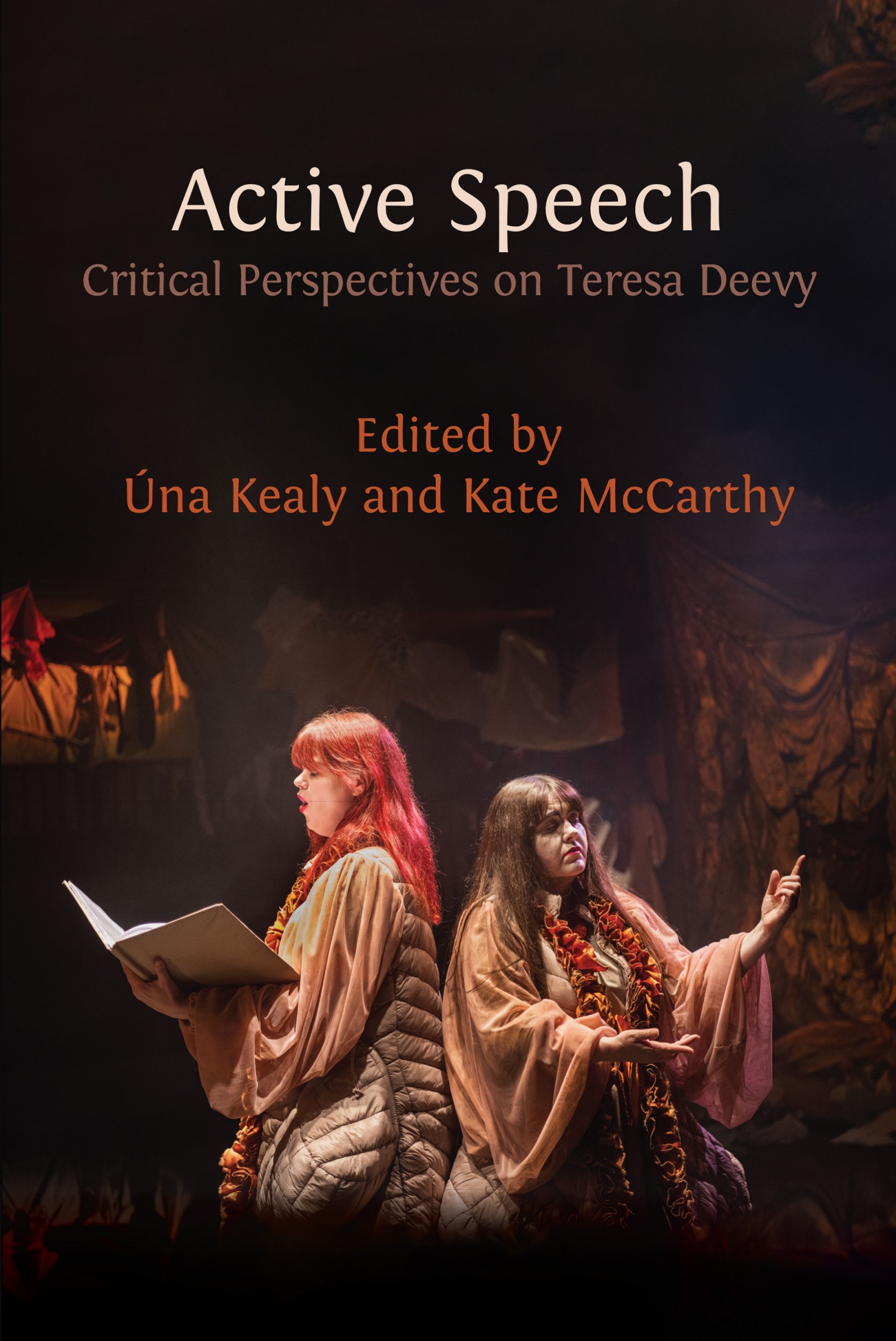
13. ‘You Can Feel the Change in the Air’: Reflecting on Talk Real Fine, Just Like a Lady, a Shapeshifting of Teresa Deevy’s The King of Spain’s Daughter
Amanda Coogan, Alvean Jones, and Lianne Quigley
©2025 Amanda Coogan et al., CC BY-NC 4.0 https://doi.org/10.11647/OBP.0432.13
This panel formed part of the Active Speech: Sharing Scholarship on Teresa Deevy conference and was recorded in December 2020.1 All three participants are members of the Deaf community with Amanda being a hearing CODA (Child of Deaf Adult(s)) whose first language is Irish Sign Language (ISL).2 A captioned and ISL translated recording of this panel discussion is available.3 In this conversation, Amanda Coogan, Lianne Quigley, and Alvean Jones discuss their ongoing collaboration and, in particular, their experiences engaging with Teresa Deevy’s life and work. As well as discussing their collaboration on Talk Real Fine, Just Like a Lady, they also explore their connections with Deevy’s life experiences.
Amanda Coogan (AC): My name is Amanda Coogan; I’m an artist specifically working in performance art. I have a long-standing relationship with the Dublin Theatre of the Deaf (DTD), working closely with Alvean Jones and Lianne Quigley.
Alvean Jones (AJ): As Amanda mentioned, she and I have a long-standing relationship, collaborating on many projects in performance art and various other theatre work. I’ve also been involved in many different theatres for a long time—in many aspects of theatre—working with Amanda and others.
Lianne Quigley (LQ): I’m an artist: I write plays, direct, and act. I’m involved in many areas of the theatre world, and I have worked with Amanda on various projects. My vision and ambition is to play in mainstream theatres to show that Deaf people are capable of being involved in all aspects of the arts.
AC: Lianne, can you explain when you first heard about Teresa Deevy?
LQ: It was at an evening workshop for theatremakers in Trinity College Dublin, during Disability Awareness Week.4 I went and heard of Teresa Deevy and that she was deaf; I couldn’t believe that I had never heard of her before then, and my interest was piqued. A few days later, brainstorming ideas for a new project with Amanda, I mentioned Teresa Deevy and we decided to ask DTD to help us research—to show everyone within the Deaf community that we do have d/Deaf artists. We didn’t know much about Teresa’s background, whether she was an ISL [Irish Sign Language] user, if she was profoundly deaf, or how she communicated with her family, but we wanted to celebrate this famous, deaf person who was recognised within the mainstream art world.
AC: Alvean, when did you first hear about Teresa Deevy?
AJ: I first heard about Deevy at the same time; it could have been the same event. It was a great match to my personal interests in Irish history. I then discovered the Teresa Deevy Archive in Maynooth University whilst there at a history conference.5
As we know, not all d/Deaf people are the same: we are all individuals and have an array of experiences, as do the hearing community. However, the one commonality we have is our experience of deafness: that’s the common ground. It doesn’t matter if you went to a school for the d/Deaf or to a mainstream school, if you were born d/Deaf or were deafened later in life; that unique ingredient, that lived experience, brings an awareness and understanding that hearing people just don’t have. Teresa Deevy had that lived experience of deafness and carried on regardless; that’s why I had such an interest in her work.
AC: So, Teresa Deevy was not a sign language user and lost her hearing? Is that correct?
AJ: Yes, that’s right, she was deafened.
AC: Did we read somewhere that her sister, Nell, acted as her interpreter? Would it be fair to say there was some translation going on from some kind of signed utterances, or what we would refer to as a home sign, or a way of communicating particular to Deevy and Nell?6

Fig. 13.1 Photographer unknown. (L-R) Nell and Teresa Deevy. © Courtesy of Jacqui Deevy. All rights reserved.
AJ: It could it have been that Nell was interpreting via lipspeaking, not necessarily sign language per se: there is a distinct difference.
LQ: Also, it’s important to remember that Deevy’s family would be familiar with her voice and understand her well enough to relay the messages—in the way that our families are familiar with our voice. Most d/Deaf people, as you say, have a similar experience in their own homes in that the family don’t have sign language, but the d/Deaf family member has a way of communicating, be that lipspeaking, gesture, or whatever way the family develop a system to communicate.7
AC: So a ‘family communication system’ rather than a ‘home sign system’. Rounding back to your points on Deevy the artist. You mention she has a beautiful interpretation [of the d/Deaf experience] expressed through her work. And could you read that, as a Deaf person, that her work captured her experiences, her life, her work, through the deaf experience or ‘deaf eyes’ if you will?
AJ: A d/Deaf lens.
AC: A d/Deaf lens. Yes. Was there a reason you picked the play The King of Spain’s Daughter to focus on?8
LQ: That was the first script that we had. We searched high and low and came across The King of Spain’s Daughter.
AC: You first heard about Teresa Deevy in 2014. Is that correct? Before the #WakingTheFeminists movement. So, as we began to consider our next project, we were specifically interested in Deevy as a deaf artist. Then the #WakingTheFeminists movement added an extra layer of interest. We were reclaiming a deaf artist and a woman playwright who had been sidelined within the story of Irish theatre. 9
If I remember rightly, we three began researching using our own different strengths. Alvean, your interest is d/Deaf history, you’re a Deaf historian and a Deaf artist and, Lianne, as you have a strong interest in how things are mainstreamed, will you explain your roles?
LQ: I’m very interested in bringing d/Deaf people into mainstream life and culture, but I want to take you back maybe ten years, or so, when I couldn’t find any d/Deaf artists. It became my mission almost [to find d/Deaf artist role models] and it was the shared mission of DTD and Alvean. We have the same philosophy in that we want to show the mainstream world that there is a variety of talent within the d/Deaf community. We decided to develop the work of d/Deaf artists and to make our productions completely ISL based, from the beginning to the end, and design them as accessible to d/Deaf and hearing audiences.
From the moment that audiences entered the Peacock Theatre [for Talk Real Fine, Just Like a Lady], the audience was guided to their seats by Deaf performers. The housekeeping and safety announcements were relayed as ISL videos in the cafe. Although Deevy may not have used sign language, we invited d/Deaf and hearing people to experience Deevy’s work brought to life via sign language. We demonstrated that, like us, she too had to face barriers in her lifetime. d/Deaf people can relate to this as they face barriers daily. We wanted to explore the challenges that Deevy faced as a deaf artist and how, despite this, she made significant work, and that we, as contemporary Deaf artists, were taking inspiration from her to make new work.
AJ: Yes, Teresa Deevy was an experienced and an accomplished playwright and she was deaf, but no one made much of this. We thought, ‘Hang on, this is a big deal!’ In the Deaf community, we think it’s a big deal that Deevy was deaf, and we wanted to recognise her as a deaf artist, a deaf playwright. Doing so is very important because such recognition has implications for contemporary society and politics.
AC: To return to our production. We believed that the 1937 Constitution’s inclusion of the phrase ‘The woman’s place is in the home’ had grave ramifications for Deevy.10 That was the starting point for us. So, at the beginning of the project, we sat down and went through the play, line by line, taking notes. Then we worked with DTD, forming a company with them to make a verbatim read-through of the play—translating it, line by line, into ISL. Then we began to look at the parallels between the lived experiences of those within our company and the sign language used by d/Deaf women in the 1930s, the time the play was written. Most d/Deaf women in Ireland were sent to St Mary’s School for Deaf Girls as boarders from a young age. Can you contextualise St Mary’s School and what happened there in the 1930s?
AJ: Prior to the main schools for the d/Deaf being set up in Ireland, there were schools for deaf people in Ireland. These schools were either Protestant or non-Catholic in ethos. The new institution, established in 1845, had ties to a deaf school, Le Bon Sauveur in Caen, northern France, as the Irish nuns received their training in the instruction of deaf children there. Upon their return to Ireland in August 1846, they opened their first school, St. Mary’s for Deaf Girls.11 For example this ‘V’ we use in ISL is the sign for Friday [finger spelt letter for V held upright brought across the chin bouncing from one side to the next]. This is directly influenced from French Sign Language and the French word for Friday.12 Hence, ISL has some similarities with old French Sign Language.
By the turn of the century, the 1901 census and 1911 census reveals that most deaf women in Ireland were single and institutionalised. At that time, before Ireland was partitioned, there were four educational institutions for deaf children, one in the North, the Claremont School, and two schools under the auspices of the Catholic Institution for the Deaf and Dumb in which the Dominican nuns looked after the education of deaf Catholic girls and the Christian Brothers looked after the education of deaf Catholic boys in Dublin.
By the 1930s, the situation hadn’t changed much but, a fact that many people don’t know, and which may come as a shock, is that different sign languages were used in the two Dublin schools and different sign language variations, male and female variations, developed in those two schools. Variation in signs remains in ISL, although there is more of an overlap now, but it’s important to know that Irish Catholic schools [for deaf people] were segregated. Men’s and women’s signs were separate and used among segregated communities. The signs developed were very distinct, for example, when you sign the days of the week the signs used today are mostly men’s signs, but women’s signs are different: there are sign variations.13
Another thing to consider is, because in Ireland there were two separated schools under the auspices of the one institution and two different languages: when deaf people became adults, the expectation was that women would change their signs and learn the male variations, which were regarded as superior. But, funnily enough, the sign for Friday is one example where women had a small victory: their variation for ‘Friday’ became more predominantly used in current ISL use. That’s one instance of women’s sign becoming dominant.
In Ireland in the 1930s, deaf men were not expected to learn their wives’ sign and when deaf people married, or got together in groups, they would use their own signs and so the men, sometimes, would not know what women were saying because they were using women’s signs. We realised that attitudes in the 1930s towards women [deaf and hearing] overlapped and we wanted to show that in our production.
AC: To put this in context, Barbara LeMaster, an American linguistic researcher visited Ireland in the 1980s to research women and men’s sign language in Ireland (she stayed with my family). She researched and recorded the different signs used between men and women at that time and made a stunning discovery. She described ISL as the starkest example of gendered language differences in the world.14 For us, as a company, that was very interesting as was the fact that women’s sign is dying out in ISL. Those signs were something we wanted to remember and so our production was full of women’s signs, isn’t that right?
AJ: Yes, that’s exactly it.
LQ: Yes, and religious signs, also. The linguistic research [into women’s signs] was carried out by you two and a number of others within the company. Also, just to let people know, our company was all women with the exception of one man who played the role of a comrade. Also, everyone in the company, with the exception of Amanda, myself, and Lorraine, were past pupils of St Mary’s School for Deaf Girls, right?
AC: Yes, almost everyone involved in the company had deep roots and connections with St Mary’s School for Deaf Girls, and part of what we wanted the production to do was to highlight the school’s hidden, but significant, position in Irish d/Deaf history and culture.
AJ: Just to fold back on the idea of hidden stories and to go back to social history again. There were different sign languages for men and women and also, at the same time, separate, deaf social clubs for men and women existed, and men and women were forbidden by the religious orders in charge to integrate in these clubs. There were, however, many other ways for men and women to meet up.
AC: So keeping the clubs separate was motivated by a type of eugenics so that deaf people would not marry and would not have more deaf children?
LQ: Something to note around women signs is that research also shows religious signs were influenced by women’s signs. Take the prayer, the Hail Mary, for example.15 ‘Hail Mary, full of grace’—these signs are women’s sign variations, not men’s. This influence is from the early 1900s, 20s, and 30s. In Deevy’s work we can see religious influence too; the religious [institutions] were the authority. You can see this in the deaf school, as well as the fact that deaf women’s lives had [a] strong religious influence.
AC: I think it would be interesting to talk about the theatre process and what it was. Firstly, we translated the play into ISL with our company [DTD]. Then we tried to find a way in, a way to claim the Deaf artist in the first place. Secondly, we wanted to show the similarities with our Deaf lived experience and to talk about feminism or the oppression of women. We wanted to talk about the 1937 [Irish] Constitution and how it oppressed women. To talk about how that oppression was paralleled with the oppression experienced by deaf women of that time. So we looked back at old, deaf, women’s sign language as a first place to investigate. As an exercise, we translated the poem—The Drover by Padraic Colum—which is where the title of the play The King of Spain’s Daughter comes from.16 We translated the poem into pure women’s signs and then we took it from there.

Fig. 13.2 Patrick Redmond, production image from Talk Real Fine, Just Like a Lady (2017), created by Dublin Theatre of the Deaf in collaboration with Amanda Coogan, produced by Live Collision, Peacock Theatre, Amharclann na Mainistreach. © Patrick Redmond. All rights reserved.
AC: We projected images of our translation of The Drover and, during the production, the video projection [which was projected onto a cyclorama situated upstage] was un-writing and re-writing Deevy’s text. We were re-writing or appropriating the text. This scene was the first way we got into the play. It was perfect for us to make the leaps we needed with the text. And, as Lianne mentioned, Deevy’s play begins with two men on a country road, looking around with their hands over their eyes, remember?
LQ: Yes.
AC: Then it became the sign for Ireland.
LQ: Yes—our sign for searching morphed into the sign for Ireland. 17
AC: Then we began with the ‘Hail Mary’, uttered using women’s signs. We carried on the prayer until the word ‘womb’ comes in. Then we had an awakening—an abrupt realisation—a realisation of our bodies, women’s bodies, and of the place of women, and [we] moved our story from there. Right?
LQ and AJ: Yes, that’s right.
AC: It was like this sign we used for the poem, a splash or a small explosion, a series of splashes.
AJ: Like mud pulling you down, like your feet getting sucked down, stuck in mud.
LQ: The squelching sound of the poem we were looking to portray.
AC: Squelching…
AJ: Yes, yes. This represented the drudgery of daily life. Repeating itself, over and over.
AC: Before we get into that, maybe we should go back and explain why we decided this production should be an immersive experience. Why, for example, we had three Mrs Marks, five Annies and, outside the auditorium, we had all the comrades.

Fig. 13.3 Patrick Redmond, production image from Talk Real Fine, Just Like a Lady (2017), created by Dublin Theatre of the Deaf in collaboration with Amanda Coogan, produced by Live Collision, Peacock Theatre, Amharclann na Mainistreach. © Patrick Redmond. All rights reserved.
AC: As you came down the stairs of the Peacock Theatre, firstly, you encountered the health and safety announcement delivered in ISL on video. It was a performative video—with the content of the safety announcement there—but in the background, an exuberant march for ISL recognition was [also] going on. To enter the auditorium then, the audience were guided by ‘comrades’ who helped them to physically navigate getting in under the cover—Mrs Marks’ skirt—before putting [their] heads through the fabric. This [immersive quality and the fact that the audience was under the skirts of the Mrs Marks characters] was really important to us because it symbolised Mrs Marks’ dress spreading outwards in pervasive oppression. The sign for oppression in ISL [clenched fist in one hand—outstretched palm in the opposite hand pressing down on the fist] is beautiful and perfect: it shows that oppression.
AJ: People expect the play to start when you enter the auditorium, but really that wasn’t the case. It had already started when you arrived at the bottom of the stairs into the Peacock. That’s really where the experience started. The comrades were placed around the lobby, just signing between each other and the [hearing members of the] audience were a bit taken aback by the experience. They had that disjointed feeling. They experienced the comrades signing to them, without voices, as they ushered them into the auditorium. Like that, the [hearing members of the] audience were the outsiders in this environment. d/Deaf people were the majority, and the minority were non-d/Deaf. Mrs Marks was there in the auditorium, towering above us, and the impact of that could be seen as the audience put their heads though the fabric. Only the audience’s heads were allowed above Mrs Marks’ skirt: that gave it [the auditorium] a really stark feeling.

Fig. 13.4 Patrick Redmond, production image from Talk Real Fine, Just Like a Lady (2017), created by Dublin Theatre of the Deaf in collaboration with Amanda Coogan, produced by Live Collision, Peacock Theatre, Amharclann na Mainistreach, featuring Amanda Coogan as Annie. © Patrick Redmond. All rights reserved.
AC: And they were all beside each other—it was a close encounter for audience and performers.
LQ: We have to remember the political impact was also what we wanted to achieve. Remember the time; the campaign for ISL recognition was in full swing. We wanted to show that ISL is part of the Deaf World and is the centrality of Deaf Communication. We wanted to show the subtlety of it, to have that quiet impact on the audience. Not a wild show, but quietly directing the audience in and having them taken aback with that up-close and personal experience. The fact that they went in under the cover and had to poke their heads through holes to access the play—to look around over this fabric at the Mrs Marks characters towering above—and with the comrades greeting everyone from the get-go, the audience were immersed in a signing world. We directed the comrades not to attempt to speak or use their voice with the audience—only to use sign language. That silence had impact; we wanted ISL recognition—now!18

Fig. 13.5 Michael O’Meara, front cover of programme for Talk Real Fine, Just Like a Lady, created by Dublin Theatre of the Deaf in collaboration with Amanda Coogan, produced by Live Collision, Peacock Theatre, Amharclann na Mainistreach, 2017. © Michael O’Meara. All rights reserved.
AC: To explain: firstly, we had Mrs Marks as the authority figure we looked up at. She represented ‘the oppressor’. We were very much looking at oppression. Throughout the development of the piece, we talked about double oppression, even triple oppression. Lianne, you were involved in the campaign for the recognition of ISL. Could you explain how you were one of the leaders in the campaign and how our play was on in the theatre throughout National ISL Awareness Week of September 2017 while the [ISL] campaign was at its height?19

Fig. 13.6 Patrick Redmond, production image from Talk Real Fine, Just Like a Lady (2017), created by Dublin Theatre of the Deaf in collaboration with Amanda Coogan, produced by Live Collision, Peacock Theatre, Amharclann na Mainistreach. © Patrick Redmond. All rights reserved.
LQ: Yes, our production took place just shy of when—a few months before—ISL was legally recognised, about three months prior [to the legal recognition], in fact. The campaign was really a very important thing for me. It definitely influenced our take on the play and how we aimed to embed ISL within it. We wanted to show that ISL was a living, thriving language and what it [ISL] means to the Deaf community—to show what was hidden to everyone, to show how ISL is a national language. And to be on stage at the Peacock, the National Theatre, was very important. The Abbey has shown great leadership in recognising ISL and providing access to their work [i.e. Abbey productions] for so long—more than twenty years. It [the Abbey] has been very inclusive of the Deaf community. It [that inclusive relationship] started slowly and Deaf access built up—we were even invited to be involved in the #WakingTheFeminists movement as well.
AC: Also the Abbey’s acceptance of ISL was really a cultural acceptance of ISL—the cultural and social aspects of ISL, not a medical or paternalism view of the language. It was quite a powerful acceptance that our beautiful language—ISL—is part of Irish culture. That’s what it meant for our National Theatre to accept ISL.
LQ and AJ: Yes, Yes.
AC: It was very powerful to present our work in the Peacock. Alvean, could you explain about the double or triple oppression?
AJ: Well, we need to talk about different levels of oppression: [and how] people, not just d/Deaf people, not just women, not just LGBT, not just Travellers, everyone can experience it. Firstly, we can talk about Irish people being oppressed: women have experienced oppression—Irish women have that double oppression. So, Irish d/Deaf women have another layer of oppression added to that.
AC: This is the triple oppression you are talking about?
AJ: It’s a triple oppression.
AC: We read in Deevy’s script, instances of women’s oppression of other women. The young Annie, for example, by Mrs Marks. She was authoritative and oppressive. We really looked at that symbolically and paralleled this [experience of oppression] with with our company members’ own experience as young, d/Deaf children whose schooling focused on [vocalised] speech acquisition. Our production, Talk Real Fine, Just Like a Lady, is exactly about that damaging, or abusive experience, [that members of] the company had: of being taught how to speak, how to use their voices, [of teachers of oralism] dismissing sign language; [of] being told to ‘talk fine’, to ‘speak up’, to ‘use their voice’.

Fig. 13.7 Patrick Redmond, ‘Talk real fine’, production image from Talk Real Fine, Just Like a Lady (2017), created by Dublin Theatre of the Deaf in collaboration with Amanda Coogan, produced by Live Collision, Peacock Theatre, Amharclann na Mainistreach, featuring Ann O’Neill as Mrs Marks. © Patrick Redmond. All rights reserved.
AJ: ‘Use your voice’. That’s why people look and talk about ‘the deaf voice’. There is no getting away from that. d/Deaf people usually have a d/Deaf tone, a d/Deaf voice—that’s there. So in classes where teaching speech happened, to make it work, one student was brought out of the class for one-to-one sessions, most of the time. This was at primary level where a lot of time was spent focusing on [vocalising] speech and how to pronounce words correctly. Lianne, do you agree?
LQ: Yes.
AJ: This didn’t happen at second level; it was only primary. The teachers would say, ‘use your voice, you have a lovely voice use it’. That gave people a false hope and the false idea that they could speak well, that they had a lovely voice and should use it to speak up—that repetitive [phrase]—‘use your voice: use it’ [—was common]. Then when you left school and met people and started speaking…of course, most [hearing] people are not used to the d/Deaf voice, that d/Deaf tone, and they were taken aback. They asked us to repeat ourselves, not understanding [our d/Deaf voices]. Very few people could understand what we were saying; that knocks the confidence of a d/Deaf speaker—that realisation, realising it’s not such a beautiful voice.
LQ: Yeah, talking about this ‘lovely speech’ mantra in deaf education, it was like a competition amongst us—a student competition. To see who could really speak, judging our speech, judging whether it was ‘okay’, or ‘rubbish’. It was like a show. The teacher would dismiss some students and applaud others. Those with ‘lovely speech’ were applauded and those without—their confidence was knocked. It was like, as we mentioned, [an] oppression. This time deaf [people] oppressing other deaf [people]. It was the system applauding lovely speech and dismissing those without it. This system produced double, or even triple, oppression.
AJ: Just to add to what Lianne said about the school system. Maybe people are not aware of this, but deaf children were separated in school into different groups. They [educators within deaf educational establishments] assessed the children on their ability to speak—if they could speak, or not. Depending on how they sounded [speaking orally], they were then separated into one of three groups. The first group for ‘hard of hearing’, or those that could speak well. Profoundly deaf children were in this group, so it was not about hearing ability—it was only based on speech articulation. The second group was for the ‘profoundly deaf’ students; these students were all taught through this oral method.20 The third group were known as ‘oral failures’—those who simply could not succeed through oral/spoken English, or had additional needs.21 These three groups were kept completely separate at primary school level. Then, in my time at secondary school, two groups were at war! The labels and stigma of ‘you’re partially deaf’, or ‘you’re profoundly deaf’, were the taunts of our war. These labels were thrown about. But then, with the third group—the signers—we never saw them in school. They were completely separated from us. We had different social times [break times].22 That is oppression, oppression, oppression!

Fig. 13.8 Patrick Redmond, production image from Talk Real Fine, Just Like a Lady (2017), created by Dublin Theatre of the Deaf in collaboration with Amanda Coogan, produced by Live Collision, Peacock Theatre, Amharclann na Mainistreach. © Patrick Redmond. All rights reserved.
AC: It was a very, very poisonous system—shockingly damaging for the community. Can you remember in Deevy’s script where Annie dreamed about the red dress and her fantasies—wanting to become the King of Spain’s daughter? We, in parallel, had one of our Annies wanting to speak, to sing even, that great scene [in Talk Real Fine, Just Like a Lady] where she uses her deaf voice alongside some opera singing and, after the song is finished, she continues in an ecstatic, fantastical reverie. That was our moment. We had one of our Annies do the dreaming of having a beautiful voice—as she was being taught and schooled to believe was the best thing [for her] to have. We also gave a sexual frisson to her reverie: on the screen behind her, we had a naked swimmer floating through the screen—a symbol of freedom—sexual freedom—freedom to express herself. When we made this scene in the rehearsal room it was very strong, very potent, and very difficult for the company, extremely difficult. We had a lot of tears. It really touched the company emotionally. We hit on a heart-wrenching memory for many of the Dublin Theatre of the Deaf company [members] when we bashed our Annie and dragged her out of her reverie. We bashed her with a particularly female symbol—a hairbrush—waking her out of her dream. The oppression of student against student—that war between the two classes of deaf students in St Mary’s School for Deaf Girls—they were very upsetting memories and very real, and affected us all deeply. It really touched the taboo or difficult emotions; it was pulling at heartstrings—especially when we were lifting her [Annie] up and then bashing her down with the hairbrushes.
AC: Showing that oppression and how it was—that sense of being at war for the children of St Mary’s, for Deaf girls. I remember [that scene] well, it was a visceral feeling of emotions; upsetting emotions that were very real and affected us deeply.
LQ: Talking about that emotion: I remember the feelings around the brush scene and how at school we were made to feel that competitiveness against each other—to talk well and use our voices. Then to have those [hopes of success] dashed and taken away from us. When we were using the brushes in the play—smacking down with the hairbrush—it just brought me back to those difficult memories. That pushing down of us, of our Deafness, of our community members. Pulling them down. And yes, you are right, it was very emotional. We had to rehearse and repeat that scene quite a bit to help us get through it—to desensitise ourselves to the raw emotions of those difficult memories—all of us, actors and the comrades, as well. It was very powerful. At the same time, it is the truth that had to be shown. It is part of our hidden history.
AC: So, when as d/Deaf children you were attempting to speak, these authoritative figures were the oppressors and, within your school experience, you felt a negative competitiveness between classes. It was quite brave to allow our production to speak about that and show it. And I think hearing people were affected emotionally by it, too.
AJ: It was like our oppression was accepted and projected onto the audience—that was the thing.
AC: That is an experience [that] many oppressed minority communities have had. But then, we made a conscious decision to come together—that community togetherness—to make a positive impact. Hence the hairbrush, and the choice of white-coloured hairbrushes was carefully chosen because we could inflect it. We turned these weaponised hairbrushes around to show a blank rectangle. In that turning, they become something different—a blank protest placard, maybe. We can’t speak to how this will be read in the future, but now, we are seeing the ISL campaign as a coming together of the community. Really it was showing how the recognition of ISL was, in that moment, a coming together of a community, in some way? Right? Am I wrong, or right?
AJ: You’re right.
AC: Before there was the division: that was the oral system, a division between those that could talk, and those that could not; those who could belong in the hearing world, and those that couldn’t. Sign language, you see, is for everyone and is accessible for everyone. Everyone is on the same side.
AJ: We see something similar in Deevy’s work. Annie and Mrs Marks have that same antagonism. Mrs Marks always wanted that societal approval. Annie herself wasn’t bothered—she wanted independence. That’s where the antagonism was embedded. You can see it in all walks of life, these differences, these variations. So that brought us to the end of the production and the showing of the recognition of ISL. The [ISL] campaign was joyous, celebratory, a joy in the struggle, a joy in that collective voice, standing together, and being recognised.
LQ: The ISL celebrations brought together different people: it didn’t matter if you read lips, or you used ISL, in all our diversity it still brought everyone together. We are all different, but united in one thing that we all wanted to achieve: one aim for every d/Deaf person. ISL is one thing, but the coming together of the Deaf community was our focus. When we stood in the Peacock and turned those hairbrushes around—from weapon of oppression to campaigning object—this represented the [Deaf] community coming together in the campaign of ISL recognition. We showed the joy and the emotions, the highs and lows of the campaign. We came together as one—it was very moving.
LQ: Our production began with the three of us here, researching and developing this piece. But, that final scene, of all of us just standing still, showing the back of our hairbrushes as campaigning placards, which we had just used to bash our friend—that was very powerful. Just standing, holding up our hairbrush/placards and standing there, in witness. It felt like we had come through a journey. Through oppression and continuous struggle, we stood still and held that symbol of resistance high. For me, I felt like a statue that had a dream [of equality] and that dream was moving closer. Remember, this production was a few months before the legal recognition of ISL—the realisation of that dream. I remember the video behind us in the Peacock, of us all frolicking around joyously making our ISL recognition march, and seeing the audience stunned and with tears in their eyes watching that final scene. We stood there for—I don’t know—ten minutes, holding up our symbols of resistance and smiling. It was a very emotional end. We stood there with pride.
AC: I remember we decided in rehearsals how we would stop the aggression with the brushes—that Alvean would stand out from the crowd, hold up her hand and say, ‘STOP—NO MORE’. She stopped us and then we turned around and turned this weapon into something positive. Then we just stood still, as Lianne mentioned, full of pride and full of passion. Letting all the fun and joy happen in the projection behind us. We just stood there like witnesses. It was emotional.
AJ: It was like this was a perfect example of that idea of pleasing society and accepting the social norms. But like Lianne described, society is just a construct. Who changes society? That is for the individuals within it. Remember our five Annies? One of our Annies was a singer. The others ganged up on her, attacking her, until another Annie stood up and said, ‘STOP’. That’s where change happens. When we all agree, mutual consensus. Together, we agree to change society, that’s what it is, that’s it.
AC: It’s the power of standing together for what’s right.
LQ: And when we produced this work, we were reading the oppression of women. Deevy wanted to shine a light on women, on their lives, and how they were being oppressed. And the fact that Deevy’s works famously fell out of favour in the new, conservative Ireland post-Constitution. Her work was put aside, forgotten. I found out about her in 2014, and it has been amazing to watch the re-discovery of her work.
AJ: Definitely, Lianne. People are now recognising her work. Even ten years ago, I had no idea who she was and now, there is much more awareness. When you look back at the 30s, when there were few women writers, she was there telling the stories of women’s oppression, religious oppression. She was against censorship. She was very outspoken. If you look at the 1916 Proclamation and the words it uses.23 It says men and women are equal. Then in the 1937 Constitution: oh, my God! Each line had to be passed by the Pope in the Vatican!
AC: It [the 1937 Constitution] says: ‘In particular, the State recognises that by her life within the home, woman gives to the State a support without which the common good cannot be achieved’.24
AJ: Now, talking about the 1937 Constitution, in my opinion, Teresa Deevy was both a woman of her time and a woman ahead of her time.25
LQ and AJ: Yes, yes, yes.
AJ: She had those two things in one person—that’s my view of her.
LQ: To refer back to what Alvean mentioned about the 1916 Proclamation, I have a passion for Irish history. Post-1916, we had the War of Independence, which I read as a war for equality. Things changed. Then, with independence, there was more religious control in the country and those conservative changes were relatively rapid and widespread. That alone was difficult for those women who were active in the war; they had to obey the new structures and new governments. And then, the Constitution in 1937. I imagine those women involved in 1916 were not happy at all about that. And again, you have to remember the religious control here.
AC: And we must remember d/Deaf and any ‘othered’ people were thrown into institutions. We know about the institutions and the stories about the institutional lives now. It’s important to keep remembering and telling those stories.26
AC: Lianne, would you tell us more about the importance of the lived experience?
LQ: Yes, for the last few years people have been researching Teresa Deevy’s work, and I think it’s very important to recognise her lived experience. She’s a deaf or deafened person, so, for example, as she was losing her hearing, she was traveling around London, the UK, London in particular—she attended various theatres. She became fascinated with the theatre and writing plays. She used to try to access the theatre through lip-reading. Imagine the barriers that she faced? We have to imagine her lived experience as a deaf person. She missed out on so much because she couldn’t hear. That was my first point. My second point is how did her life experience influence her writing? I passionately believe the barriers she faced on a daily basis must have influenced her work.
AJ: I would love to do more research. I’d like to add that there is another example of a deaf writer who had a similar experience: a deaf man, in this case; his deafness strongly influenced his writing. His name was Jonathan Swift and, whenever I tell people that he was deafened, there’s always an element of shocked reaction. And he, like Deevy, was deafened, so maybe there are some parallels there between the two. I think, for him, he was deafened by Ménière’s [disease], that is what caused his hearing loss.27 His work is heavily influenced by his time spent people watching, which helped influence his satires. Similar to Deevy, I suppose—we can see some comparisons there. I know it would need a lot more research on the subject, but I think there may be some parallels between Swift’s writing as a deafened author and Deevy as a deafened author. She wrote about society and the role of women in society. We don’t exactly know what her interests were at the time. Maybe she observed what was happening in society from her perspective. Sometimes, being d/Deaf or deafened, the writer can bring a completely different perspective to a hearing writer’s perspective on the world and, hence, that may influence their writings. I mean there are other famous d/Deaf people, but for the moment we’re just focusing on these two.
LQ: I read something about Deevy and how she was very close with her sister. Apparently, she went everywhere with her—to meetings, the theatre, etc. Her sister was always there and maybe acted like an interpreter for her. Whether she was lipspeaking, or they had their own signing system, I’m not sure. But apparently, later on, people used to say she became very quiet after her sister had passed. They said she was lost without her sister.28
AJ: She began to isolate herself more from the world, that’s exactly the kind of experience d/Deaf people have that others can’t relate to. Yes, especially if you’re d/Deaf or deafened, it isn’t relevant in general society. People can look at a Deaf person and say that they are very quiet but then, when they see the same person in the company of Deaf people, they’re shocked to see a different personality. While speaking their first language, they are more outgoing because it is more inclusive for them, and they know what is being said. Maybe they seemed quiet from an outsider’s perspective; maybe Deevy was lost and preferred to be by herself because she didn’t know what people were saying around her. Maybe she just preferred to be alone on a bicycle—you know, she was a famous figure going around on her bicycle in the town.29
AJ: Lianne, do you want to talk more about the emotional aspect of the process of making Talk Real Fine, Just Like a Lady?
LQ: The emotional aspects of our play in the Abbey Theatre, do you mean? Yeah, it was interesting. Prior to our discussions and the brainstorming, we were really proud of this project. We were talking about how it was so emotional and powerful, the research process—the whole journey in fact. You have to remember at the time, back in 2017, we were tirelessly campaigning for ISL recognition. I think the emotion you see throughout the play, especially the triumph at the end, is both partly acting, but also an innate connection with Teresa Deevy and her life experience. There’s such a strong connection that just couldn’t be denied. Ten years prior to this, I had never even heard of Teresa Deevy, but there was just an innate kinship that gave me the hunger and the drive to continue the research and uncover as much as possible about her life experience as a deafened woman.
AC: Can we just put this in context? So, ISL has just been enacted, literally days prior to this recording here today.30 So, at the moment, we are sitting in a completely different world to that of years gone by, before the legislation arrived. Everything now is in a different context. Now, I know it’s not perfect and nothing is going to change overnight, but this was huge for us, especially for me. From my personal experience, it is my home language. I was always told by my mother, when I was younger, ‘Don’t use sign language on the street. It’s our secret, it’s not for on the street, we only use sign language at home’. The difference is that, now, ISL is recognised in the law of this country. I think by the end of our production of Talk Real Fine, when we stood up there, proud, even though the Act still had not been passed, we were still in the middle of the campaign, we knew in our hearts that there was a lot at stake.
LQ: Absolutely, you’re right, and when you describe your experience growing up and being told not to use ISL in public, that’s completely different from my experience. I grew up in a family as the only d/Deaf person. My family were all hearing, my family never signed, they never signed with me because they took their advice from the so-called ‘experts’ who told them that sign language was bad. I think, when we stood there proud, we were thinking of the younger generation: campaigning for their future, so they will have it better than we had, and the girls of my time. I was lucky, in a sense: my parents accepted and encouraged my language choice. While my father never really learned full sign language, some of the family members would use a mixture of a few signs they learned and gesture. I learned to sign very early, but the difference between then and now is, if a child is born deaf into a hearing family, or the parents are Deaf, the opportunities they have now are amazing! The recognition of ISL as a language will make a huge difference in comparison to my time; back then, it was taboo. So, I suppose, I never really comprehended the enormity of it, through the years of the campaign, until it became a reality. This was no mean feat! Like you said, it won’t be perfect, and will evolve over time, but you can feel the change in the air. I don’t know if you saw, just there on the 23rd of December—the day the law was enacted—on that morning, the Minister for Children, Equality, Disability, and Integration and Youth stood up and addressed the public using ISL, along with Senator Mark Daly.31 That was quite something to see. I know it took effort and, five years ago, I probably would have criticised their efforts, but they have to be commended. No one asked, or forced them, to learn sign language. They did it out of their own interest. This really gives me hope for a better, more inclusive future. I know there is a lot of interest in sign language, at the moment, and I do hope more and more people will learn sign language and people will see the bigger picture that there is a future with less blurred lines.
Bibliography
Bank, Jonathan, John P. Harrington, and Christopher Morash (eds), Teresa Deevy Reclaimed, 2 vols (New York: Mint Theater, 2011 and 2017)
Centre for Integration and Improvement of Journalism, The Diversity Style Guide (2024), https://www.diversitystyleguide.com/glossary/deaf-deaf/
Colum, Padraic, Wild Earth and Other Poems (New York: Henry Holt, 1916), https://archive.org/details/wildearthotherpo00colu/page/n3/mode/2up
Commission to Inquire into Child Abuse, Commission to Inquire into Child Abuse Report, 6 vols (Dublin: Stationery Office, 2009), https://childabusecommission.ie/?page=241
Cheasty, James, ‘The Curtain Rises’, Irish Farmers’ Journal, 6 June 1964, p. 28
Deevy, Teresa, ‘The King of Spain’s Daughter’, in Irish Women Dramatists 1908–2021, ed. by Eileen Kearney and Charlotte Headrick (New York: Syracuse University, 2014), pp. 44–58
Donohue, Brenda, Ciara O’Dowd, Tanya Dean, Ciara Murphy, Kathleen Cawley, and Kate Harris (eds), Gender Counts: An Analysis of Gender in Irish Theatre 2006–2015 (Belfast: Ulster University, 2017), https://pure.ulster.ac.uk/ws/portalfiles/portal/11631340/Gender_Counts_WakingTheFeminists_2017.pdf
Dunne, Seán, ‘Rediscovering Teresa Deevy’, Cork Examiner, 20 March 1984, p. 10
Heffernan, Georgina, and Elizabeth Nixon, ‘Experiences of Hearing Children of Deaf Parents in Ireland’, The Journal of Deaf Studies and Deaf Education, 28.4 (2023), 399–407, https://doi.org/10.1093/deafed/enad018
Irish Deaf Society, Irish Sign Language (ISL) Awareness Week, 16th–24th September 2017, http://dublindiocese.ie/wp-content/uploads/2017/09/ISL-Awareness-Week-2017-Campaign-Messages.pdf
Irish Statute Book, Irish Sign Language Act 2017, https://www.irishstatutebook.ie/eli/2017/act/40/enacted/en/print#sec3
Kealy, Úna, and Kate McCarthy, ‘Shape Shifting the Silence: An Analysis of Talk Real Fine, Just Like a Lady (2017) by Amanda Coogan in Collaboration with Dublin Theatre of the Deaf, an Appropriation of Teresa Deevy’s The King of Spain’s Daughter (1935)’, in The Golden Thread: Irish Women Playwrights, 1716–2016, 2 vols, ed. by David Clare, Fiona McDonagh, and Justine Nakase (Liverpool: Liverpool University Press, 2021), I, 197–210, https://doi.org/10.3828/liverpool/9781800859463.003.0015, https://www.liverpooluniversitypress.co.uk/pb-assets/OA%20chapters/Una%20Kealy%20and%20Kate%20McCarthy%20chapter-1710157142.pdf
Keogh, Claire, #WakingTheFeminists and the Data-Driven Revolution in Irish Theatre (Cambridge: Cambridge University Press, 2025), https://doi.org/10.1017/9781009523066
LeMaster, Barbara, ‘Language Contraction, Revitalization, and Irish Women’, Journal of Linguistic Anthropology, 16.2 (2006), 211–228, https://doi.org/10.1525/jlin.2006.16.2.211
LeMaster, Barbara, ‘School Language and Shifts in Irish Identity’, in Many Ways to Be Deaf: International Variation in Deaf Communities, ed. by Leila Monaghan, Constanze Schmaling, Karen Nakamura, and Graham H. Turner (Washington, DC: Gallaudet University Press, 2003), pp. 153–172
McGettrick, Claire, Katherine O’Donnell, Maeve O’Rourke, James M. Smith, and Mari Steed (eds), Ireland and the Magdalene Laundries: A Campaign for Justice (London: I.B. Tauris/Bloomsbury, 2021), https://doi.org/10.5040/9780755617524
Murphy, Fiona, The Shape of Sound (Melbourne: Text Publishing Company, 2021)
National Centre for Disability and Journalism, Arizona State University, Disability Language Guide (2021), https://ncdj.org/wp-content/uploads/2021/08/NCDJ-STYLE-GUIDE-EDIT-2021-SILVERMAN.pdf
O’Brien, Susan, ‘The Blessed Virgin Mary’, in The Oxford History of British and Irish Catholicism, vol. IV: Building Identity, 1830–1913, ed. by Carmen M. Mangion and Susan O’Brien (Oxford: Oxford University Press, 2023), pp. 154–172, https://doi.org/10.1093/oso/9780198848196.003.0009
Rose, Heath, and John Bosco Conama, ‘Linguistic Imperialism: Still a Valid Construct in Relation to Language Policy for Irish Sign Language’, Language Policy, 17 (2018), 385–404, https://doi.org/10.1007/s10993-017-9446-2
Saunders, Helen, ‘Growing Up Deaf in Ireland’ (unpublished M. Phil thesis, Trinity College Dublin, 1997)
Smith, James M., Ireland’s Magdalen Laundries and the Nation’s Architecture of Containment (Notre Dame, IN: University of Notre Dame Press, 2007)
Stiles, H. Dominic W., ‘“Brandy for giddiness, 2s”—Jonathan Swift’s Meniere’s Disease [sic]’, UCL Ear Institute & Action on Hearing Loss Libraries, University College London, 13 April 2018, https://blogs.ucl.ac.uk/library-rnid/2018/04/13/brandy-for-giddiness-2s-jonathan-swifts-menieres-disease/
Tillingshurst, Edward S., ‘What is Failure in Oral Instruction?’, American Annals of the Deaf, 53.4 (1908), 308–322
1 Funded by South East Technological University (then WIT), Maynooth University, and Waterford Libraries, the conference took place online from 12–19 February 2021.
2 Georgina Heffernan and Elizabeth Nixon define CODAs as hearing children of one or two Deaf parents in ‘Experiences of Hearing Children of Deaf Parents in Ireland’, The Journal of Deaf Studies and Deaf Education, 28.4 (2023), 399–407. Fiona Murphy explains that: ‘Identity is a fluid concept and a personal choice. Lowercase deaf refers to deafness as a medical condition. It does not indicate the degree of hearing loss an individual may have. Some people with hearing loss may prefer to use the term “hard of hearing”. Uppercase Deaf refers to people who identify as culturally Deaf and may use sign language. Given the ongoing suppression of sign-language education, not all Deaf people are fluent signers or even have access to the Deaf community. Again, this word does not indicate the degree of hearing loss an individual may have’. See Fiona Murphy, The Shape of Sound (Melbourne: Text Publishing Company, 2021), n.p. Thus, our capitalising of the word ‘Deaf’ here recognises Deafness as a social category and Deaf people as a group who share a particular history and culture. In line with Dublin Theatre of the Deaf, the Irish Deaf Society, the Irish Deaf Youth Association, the Centre for Deaf Studies, Trinity College Dublin, and researchers in the field, we capitalise the letter D in the word Deaf, when appropriate, to signal accord with the positive values within the Deaf community and Deaf culture. We use a lowercase d when referring to audiological status. When we determine that the reference is to both audiological status and Deaf culture, we use the term d/Deaf. For more on d/Deaf, see the entry on ‘Deaf, deaf’, in the Centre for Integration and Improvement of Journalism, The Diversity Style Guide (2024), and the entry for ‘Deaf’ in The National Centre for Disability and Journalism, Arizona State University, Disability Language Guide (2021)
3 Practitioners’ Panel: Talk Real Fine, Just Like a Lady, online video recording, YouTube, 12 February 2021, https://www.youtube.com/watch?v=EIRLkX_95R8&t=35s. In reshaping a live, online conversation as prose, some parts of the discussion herein were edited and adapted from this original conversation.
4 Lecture Series 2014–15: Disability & Literature, Trinity Long Room Hub Arts & Humanities Research Institute.
5 The Russell Library in Maynooth University, National University of Ireland, Maynooth houses the physical archive of Teresa Deevy. Some documents held by the Russell Library, Maynooth can be accessed online via a Digital Repository of Ireland website page entitled ‘The Teresa Deevy Archive’. Digital Repository of Ireland (DRI), The Teresa Deevy Archive, https://doi.org/10.7486/DRI.95944b38t
6 Seán Dunne notes that ‘with Nell acting as her ears, she [Deevy] kept up an interest in every detail of theatrical and cultural life in Dublin. When people spoke in ways that were too difficult for her to lip-read, Nell interpreted for her’. See Seán Dunne, ‘Rediscovering Teresa Deevy’, Cork Examiner, 20 March 1984, p. 10.
7 Dunne records that, as Deevy explained to Kyle Deevy, her nephew, she and Nell ‘had perfected their ability to talk under all conditions’ (ibid.). Deevy was deafened in early adulthood. In relation to her ability to verbally converse with hearing people, her friend James Cheasty, recalling a car journey he took with her and Nell, describes how his replies to Deevy’s spoken conversation ‘were transmitted to her by Nell whom she was able to lip-read. Nell was really Teresa’s ears’ (James Cheasty, ‘The Curtain Rises’, Irish Farmers’ Journal, 6 June 1964, p. 28).
8 Teresa Deevy, ‘The King of Spain’s Daughter’, in Irish Women Dramatists 1908–2021, ed. by Eileen Kearney and Charlotte Headrick (New York: Syracuse University, 2014), pp. 44–58.
9 From November 2015 to November 2016 #WakingTheFeminists functioned as a grassroots movement and campaign that called for equality for women in the Irish Theatre sector. #WakingTheFeminists commissioned a study entitled Gender Counts: An Analysis of Gender in Irish Theatre 2006–2015, ed. by Brenda Donohue, Ciara O’Dowd, Tanya Dean, Ciara Murphy, Kathleen Cawley, and Kate Harris (Belfast: Ulster University, 2017). The study demonstrated the underrepresentation of people who identified as women and men in key roles across the sector. The report also analysed the relationship between public funding and representation in ten organisations funded by The Arts Council of Ireland (An Chomhairle Ealaíon); Claire Keogh, #WakingTheFeminists and the Data-Driven Revolution in Irish Theatre (Cambridge: Cambridge University Press, 2025), http://doi.org/10.1017/9781009523066
10 Bunreacht na hÉireann (Constitution of Ireland) was ratified on 29 December 1937. Government of Ireland, Constitution of Ireland, January 2020.
11 The first public school for deaf children in Ireland, the Claremont School for the Deaf and Dumb, was established in Glasnevin in 1816 by Charles Orpen and was Church of Ireland in ethos. The Catholic Institution for the Deaf and Dumb (later renamed The Catholic Institution for the Deaf, then the Catholic Institute for Deaf People, and now known as Reach Deaf Services) was founded in 1845. In January 1846, the Catholic Institution for the Deaf and Dumb sent two girls and a group of nuns over to Le Bon Sauveur for eight months so that the Irish nuns could learn how to teach deaf children when they returned to Ireland. While the two girls were in France, they picked up old LSF, (French Sign Language). Upon the group’s return to Ireland St Mary’s School for Deaf Girls was established and opened in August 1846 (Commission to Inquire into Child Abuse, ‘St Mary’s School for Deaf Girls, Cabra, Commission to Inquire into Child Abuse Report, 2.15’, in Commission to Inquire into Child Abuse Report, 6 vols (Dublin: Stationery Office, 2009), II, 551–556). St Joseph’s for Deaf Boys opened in 1856 and the school was relocated and given over to be managed by the Christian Brothers in 1857. (‘St Joseph’s School for Deaf Boys, Cabra (‘Cabra’), 1857–1999’, in ibid., I, 555–580). The Mary Immaculate School for Deaf Boys (later renamed as Mary Immaculate School for Deaf Children) was located in Stillorgan, County Dublin. Recognised on 10 April 1956, the school prepared children aged three to ten for St Joseph’s. (‘Mary Immaculate School for Deaf Children’, in ibid., II, Child Abuse Report, 557–560).Other schools for deaf children were established elsewhere in Ireland at roughly the same time, and these were non-Catholic in ethos. The editors are grateful to Alvean Jones for her help in creating this footnote.
12 In French, ‘Friday’ is ‘vendredi’.
13 The men’s ISL sign variation for ‘Friday’ also uses a V sign, but it is turned horizontally and moved under the chin, slid from right to left.
14 For research into the gendered nature of Irish Sign Language, see Barbara LeMaster, ‘Language Contraction, Revitalization, and Irish Women’, Journal of Linguistic Anthropology, 16.2 (2006), 211–228; Barbara LeMaster, ‘School Language and Shifts in Irish Identity’, in Many Ways to Be Deaf: International Variation in Deaf Communities, ed. by Leila Monaghan, Constanze Schmaling, Karen Nakamura, and Graham H. Turner (Washington, DC: Gallaudet University Press, 2003), pp. 153–172; Úna Kealy and Kate McCarthy, ‘Shape Shifting the Silence: An Analysis of Talk Real Fine, Just Like a Lady (2017) by Amanda Coogan in Collaboration with Dublin Theatre of the Deaf, an Appropriation of Teresa Deevy’s The King of Spain’s Daughter (1935)’, in The Golden Thread: Irish Women Playwrights, 1716–2016, 2 vols, ed. by David Clare, Fiona McDonagh, and Justine Nakase (Liverpool: Liverpool University Press, 2021), I, 197–210.
15 The ‘Hail Mary’ is a devotional prayer to Mary, mother of Jesus, traditionally prayed by Roman Catholics as a standalone prayer or as part of the Rosary. For details of the Rosary and the full text of the Hail Mary, see ‘The Mysteries of the Rosary’, vatican.va, https://www.vatican.va/special/rosary/documents/misteri_en.html. For more on the rise of the figure of the Blessed Virgin Mary in Ireland in the early twentieth century see Susan O’Brien, ‘The Blessed Virgin Mary’, in The Oxford History of British and Irish Catholicism, vol. IV: Building Identity, 1830–1913, ed. by Carmen M. Mangion and Susan O’Brien (Oxford: Oxford University Press, 2023), pp. 154–172.
16 Padraic Colum, ‘The Drover’, in Wild Earth and Other Poems (New York: Henry Holt, 1916), pp. 5–6.
17 The ISL sign for ‘looking’ is easily inflected to become the ISL sign for ‘Ireland’. See Figures 12.4 and 12.5 in Chapter 12 in this volume.
18 The Irish Sign Language Act was enacted on 24 December 2017 and recognises ‘the right of Irish Sign Language users to use Irish Sign Language as their native language’. See Irish Statute Book, Irish Sign Language Act 2017.
19 ISL Awareness Week (16–24 September 2017) ran in tandem with the third International Conference of the World Federation of the Deaf under the theme of ‘Full Inclusion with Sign Language’, making the case that full social inclusion of Deaf people was only possible when Irish Sign Language was recognised and used widely used within society. The ISL campaign argued that the failure by the Irish State, at that time, to officially recognise ISL as a language and to fully implement the United Nations Convention on the Rights of Persons with Disabilities (UNCRPD) had a detrimental impact on Deaf people’s lives and prevented them from achieving their goals. For an overview of the themes of the campaign, see Irish Deaf Society, Irish Sign Language (ISL) Awareness Week, 16th–24th September 2017. Heath Rose and John Bosco Conama’s analysis of ISL as the subject of linguistic imperialism in Ireland usefully contextualises the 2017 ISL campaign. See Heath Rose and John Bosco Conama, ‘Linguistic Imperialism: Still a Valid Construct in Relation to Language Policy for Irish Sign Language’, Language Policy, 17 (2018), 385–404.
20 In primary school, these groups occupied completely separate spaces but post-primary they occupied the same space within the school building leading to the divisions as described above. The term ‘hard of hearing’ was the classification used by the school authorities for the first group—those who were assessed as having clearer speech, regardless of their actual hearing level. However, the pupils themselves did not use this term, as hard of hearing had a different meaning within the Deaf community. Instead, they referred to this group as partially deaf. The wording reflects the terminology used by the pupils rather than the official school categorisation. The editors are grateful to Alvean Jones for her help in creating this footnote.
21 For a definition of ‘oral failures’ (created in 1908 and within an American context) reflecting the seemingly well-intentioned, but actually oppressive, discriminatory, and paternalistic thinking and language from which such terminology emanates, see Edward S. Tillinghurst, ‘What is Failure in Oral Instruction?’, American Annals of the Deaf, 53.4 (1908), 308-22 (p. 311).
22 Chapters two and three of Helena Saunders’ M. Phil dissertation entitled ‘Growing up deaf in Ireland’ usefully contextualises the changing practices of deaf education in Ireland in the late nineteenth and early twentieth centuries. See Helena Saunders, ‘Growing Up deaf in Ireland’ (unpublished M. Phil thesis, Trinity College Dublin, 1997).
23 The full text of the ‘1916 Proclamation of Independence’ can be accessed here: https://www.gov.ie/en/publication/bfa965-proclamation-of-independence/.
24 Government of Ireland, Constitution of Ireland, January 2020(Article 41.2.1).
25 Bunreacht na hÉireann (Constitution of Ireland) was ratified on 29 December 1937. Ibid.
26 Ireland and the Magdalene Laundries: A Campaign for Justice, ed. by Claire McGettrick, Katherine O’Donnell, Maeve O’Rourke, James M. Smith, and Mari Steed (London: I.B. Tauris, 2021); James M. Smith, Ireland’s Magdalen Laundries and the Nation’s Architecture of Containment (Notre Dame, IN: University of Notre Dame Press, 2007).
27 Jonathan Swift (1667–1745) contracted the disease in his early twenties and it seems he became deafened shortly, thereafter, in 1690. For more on Swift’s contraction and experience of Ménière’s disease, see H. Dominic W. Stiles, ‘“Brandy for giddiness, 2s”—Jonathan Swift’s Meniere’s Disease [sic]’, UCL Ear Institute & Action on Hearing Loss Libraries, University College London, 13 April 2018. Deevy was also deafened as a result of Ménière’s disease.
28 See footnote six of this chapter.
29 Dunne, ‘Rediscovering Teresa Deevy’.
30 The Irish Sign Language Bill commenced on 23 December 2020.
31 In 2020, Mr Roderic O’Gorman, TD, was elected to this ministerial position and Senator Mark Daly was appointed as the Cathaoirleach of Seanad Éireann (Chairperson of the Irish Senate).