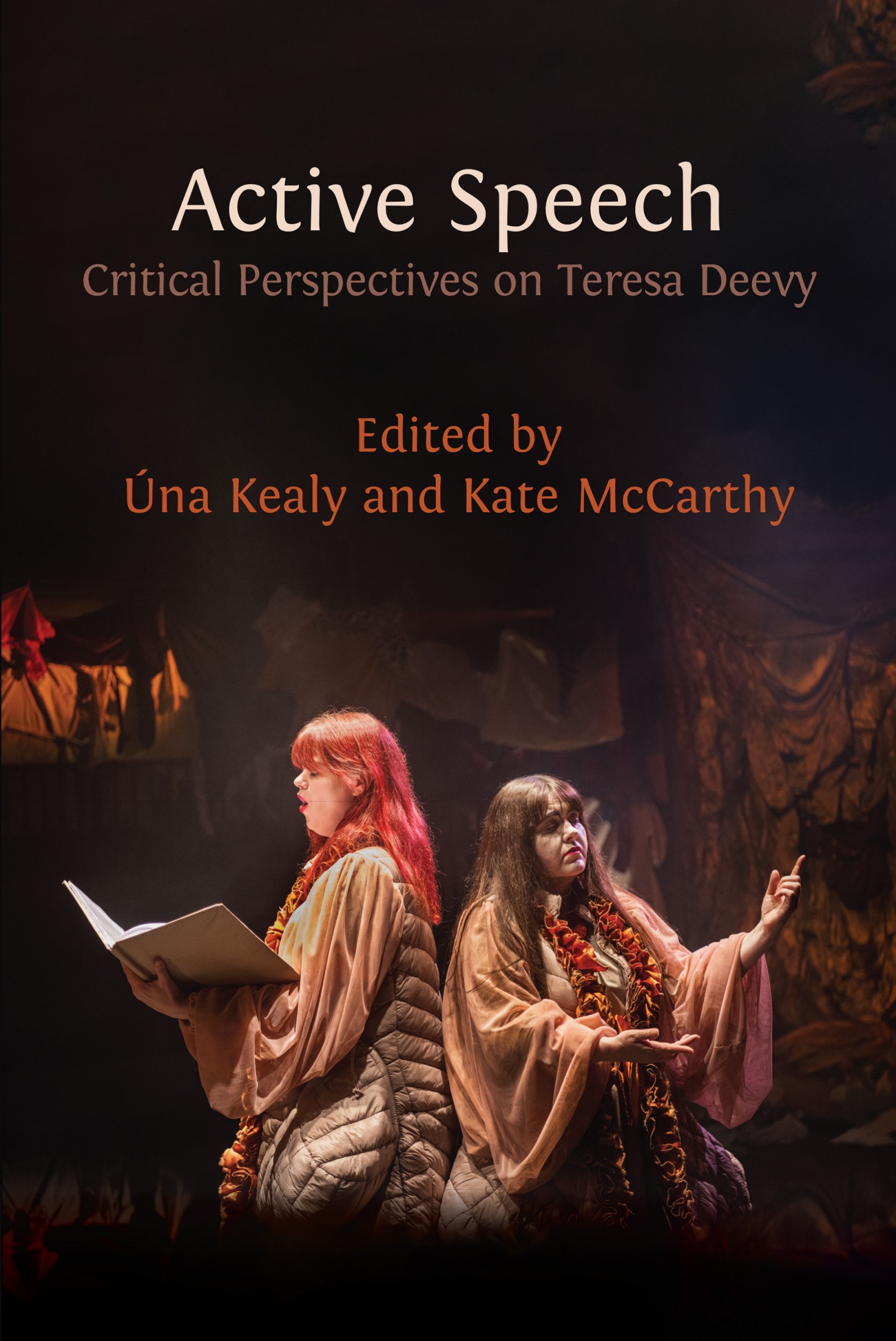
11. Teresa Deevy’s Katie Roche: Art, Culture, and Performance
Cathy Leeney
©2025 Cathy Leeney, CC BY-NC 4.0 https://doi.org/10.11647/OBP.0432.11

Fig. 11.1 Ros Kavanagh, production image from Katie Roche (2017), directed by Caroline Byrne for the Abbey Theatre, Amharclann na Mainistreach, featuring Caoilfhionn Dunne as Katie Roche. © Ros Kavanagh. All rights reserved.
Katie Roche is featured in Modern Ireland in 100 Artworks as the artwork for 1936, the year in which it was first performed at the Abbey Theatre (effectively the national theatre).1 Fintan O’Toole, co-editor of the book, comments on the choice to affirm that Teresa Deevy’s play ‘raises startlingly blunt questions about the role of women in Eamon de Valera’s Ireland’.2 Placing the work in this historical cultural context is an acknowledgement of its social and theatrical significance. On the understanding that the past is a different country, seeing Katie Roche through the lens of the 1930s risks confining the play to a twenty-first-century interpretation of what it was and what it meant at the time, thereby limiting the cultural meaning we assign to it today. Positioned in Modern Ireland in 100 Artworks amidst a series of novels, paintings, sculptures, plays, and the works of poets and architects, the play’s and Deevy’s place in Irish culture and the national theatrical canon are recognised, but a question is implicitly posed—is Katie Roche, almost ninety years later, likely to be seen as museum theatre—albeit fascinating in that it reveals Ireland’s 1930s’ attitudes to those born outside of wedlock, and the socially endorsed limitations projected on them and on their expectations, their disadvantage, and alienation? While Modern Ireland in 100 Artworks raises questions about the historicity of artworks, their pasts and presences now, it also invites the reader actively to consider how all art lives in the moment of encounter with a spectator, listener, or reader, and perhaps that works of theatre art live most necessarily and intensely in performance before an audience. In costumes and hair styles that recall old films of the period, does Katie Roche reveal to audiences characteristic values and mores of the 1930s, and the period’s social chasm between the uneducated and the professional, the divided expectations and lives of men and women, and the social dissonance of a young woman’s ambition for self-development? All of these aspects of the play point towards Katie Roche as a valuable artefact, reminding new generations that conditions of life are changeful, containing over time possibilities of both human advancement and recession. The record of revivals of the piece at the Abbey Theatre problematises this historical view to suggest that the play continues to present difficult truths and confusions, requiring, over many decades, renewed examination.3
This chapter explores Deevy’s 1936 play to argue for its status as a text that sustains contemporary revival. Elements that work in favour of this are the play’s complex and layered structure that brings together a number of theatre genres (realism, expressionism, and comedy), and places at its centre a characterisation that contains multitudes. Beginning with Katie Roche as a valuable record of the conditions under which young women in Ireland in the 1930s lived, and the constraints they often experienced, this chapter looks at aspects of two revival productions at the Abbey Theatre to contrast the play’s first reception with later stagings of the text.4
Deevy’s spotlighting of girls or young women at formative points in their lives is one of her major contributions to the twentieth-century Irish theatrical canon. She recreates (but does not reproduce) such figures in In Search of Valour (Ellie), The King of Spain’s Daughter (Annie), Katie Roche, and in Wife to James Whelan (Nan), exposing defining moments of aspiration, self-doubt, risk, desire, stubborn resistance, disillusion, and survival—comings of age. In this regard alone, these roles comprise a counter to the more common male-centred narrative of maturation. It is not unusual for Ellie, Annie, Katie, or Nan to be unfemininely self-absorbed, determined, ambitious, or impulsive. These qualities, controversial in women in the 1930s, remain easily relatable for current audiences even in a post-#MeToo context.5
As to Katie herself, her ‘mind is a very opal’;6 she is by turn ecstatic, ambitious, powerless, abject, stubbornly a force of imbalance and unease. In 1936, Katie appeared to some as being beyond comprehension; Joseph Holloway, architect, inveterate theatre goer, and diarist wrote that she was ‘the strangest character I ever saw on the stage’.7 Several newspaper reviews express puzzlement at the character and the play too. The Evening Herald commented on Katie as ‘the most complex creature, as near to insanity as makes no difference’, and on the play as ‘most evasive’.8 Writing on the 1994 Peacock production, O’Toole renews the question of Katie’s sanity: ‘Katie’s closeness to complete madness is embraced’.9 Reading Katie as insane raises questions of judgement arising from socio-scientific changes in the way the discipline of psychology understands madness relative to social norms and constraints. Perhaps it is attitudes expressed towards Katie by other characters that are insane rather than the young woman herself? Playwright and perceptive critic, T.C. Murray, wrote in 1939 that the heroine, ‘capricious and imaginative’, allowed ‘her romantic passions to rule her heart, while her social conditioning rules her head’10—at least recognising how Katie is torn between these opposing forces. Whilst the Abbey’s 1936 premiere production was on tour to the Arts Theatre in Cambridge, The Granta’s very probably woman reviewer turned previous analysis on its head: the play ‘is emphatically not […] the story of an erring wife who takes on a job and fails to carry it out; rather it is the story of a crassly stupid husband’.11 This critic found no mystery in Katie Roche, ‘the spoken lines are so good that we can without any effort fill in the blanks’.12 This critic’s relaxed identification with the title role is, for whatever reason, refreshingly out of harmony with recorded views inside Ireland in 1936, and opens a field of possibility around the nature of the lead character and her world.
Katie Roche places a captivating character in the midst of a social environment that will almost certainly overwhelm her, humble her, and re-shape her into some kind of acceptability. It is not so much the physical setting in which she lives that confines her—a small, rural cottage surrounded by countryside and a beautiful river landscape. For Katie, this is a life-saving source of pleasure and beauty, but the demands of marriage mean that she will be taken away from it. It is the social environment that traps Katie, and she must rely almost entirely on her inner self to deal with that. Pictured as she is defined by Deevy’s stage directions, we meet Katie in a domestic space that is not her own, that is at odds with her aspirations, and that she tries but fails to transform. It is the stage that tells us of Katie’s inner life, of her thoughts and desires as she gazes offstage into forbidden freedoms and pleasures. The drama is, in part, a meta-drama of ownership of the stage as she tries hopelessly to control it.
Early twentieth-century Irish theatre is marked by several influential plays that, with careful discretion, explore the social and sexual issues involved in the power play of heterosexual relationships between young women and older men. Examples include any of the play versions of the story of mythical Deirdre, Synge’s The Shadow of the Glen (1903), Gregory’s Grania (1912) and, later, T.C. Murray’s Autumn Fire (1924).13 Alongside Gregory, who never achieved an Abbey production of Grania, Deevy’s choice to explore the older man/younger woman plotline foregrounds the young woman’s emotional journey and the imbalances of social power that it reveals. Synge’s precedent The Shadow of the Glen shares with Katie Roche key aspects of staging, such as silences, uneasy dialogue, bodies repressed or desiring, and the creation of environments and spaces that seem to shape how the power dynamic operates. Synge reshaped the folk tale that inspired his play, turning it away from tragedy and towards imaginative poetic romance that overlays earlier images of Peggy Cavanagh’s abject existence, stravaging the roads—Nora escapes into a utopian adventure in the beauty of the natural world, seductively expressed by the Tramp.14 Deevy returns to the trope, but dares to unsettle either/or actions, potentially allowing a space of theatrical uncertainty, a gap between what may be said and what may be done, so that both are present uncomfortably together. The textual ending of Katie Roche refuses defined closure; it is persistently unstable and open to interpretation.
Katie is the figure that haunted Irish society in the 1930s and that haunts Irish society again now—marked out through no fault of her own, betrayed by the Catholic Church and by Mrs Roche who brought her up but did not educate her, the nuns who exploited her for profit, and her community, which tolerates her but will not accept her into it. She is the embodiment of everything that Irish society did not wish to acknowledge and respect. Yet, Katie’s personality powers the play. She is the most interesting person onstage. She is loved by Amelia and Michael. Whether because he once loved Katie’s mother, or to advance his career, Stanislaus wants to marry her and thinks he loves her. And she has the nerve to take herself seriously, to have high ambitions to find ‘something great to do’.15 Katie Roche stands out in the centrality of Katie herself, chief protagonist, the spark, the charge that connects with spectators.
Katie: Why I said now I wouldn’t marry you—I was thinking in my mind—if I were to lose my soul and my body—that would be a bad thing. […] And how do I know would I have the grace to withstand you?16
She hesitates to marry and recognises the operations of power for a young woman in a relationship with a much older man. Her insights into the risk to her self grow out of her belief in her own potential as a person. Deevy creates Katie as a lone individual, without the advantages of education, independence, or social opportunity, who holds to her conviction that she has ‘something great to do’ in life. The audience watches her struggle towards this ambition and judges whether she achieves her goal, or not. Deevy’s plays are remarkable in many respects, but most remarkable perhaps is her choice to write about girls and young women whose circumstances of birth, and/or whose lively imaginations and ambitions, were anathema to the patriarchal attitudes that were closing in and closing down such initiatives in Irish women’s lives, for example in de Valera’s Constitution of 1937. Girls and young women who gave birth when unmarried, and their children, were victimised and deemed socially intolerable. The first two decades of the twentieth century had fostered a rebellious energy towards ideals of gender equality that inspired so much of women’s political activism in that period. The 1930s, however, saw gradual reversals in social mores and legislation concerning women’s roles in society that damaged and delayed access to their rights, status, and social participation as citizens.17 But the figure of Katie Roche confronts spectators, challenging them to recognise and care about her, when, in that decade and for long afterwards, Church and State were intent on disappearing her from society, wiping her out of the record and, literally in some cases, obliterating her identity.18 Not only in Katie Roche, but in her earlier short play In Search of Valour, or A Disciple, too, Deevy’s action in making the choice to place Katie and Ellie centre stage amounts to a provocation.19 In response to Judy Friel’s 1994 production and Derbhle Crotty’s vividly complex performance, O’Toole was perhaps the first critic to recognise how the play delivered a deeply unstable and destabilising emotional charge, careering between absurd laughter, fury, desire, and despair.
Aside from the powerful attraction of Katie as the pulsing centre of Katie Roche and her appeal to Abbey audiences over the past almost ninety years, Katie Roche the play is, theatrically speaking, kaleidoscopic, presenting many production possibilities of emphasis and genre, and thus of casting, scenographic presentation, and interpretation in performance. As such, with other works whose authors play with or break the rules of genre (Ibsen and Synge come to mind), the play shares the power to upset expectation and to shock audiences into attention, sending them away unsettled and stimulated into doubt. While learning to lip-read in London, Deevy has cited how, in her frequent theatre visits, the works by Chekhov and Bernard Shaw (she saw Heartbreak House) influenced her especially; earlier, at school, she had read symbolist playwright Maeterlinck’s The Blue Bird (1908) which, translated into English, had premiered in London at the Theatre Royal Haymarket in 1910.20 From these experiences it is reasonable to conclude that her understanding of theatrical form drew from a relatively wide platform that included Chekhov’s wild mix of pathos, comedy, and the absurd; Shaw’s theatre of ideas and polemic; and, from her reading, Maeterlinck’s symbolic dream spaces, stillness, and internalised static drama and ‘school of silence’ in The Blue Bird.21 When T.C. Murray observes Katie Roche’s ‘strange tantalizing quality’, it is easy to see a connection with Maeterlinck’s style.22 Chiefly though, expressionist techniques seem to have offered Deevy ways of exposing inner states of mind, thus making, in T.S. Eliot’s famous words, ‘a raid on the inarticulate’.23 Most thoroughly in her early one-act In Search of Valour (1931), the playwright recruits an army of modernist/expressionist devices—archetypal characters, bizarre setting, vocal incantation and repetition, abrupt changes of action, ‘harsh audio effects [and] confusion of inner and outer reality’.24
This is not to suggest that Katie Roche is purely an expressionist drama, but to acknowledge its potential for expressionist stagings in its sometimes oneiric and constantly interrupted actions, its comedic character types (Margaret Drybone and Frank Lawler) and rhetoric-spouting archetypes such as Reuben, its silences and repetitive dialogue, all of which work in tension with what is most immediately visible in the play: a psychological, emotional narrative and the realist social drama of Katie’s disadvantage.25 The 2017 Abbey staging of Katie Roche materialises some of this potential in both scenography and in performance, while the 1994 production makes visible Deevy’s deliberately fractured dramaturgy.
Katie Roche in 1994 at the Peacock Theatre26
Director Judy Friel took Deevy’s written text in all of its aesthetic complexity and opposing energies, staging Katie Roche as written, paying attention to the many and detailed stage directions which signal the author’s wish, perhaps, for her textual meaning to be fully performed, intensely seen as well as heard. Friel judged that ‘the ending [of Katie Roche …] is a whitewash’.27 In rehearsal, she found no way around the tenuously ‘happy’ ending and chose resolution over ambiguity.28 The convention of definitive closure is evoked in this decision and, perhaps, militated against the disturbance that the production had effectively created through what had gone before: the abrasive fractured styles of performance and Crotty’s powerful playing of Katie.
The setting indicated in the play text of Deevy’s Katie Roche is that all action takes place within one room, and reading the semiotics of that room is a significant part of the production’s dramaturgy. It is 1936 on an August afternoon in the living room of Stanislaus’s cottage in Lower Ballycar, a generic small Irish country town. There are flowers in a bowl and the sun streams through the window, ‘throwing shadows of chairs and table’. ‘It is a pleasant little room’, the stage direction continues, ‘time-worn now and scantily furnished’.29 The poster image for the production was of Derbhle Crotty, wearing a gingham, cotton dress and white apron, and smiling into the sun. Her beauty and promise were, it was hinted, at stake in the drama. The front entrance to the house opens directly into this room, so that the natural world surrounding it, although offstage, is immediately within reach. Overall, Paul McCauley’s set supported Deevy’s description of the setting, as seen from the audience space, and flagged a realist reading of the play. It is worth noting that the play text opens on an empty living room. Stanislaus is the first to enter. Indeed, although Katie and Amelia are the long-term residents, neither of them is very much truly ‘at home’. This is emphasised when it is revealed later that Stanislaus, and not Amelia, owns the house. Amelia was absent for much of the performance and, when she was present, fell into reliance on her obsessive concerns for the ritual of tea and scones to give at least some impression of domesticity. The Peacock stage signalled modest, cosy warmth, but the space was repeatedly a place of passage; Act Two did convey some sense of homeliness that quickly fell apart in the dislocated conversation between Katie and Stanislaus.
Friel cast the play brilliantly with Derbhle Crotty as a captivating, emotional changeling Katie, weirdly sharing the same stage with an odd mix of characters played by performers who had huge experience of the Abbey Company style, with Clive Geraghty as Stanislaus, Fedelma Cullen as Amelia, Maire O’Neill as Margaret Drybone, and Niall O’Brien as a hilarious Frank Lawlor. In the role of Reuben, an archetypal figure out of medieval drama, Roy Hanlon (who was repeatedly cast at the Abbey as authoritative, patriarchal figures) turned the question of style topsy turvy. Out of this entertaining whirligig, Crotty in the character of Katie held our look. Her vitality, vulnerability, wilfulness, determination, and her glaring out-of-placeness amidst restrictive social surroundings, may be read as a character-based and fascinating exposé of Deevy’s impossible task—to dramatise the forces surrounding Katie and her contest with them in their external and internalised forms, without also thoroughly devaluing and defeating Katie herself. Character held prominence over full confrontation with the shocking roughness with which Katie is treated by her biological father and, at times, by Stanislaus; the unspoken pressures found only oblique expression within the production’s realist conventions of setting and gesture. The kaleidoscopic instability of Deevy’s play, its mix of genres—realist drama, social comedy, expressionist coming of age, Abbey farce—was revealed. So within the dominant realist style and setting, Reuben’s announcement that he is Katie’s father was unconvincing. Back in the 1975 production at the Abbey (under the direction of Joe Dowling), Jeananne Crowley, playing Katie, pointed to this moment as a performance impossibility—Katie is given no time to absorb this momentous information. Dramatically, in terms of realist style, it was like an explosion that the play does not deal with.30 How to manage this scene in a way that blends with events before and after and resonates with the moral absolutism of English medieval drama is a key challenge to directors of the play. In the 1994 production, it was the most unbalancing of a series of shifting theatrical styles across the performance’s discordant genre complexity, tested against the realist cottage setting in the confines of the Peacock stage. The 2017 Abbey production, in contrast, presented a spatially dystopian image of Katie’s existence, and one that moves the play totally out of realist representation, and into expressionism and ritualised action.
In his critique of the 1994 Peacock production, O’Toole renewed the question of the heroine’s sanity. More recently, O’Toole has put aside the issue of madness and moves to issues of unstable identity, assessing Katie as having ‘fantasy versions of herself […] a saint, a lover or the child of “great people”. But she has no fixed self’; he continues, ‘such a thing is a luxury her society will not allow her. [… The play’s] central character has no character’.31 In Ireland, in light of the Ryan Report” (the Report of the Commission to Inquire into Child Abuse) and Justice Quirke’s Magdalen Commission Scheme (2013) for redress for those held illegally in Magdalene Laundries, one may appreciate this emphasis on the power of society to define the individual as a literal nobody, to exile them from social definition, identity, and rights by hiding, falsifying, or refusing to release their true history.32 Considering Katie Roche in Ireland in 2022 invites recollection of the first hundred years since the formation of the Irish State—work for another day—but with odd irony, 2022 was also chosen by many to celebrate the centenary year of modernism and its notion of the empty character, a vacuum filled by cultural fragments and discourses but owning no essence. Katie recognises how some others view her in this way when she replies to Stanislaus’s qualified admission of love for her, ‘My heart and my mind! A queer way to love!… Taking a body to pieces!’33 Deevy’s control of character exposition certainly supports this view; nobody will talk to Katie about her life and origins, and when, for example, Reuben abruptly reveals his identity as her father, the bare facts are offered with insulting brevity, refusal of responsibility, and inherent disdain.34
Katie Roche in 2017 at the Abbey Theatre35
Katie Roche at the Abbey Theatre in 2017 loosened the play from its 1936 context, which was visually present through costume and prop design. As a radically contrasting approach to Deevy’s text, this production raises fascinating issues of textual integrity, the hermeneutic impact of stage space and design, casting, and of the power of visuality in theatre for a twenty-first century audience. Addressing all of these points is beyond the scope of this chapter and the body in space is the focus of attention here. What the spectator sees often shapes their engagement and responses definitively. In Roland Barthes’s terms images are polysemic, unstable, and exceed explanation, and, in this sense, the spectator becomes the maker of meaning.36 In the process of making performance, visual and textual meanings create the embryo for the fully-grown staging that goes on to live in the mind of the spectator. Visual information in performance focusses on the body in space and flows powerfully, beyond language, to make meaning in the audience. The embodiment of character or role is a defining decision, and is disarmingly malleable and subjective, as the power to create meaning resides as much, if not more, in body and space than in narrative and speech.
Aspects of Caroline Byrne’s staging that relate to her key choice to make the stage Katie’s— choices made to externalise Katie’s inner state spatially and visually—are foregrounded here. Gone is the cottage living room, its modest domesticity and crushing atmosphere of stasis. This led to the fulfilment of Byrne’s wish to free the play from its historical theatrical context of Abbey realism.37 In collaboration with designer Joanna Scotcher, the scenography would externalise Katie’s inner world in terms of spatial proportions, imposing angular shapes, textures, and materials such as faux marble, glass, and dark earth in contrast with hard white surfaces.38 With dramaturg Morna Regan, Byrne set out to ‘explore the play as a psychological drama and an expressionistic drama’ and ‘[t]o create a very sealed experience’.39 From this premise, daring decisions were taken by Byrne and Regan to find the through line of the drama that expresses this internal world, so that Katie’s thoughts, dreams and fears, and identity would be made visible materially and viscerally, in classic expressionist style. Some images of Scotcher’s stage and costume designs show the kind of decisions made to accommodate this reading of Katie Roche as ‘a personal/psychological space’—an externalised expression of Katie’s internal world.40 The, relatively, much larger Abbey Theatre stage allows for an imposing architectural structure making a marble-effect, pillared framework for the white stage floor. Above the centre, a glass guillotine hangs ominously over the action. At the centre stands an oblong table, shaped like an altar (which it later becomes), all white. The floor is covered with dark earth, obscuring the white beneath except where a pathway has been made. Severe angles and squared-off shapes contrast with the softness of the human bodies, and the soft brown earth, at one moment, offers a sense of rootedness and the natural, and, at another, is an image of stained humiliation when Katie lies or crouches on the floor, soiling her clothes and marking her out as unsocialised and animalistic. Caoilfhionn Dunne as Katie is seen downstage, seated. Only the costumes and chairs reflect the period of the action. The height of the setting extends an image of the height of Katie’s aspirations, their grandeur relative to the self-image that has been imposed upon her, down in the dirt. Katie’s ownership of the space is emphasised in expressionist fashion through her starkly lit and isolated actions of reflection and imagining, such as watching water flowing from a cup into a saucer—an onstage reference to her pleasure in the flow of the offstage river in the place she calls home. Other parodic images, such as the enormous platter of scones offered by Amelia in the midst of an emotional crisis, reference the ridiculous comedy of social conventions.
There are scenes throughout the play text when Katie is alone and re-organising the space for her own purposes—hanging images of saints whose glory she wishes to emulate, or inviting Michael for drinks. Dunne’s flirtatious behaviour with Michael (played by Kevin Creedon) was counter-pointed by an innocent posy of snowdrops, their heads bowed, sprouting from a tiny mound of earth. This delicate object was repeatedly near her, or in Katie’s hands. The ritual of her marriage to Stanislaus was performed more as a sacrifice at the altar of pure white. Meanwhile, in the background, the ghostly hands of black-clad stage technicians tidied away any domestic disorder. Dunne’s embodiment of Katie Roche in 2017 contrasts significantly with Crotty’s. While both embodied a dizzy-making series of emotional states, Crotty’s Katie often had significant authority on the stage, when she challenged Reuben’s physical attack on her, for example, and also through her articulate insights into Stanislaus’s and Amelia’s personalities. Dunne’s performance veered through bewilderment, frustration, ecstasy, flirtation, physical androgyny, to threatened pride; there were times when her anger and powerlessness were physically acted out in flashes of harshness that seemed to be turned inwards against herself.
Very substantial editing of Deevy’s text was required to clear away the stylistic theatrical mix in the full text and to invite audiences to understand a reading of Katie in new terms, making available, but not defining, a sustained subtext to Deevy’s dialogue. This mode of deconstruction of the dramatic text challenges the spectator to be alert to visual messages without being offered a single way of interpreting their meanings. The un-decidability of meaning, the labile potential of scenography, opens an opportunity for the audience to connect with the scene in relation to their own world view and their sense of the social context of the time of performance—the world outside the theatre building. The spectator is uprooted from familiar conventions of character and action and invited to experience the play cut loose from its theatrical origins. This production, I would argue, enabled a full dramatisation, not of individual characters and situations in 1930s Ireland, but of the forces surrounding Katie and fighting for her attention. Audiences saw her contest with those forces in their external forms (personal history, social/economic environment, and gender), while crucially the entire stage space expressed the pressures in her internal soul and mind. In this way, the audience could connect with, and find some understanding of, Katie’s internalised fears, doubts, and aspirations. In common with the 1994 production, but in different terms, I would argue that this was achieved without diminishing or devaluing the young woman’s lost promise and her vulnerable, fascinating self. The forces operating around and within Katie are not, in twenty-first-century Ireland or elsewhere, by any means erased from contemporary realities of hierarchies, social class, and gendered power.
Comparing Katie Roche in 2017 and in 1994 (the only performances I have seen live) involves a valuable balance of losses and gains where Deevy’s text is concerned. Struggle, humour, charm, waste, and absurdity were disrupting and welcome aspects in 1994, and the Peacock production celebrated not only the nuanced complexity of the play, but the skill of Abbey Theatre performers in handling the variety of playing styles demanded and showcasing a highly professional and accomplished style of performance. In 2017, the play was tested before a twenty-first-century audience and proved its power to resonate with contemporary realities, while confronting the painful histories of young women such as Katie. Byrne’s production was an illustration of the rich potential of this text to accommodate interpretation and re-interpretation for contemporary audiences. It was a test of the play as an open text, one that accommodates multiple points of entry with extraordinary, layered spaciousness; Katie Roche allowed for processes of careful deconstruction and coherent and deliberate re-emphasis to explore what Katie means to spectators now in 2017 and, putatively, in the future.
Arguably, many plays unseen for decades or even centuries, deserve our re-consideration, not as remnants of the past, but as sites of contemporary theatrical adventure. The feminist project of retrieving lost work by women, and initiatives to recover work by authors from other cultural or racial minorities, have proved that brilliant texts, unvalued or dismissed by prejudiced critics or academics, are now recognised as a vital part of the canon and crucial to the social impact of theatre performance.41 The theatrical potential of play texts to live outside of their time of writing, to engage present-day audiences, questions assumptions of ‘museum’ theatre.42 Their renewal demands the activation of the full vocabulary of performance, scenography, and stage technology to bring old texts to life in the always present moment of performance, to reveal connections and dissonances between the contemporary and the historical; thus, cycles of progress and recession may be exposed, leading to a deconstruction of the myth of absolute progress and a sense of change as something to be made rather than undergone. The liveliness, flexibility, and renewal of the Irish theatrical canon is enhanced and deepened by such projects. Further explorations of Deevy’s work, in general, such as those created by Amanda Coogan, lie waiting in the wings as part of a palimpsest for production involving cultural and theatrical processes of re-evaluation and re-invention.43
Bibliography
A.E., Deirdre: A Drama in Three Acts (Dublin: Maunsel and Co., Ltd., 1907), https://archive.org/details/deirdredramainth00ae18/page/n9/mode/2up
Bank, Jonathan, John P. Harrington, and Christopher Morash (eds), Teresa Deevy Reclaimed, 2 vols (New York: Mint Theater, 2011 and 2017)
Barlow, Judith E., ‘Introduction’, in Sophie Treadwell, Machinal (London: Nick Hern Books, 1993), pp. vii–ix
Barthes, Roland, ‘Rhetoric of the Image’, in Image Music Text, trans. by Stephen Heath (London: Fontana Press, 1977), pp. 32–51
Brockes, Emma, ‘#MeToo Founder Tarana Burke: “You Have to Use Your Privilege to Serve Other People’’, The Guardian, 15 January 2018, https://www.theguardian.com/world/2018/jan/15/me-too-founder-tarana-burke-women-sexual-assault
Byrne, Caroline, and Marie Kelly, ‘Interview with the Director’, in Abbey Theatre Research Pack: Teresa Deevy: Katie Roche, researched and compiled by Marie Kelly, School of Music and Theatre, University College Cork (Dublin: The Abbey Theatre, 2017), pp. 36–40, https://www.abbeytheatre.ie/wp-content/uploads/2017/10/KATIE-ROCHE_RESEARCH-PACK-2017.pdf
Commission to Inquire into Child Abuse, Commission to Inquire into Child Abuse Report, 6 vols (Dublin: Stationery Office, 2009), https://childabusecommission.ie/?page=241
Daly, Mary E., Women and Work in Ireland (Dundalk: Irish Economic and Social History Society of Ireland/Dundalgan Press, 1997)
Deevy, Teresa, ‘The Enthusiast’, One Act Play Magazine, 1.9 (1938), n.p.
Eliot, T.S., ‘East Coker’, in Four Quartets (London: Faber, 1944), p. 31
Ferriter, Diarmaid, ‘A Fascist and Slave Conception of Woman’, in Judging Dev: A Reassessment of the Life and Legacy of Eamon De Valera, ed. by Diarmaid Ferriter (Dublin: Royal Irish Academy, 2007), pp. 235–275
Friel, Judy, ‘Rehearsing Katie Roche’, Irish University Review, 25.1 (1995), 117–125
Gregory, Augusta, ‘Grania’, in Irish Folk-History Plays (New York: G.P. Putnam’s and Sons, 1912), pp. 1–67, https://archive.org/details/irishfolkhistory00greg/page/66/mode/2up
Holloway, Joseph, Joseph Holloway’s Irish Theatre, ed. by Robert Hogan and Michael J. O’Neill, 3 vols (Dixon, CA: Proscenium Press, 1969)
Kearney, Eileen, and Charlotte Headrick, ‘Teresa Deevy (1894–1963)’, in Irish Women Dramatists 1908–2001, ed. by Eileen Kearney and Charlotte Headrick (Syracuse, NY: Syracuse University Press, 2014), pp. 41–43
Kearney, Eileen, Charlotte Headrick, and Kathleen Quinn, ‘Introduction’, in Irish Women Dramatists 1908–2001, ed. by Eileen Kearney and Charlotte Headrick (Syracuse, NY: Syracuse University Press, 2014), pp. 1–27
Leeney, Cathy, Irish Women Playwrights, 1900–1939 (New York: Peter Lang, 2010), https://doi.org/10.3726/978-1-4539-0373-5
Maeterlinck, Maurice, The Blue Bird: A Fairy Play in Six Acts, trans. by Alexander Teixeira De Mattos (London: Methuen, 1910), https://www.gutenberg.org/files/8606/8606-h/8606-h.htm
McGettrick, Claire, Katherine O’Donnell, Maeve O’Rourke, James M. Smith, and Mari Steed (eds), Ireland and the Magdalene Laundries: A Campaign for Justice (London: I.B. Tauris/Bloomsbury, 2021), https://doi.org/10.5040/9780755617524
Murray, T.C., Autumn Fire (n.p., 1924)
Murray, T.C., ‘Two Irish Playwrights’ [Unattributed newspaper cutting]
O’Toole, Fintan, ‘1936: Katie Roche’, in Modern Ireland in 100 Artworks, ed. by Fintan O’Toole, Catherine Marshall, and Eibhear Walshe (Dublin: Royal Irish Academy and Irish Times, 2017), pp. 61–63
O’Toole, Fintan, ‘Second Opinion: What Katie Doesn’t Do’, Irish Times, 26 April 1994, p. 10
Owens, Rosemary Cullen, A Social History of Women in Ireland 1870–1970 (Dublin: Gill and Macmillan, 2005)
Roche, Anthony, ‘Woman on the Threshold: J.M. Synge’s The Shadow of the Glen, Teresa Deevy’s Katie Roche and Marina Carr’s The Mai’, Irish University Review, 25.1 (1995), 143–162
Shakespeare, William, Twelfth Night, or What You Will, ed. by Jonathan Bate and Eric Rasmussen (Hampshire: Macmillan, 2008)
Shaw, George Bernard, Heartbreak House: A Fantasia in the Russian Manner on English Themes (London: Constable, 1919), https://www.gutenberg.org/files/3543/3543-h/3543-h.htm
Synge, J.M., Deirdre of the Sorrows, 1909, https://www.gutenberg.org/files/1922/1922-h/1922-h.htm
Synge, J.M., The Shadow of the Glen, 1903, https://www.gutenberg.org/files/1618/1618-h/1618-h.htm
Tambe, Ashwini, ‘Reckoning with the Silences of #MeToo’, Feminist Studies, 44.1 (2018) 197–203, https://doi.org/10.15767/feministstudies.44.1.0197
Worth, Katharine, The Irish Drama of Europe from Yeats to Beckett (London: Athlone Press, 1986)
Yeats, W.B., Deirdre (Dublin: Maunsel and Co., Ltd., 1907), https://archive.org/details/deirdre00yeatgoog/page/n54/mode/2up
1 Teresa Deevy, ‘Katie Roche’, in Teresa Deevy Reclaimed, 2 vols, ed. by Jonathan Bank, John P. Harrington, and Christopher Morash (New York: Mint Theater, 2011), I, 57–102.
2 Fintan O’Toole, ‘1936: Katie Roche’, in Modern Ireland in 100 Artworks, ed. by Fintan O’Toole, Catherine Marshall, and Eibhear Walshe (Dublin: Royal Irish Academy and Irish Times, 2017), pp. 61–63.
3 In Ireland, Katie Roche was produced in 1936 (and toured to Britain in 1937), in 1949 (this production was revived in 1953 when the Abbey had taken up residence at the Queen’s Theatre), in 1975, in 1994 (on the smaller Peacock stage) and, most recently (and this time on the main stage), in 2017.
4 Fintan O’Toole was one of the first critics to acknowledge Katie Roche’s theatrical genre/stylistic assemblage. See Fintan O’Toole, ‘Second Opinion: What Katie Doesn’t Do’, Irish Times, 26 April 1994, p. 10.
5 In 2007, in Alabama, Tarana Burke first coined the phrase, Me Too, for an activist group she founded to work with survivors of sexual violence. On 15 October 2017, actor Alyssa Milano asked her Twitter followers to reply ‘me too’ if they had ‘been sexually harassed or assaulted’ (@Alyssa_Milano). Using the hashtag #MeToo, survivors of sexual violence, harassment, and coercion shared their testimony on various social media platforms in solidarity with other survivors and victims of sexual violence and called out the perpetrators. Legal proceedings against, and resignations of, high-profile people in media and entertainment followed. See Emma Brockes, ‘#MeToo Founder Tarana Burke: “You Have to Use Your Privilege to Serve Other People’’, The Guardian, 15 January 2018, https://www.theguardian.com/world/2018/jan/15/me-too-founder-tarana-burke-women-sexual-assault; Ashwini Tambe, ‘Reckoning with the Silences of #MeToo’, Feminist Studies, 44.1 (2018), 197–203.
6 Feste in William Shakespeare, Twelfth Night, or What You Will, ed. by Jonathan Bate and Eric Rasmussen (Hampshire: Macmillan, 2008), III. 4. 82.
7 Joseph Holloway, Joseph Holloway’s Irish Theatre, ed. by Robert Hogan and Michael J. O’Neill, 3 vols (Dixon, CA: Proscenium Press, 1969), II (1932–1937), 52.
8 Digital Repository of Ireland (DRI), The Teresa Deevy Archive, M.B., ‘“Katie Roche”: Miss Deevy’s New Play at Abbey’, Evening Herald, 17 March 1936, PP/6/178(14), https://doi.org/10.7486/DRI.5999vb24x
9 O’Toole, ‘Second Opinion’, p. 10.
10 T.C. Murray, ‘Two Irish Playwrights’ [Unattributed newspaper cutting].
11 DRI, The Teresa Deevy Archive, The Granta, 24 February 1937, https://doi.org/10.7486/DRI.5999vb26g
12 Ibid.
13 J.M. Synge, The Shadow of the Glen, 1903; Augusta Gregory, ‘Grania’, in Irish Folk-History Plays (New York: G.P. Putnam’s and Sons, 1912), pp. 1–67; T.C. Murray, Autumn Fire (n.p., 1924). Plays based on the mythic Deirdre include George Russell’s in 1902, W.B. Yeats’s in 1906, and Synge’s in 1909. See A.E., Deirdre: A Drama in Three Acts (Dublin: Maunsel and Co., Ltd., 1907), pp. 8–53; J.M. Synge, Deirdre of the Sorrows, 1909; W.B. Yeats, Deirdre (Dublin: Maunsel and Co., Ltd., 1907), pp. 1–45.
14 For insightful analysis of Katie’s love for the natural world’s open spaces, outside the confinements of Stanislaus’s house, see Anthony Roche, ‘Woman on the Threshold: J.M. Synge’s The Shadow of the Glen, Teresa Deevy’s Katie Roche and Marina Carr’s The Mai’, Irish University Review, 25.1 (1995), 143–162.
15 Deevy, ‘Katie Roche’, p. 102.
16 Ibid., p. 61.
17 See Rosemary Cullen Owens, A Social History of Women in Ireland 1870–1970 (Dublin: Gill and Macmillan, 2005), pp. 190–214; Mary E. Daly, Women and Work in Ireland (Dundalk: Irish Economic and Social History Society of Ireland/Dundalgan Press, 1997); Diarmaid Ferriter, ‘A Fascist and Slave Conception of Woman’, in Judging Dev: A Reassessment of the Life and Legacy of Eamon De Valera, ed. by Diarmaid Ferriter (Dublin: Royal Irish Academy, 2007), pp. 235–275.
18 See Ireland and the Magdalene Laundries: A Campaign for Justice, ed. by Claire McGettrick, Katherine O’Donnell, Maeve O’Rourke, James M. Smith, and Mari Steed (London: I.B. Tauris/Bloomsbury, 2021).
19 The play’s first title in performance and publication was A Disciple. It was retitled as The Enthusiast and published under that title in 1938, see Teresa Deevy, ‘The Enthusiast’, One Act Play Magazine, 1.9 (1938), n.p. Finally, it was republished in 1947 as In Search of Valour (in a collection of one act plays), a title that better flags its central idea.
20 Eileen Kearney, Charlotte Headrick, and Kathleen Quinn, ‘Introduction’, in Irish Women Dramatists 1908–2001, ed. by Eileen Kearney and Charlotte Headrick (Syracuse, NY: Syracuse University Press, 2014), pp. 1–27; George Bernard Shaw, Heartbreak House: A Fantasia in the Russian Manner on English Themes (London: Constable, 1919), https://www.gutenberg.org/files/3543/3543-h/3543-h.htm; Maurice Maeterlinck, The Blue Bird: A Fairy Play in Six Acts, trans. by Alexander Teixeira De Mattos (London: Methuen, 1910).
21 See Katharine Worth, The Irish Drama of Europe from Yeats to Beckett (London: Athlone Press, 1986), pp. 72–87. See also Eileen Kearney and Charlotte Headrick, ‘Teresa Deevy (1894–1963)’, in Irish Women Dramatists 1908–2001, pp. 41–43, p. 42.
22 Murray, ‘Two Irish Playwrights’. See also moments of stillness, dream, and fantasy in The King of Spain’s Daughter (1935) and Wife to James Whelan (1942): Teresa Deevy, ‘The King of Spain’s Daughter’, in Teresa Deevy Reclaimed, II, 17–26, and Teresa Deevy, ‘Wife to James Whelan’, II, 109–158.
23 T.S. Eliot, ‘East Coker’, in Four Quartets (London: Faber, 1944), p. 31.
24 Judith E. Barlow, ‘Introduction’, in Sophie Treadwell, Machinal (London: Nick Hern Books, 1993), pp. vii–ix (p. viii). Machinal, an expressionist masterpiece, was first produced in New York in 1928 and revived in London by the Royal National Theatre in 1993 with Fiona Shaw in the role of Woman.
25 The potential of Deevy’s work to inspire innovative production is evidenced by Amanda Coogan’s adaptation of The King of Spain’s Daughter in Talk Real Fine, Just Like a Lady at the Peacock Theatre in 2017, which was created by Dublin Theatre of the Deaf in collaboration with Coogan and produced by Live Collision.
26 Katie Roche, dir. by Judy Friel, Peacock Theatre, Dublin, 13 April–21 May 1994.
27 Judy Friel, ‘Rehearsing Katie Roche’, Irish University Review, 25.1 (1995), 117–125 (p. 123).
28 Ibid., p. 123.
29 Deevy, ‘Katie Roche’, p. 57.
30 Jeananne Crowley interview with Cathy Leeney, 31 January 2000, Dublin. See Cathy Leeney, Irish Women Playwrights, 1900–1939 (New York: Peter Lang, 2010), p. 180.
31 O’Toole, ‘1936: Katie Roche’, p. 63.
32 The Commission to Inquire into Child Abuse, Commission to Inquire into Child Abuse Report, 6 vols (Dublin: Stationery Office, 2009).
33 Deevy, ‘Katie Roche’, p. 71.
34 Ibid., see p. 60, p. 63, p. 79, respectively.
35 Katie Roche, dir by Caroline Byrne, Abbey Theatre, Dublin, 26 August–23 September 2017.
36 Roland Barthes, ‘Rhetoric of the Image’, in Image Music Text, trans. by Stephen Heath (London: Fontana Press, 1977), pp. 32–51. Barthes lays out the conditions applying to ‘open’ texts.
37 Caroline Byrne and Marie Kelly, ‘Interview with the Director’, in Abbey Theatre Research Pack: Teresa Deevy: Katie Roche, researched and compiled by Marie Kelly, School of Music and Theatre, University College Cork (Dublin: The Abbey Theatre, 2017), pp. 36–40 (p. 36).
38 Ibid., p. 36.
39 Ibid., p. 36 and p. 37, respectively.
40 Ibid., p. 38.
41 Outstanding English language examples internationally are Aphra Behn’s The Rover (1677), Susan Glaspell’s Trifles (1916), Sophie Treadwell’s Machinal (1928), and Lorraine Hansberry’s A Raisin in the Sun (1959). In Ireland, the growth of interest in Teresa Deevy’s work in the 2010s and 2020s outstrips what might have been thought possible thirty years ago.
42 Byrne and Kelly, ‘Interview with the Director’, p. 36.
43 Teresa Deevy’s Possession was created and directed by Amanda Coogan in collaboration with Lianne Quigley, Alvean Jones, Linda Buckley, Dublin Theatre of the Deaf and Cork Deaf Community Choir. Creative producer Lynette Moran produced Possession at the Project Arts Centre 21–24 February 2024, while Susan Holland produced it at the Granary Theatre for the Cork Midsummer Festival, 21–23 June, 2024. Possession was funded as part of ART:2023: A Decade of Centenaries Collaboration (the Arts Council and the Department of Tourism, Culture, Arts, Gaeltacht, Sport, and Media).