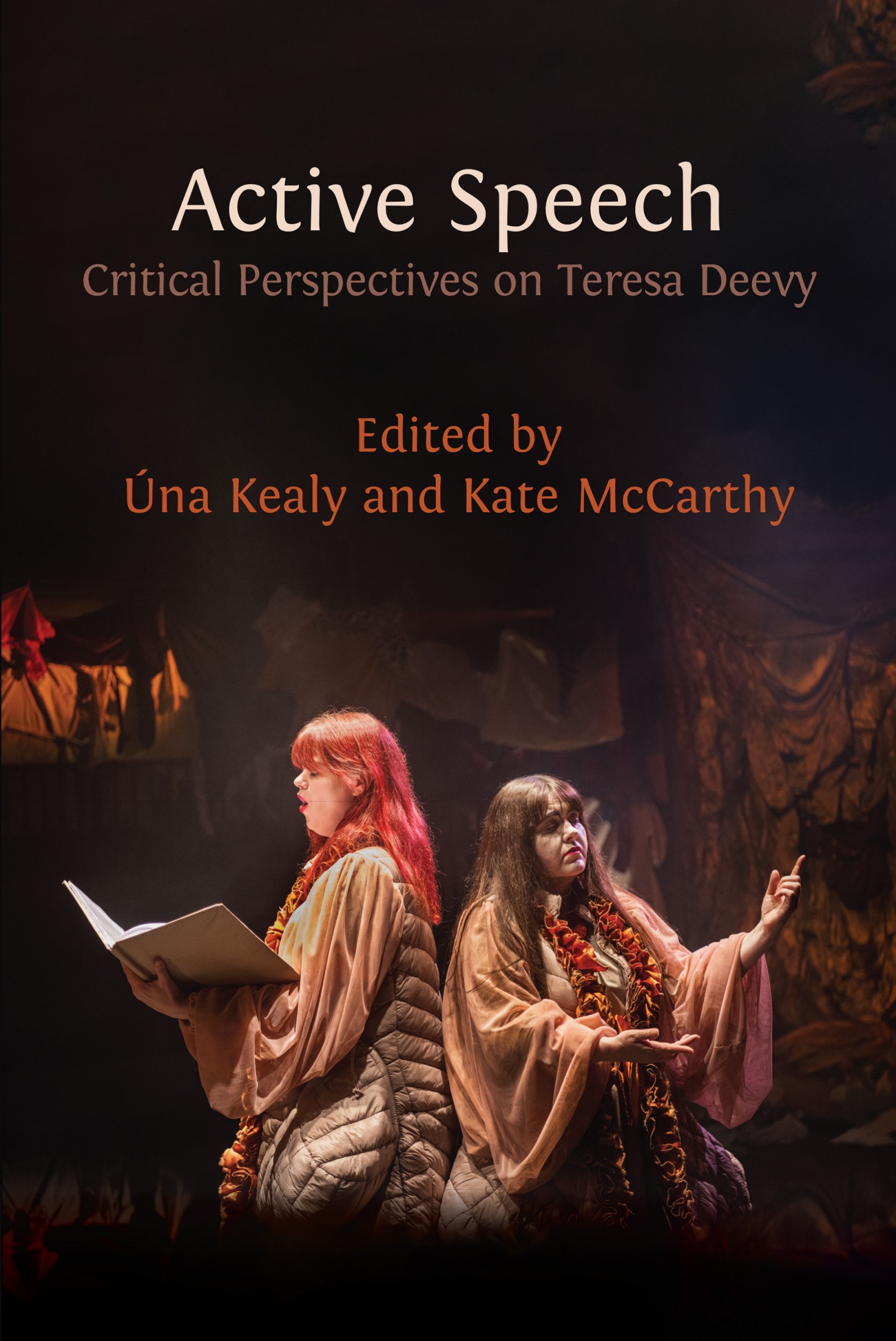
Teresa Deevy: Life, Scholarship, Practice
Úna Kealy and Kate McCarthy
©2025 Úna Kealy and Kate McCarthy, CC BY-NC 4.0 https://doi.org/10.11647/OBP.0432.00
Teresa Deevy was born on the 21 January 1894 in Waterford and spent the early years of her life at 3 Eldon Terrace, Waterford, before moving to a house the family named ‘Landscape’ on Passage Road, Waterford. The last child of thirteen children—two of whom died in infancy—her father, Edward Deevy, died when she was two; her mother, Mary Bridget Deevy (née Feehan), died in 1930 when Teresa was thirty-six.1 One of Deevy’s sisters, Mary, was a nun at the Ursuline Convent, also in Waterford, when Deevy was a boarder at the school, but Mary (Moll) endured poor health and died as a result of contracting the Spanish Flu in 1917. Two of Deevy’s sisters became nuns, and one brother became a Jesuit priest; none of her other five sisters married. Members of the Deevy family were known for their nationalist sympathies and Deevy’s uncle, Fr Thomas Feehan, who was a parish priest in the Diocese of Ossory, was silenced by his bishop for his views on the Land League.2
Deevy’s mother, Mary Bridget Deevy, prioritised her daughters’ education and, upon reaching secondary school age, Deevy, one of eighty-one students, boarded at Saint Mary’s secondary school in the Ursuline Convent as many upper-middle-class girls did at that time.3 ‘Tessa’ Deevy was a student in the senior grade of the senior division from 1911 to 1912, experiencing there a formal and informal curriculum of music (Deevy played piano and sang second soprano), sport, dramatic, critical and journalistic writing, and debating.4 A debate in 1911, for example, invited audience and participants to consider whether women should have equal social and political rights with men, while a series of guest lecturers to the school that year lectured on: Sheridan Le Fanu, Saint Bridget, approaches to studying history, the development of Irish music, and the genre of the passion play. Regular school trips to musical recitals and concerts in Waterford city occurred and students were encouraged to write poetry, literary reviews, plays, and short stories for publication in the school magazine—St Ursula’s Annual. Drama and performance were significant aspects of the student-led activities in Saint Mary’s, and poetry readings and dramatic productions regularly occurred across all year groups. The girls’ enthusiastic attendance and participation in these activities resonates in accounts written by them:
The principal items of the day were ‘Robert Emmet’ acted by the Seniors and two French Plays in which the Juniors showed their dramatic powers. In the course of these celebrations we discovered that both Classes [sic] were fortunate in the possession of many brilliant actresses.5
The girls also performed Shakespeare’s As You Like It, which was enhanced, rather than marred, by Josie Noonan’s ‘risibility in parts of the play’ and the fact that Annie Tubridy ‘in her excitement [at multi-role playing] once mistook her costume, and appeared for the part of William, while dressed as Sir Oliver Martext’.6 While comic performances were appreciated by the students, so too were the more sombre. In a production of Dickens’ A Christmas Carol, Preparatory Division student Ethel Stephenson’s characterisation of Marley’s ghost haunted those present long after the production finished:
A shudder still passes through our frame as we think of her on that night of the play with a ghastly palor [sic] overspreading her countenance, in the form of large quantities of flour, and her hair in a pig-tail, standing out at an angle of 45o. The noise of the chains and the cash boxes still rings in our ears.7
It seems that, at the end of performances, ‘critics’ (possibly other students, or perhaps teachers) were invited to the stage to adjudicate on what had been presented. Formative, perhaps, in Deevy’s dramaturgical approach was criticism offered at the end of A Christmas Carol, which reads:
On the stage we were natural, simple affecting,
Tis only that when we were off we were acting.
—(After Goldsmith.)8
Mary Deevy also supported Deevy’s literary creativity and confidence by encouraging her to ‘invent small stories about everyday things around the house’.9 Writers must start somewhere, and it was the Ursuline Convent magazine—St. Ursula’s Annual—which provided Deevy with her first opportunity to test her authorial confidence and voice, writing, for example, about the books that she and her classmates read, and had read to them, as part of evening recreational activities. In ‘Books We Have Read’, Deevy’s love of literature emanates from her reflections on that which she and her friends enjoyed that school year. She writes:
One evening on coming up to class for recreation we found a strange ‘blue’ atmosphere. On examination, we discovered that the cause of this change was the presence of a hitherto unknown creature called ‘The Blue Bird’. The room was so beautifully and suddenly transformed by this unexpected visitor that each on[e] was filled with curiosity for what was to come—Maeterlinck’s ‘Blue Bird’ [sic].10
Short pieces such as these reveal Deevy as, what Cathy Leeney describes, ‘optimistic, energetic and intellectually alive’, while Martina Ann O’Doherty asserts that Deevy’s writings from this time attest to a student with ‘a lively, cheerful personality and an infectious ebullience’.11
Deevy pursued a BA Arts at University College Dublin (UCD), but the onset of Ménière’s disease occurred whilst she was a student there. It is likely that the symptoms of the disease (which affects the inner ear and can result in tinnitus and/or reduced audiological capability) as well as symptoms of vertigo (which can cause nausea, vomiting, and anxiety)—which O’Doherty records that Deevy experienced—impacted Deevy’s ability to continue studying at UCD.12 She returned to Waterford before moving to Cork to continue her studies at University College Cork (UCC).13 O’Doherty records that the choice to relocate to UCC was so that Deevy could live relatively ‘close to her family and [...] attend the Cork Eye, Ear, and Throat Hospital’ in Cork city. However, ‘growing deafness’ caused Deevy to leave UCC ‘in late 1914’ without graduating.14 Thereafter, she went to London to study lip-reading and, during this time, her interest in theatre grew—she would attend the theatre, often reading the script before she went.15 The plays of Anton Chekhov and George Bernard Shaw appealed to her, particularly, and she had resolved on becoming a dramatist by the time she returned to Ireland. She became politically active upon returning home, joining Cumann na mBan and visiting prisoners in Ballybricken Jail, Waterford.16 In 1918, she approached Nicholas Whittle, Director of Elections for the political party Sinn Féin, to offer her support and services to the campaign. Whittle reports that she worked, writing, in the election headquarters twelve hours a day, every day, for five weeks.17
It was Mary Deevy’s ambition that her daughter should write a book and, as Leeney notes, though Mary died in 1930, Deevy dedicated Katie Roche ‘To mother, as we planned’.18 The dedication is a recognition of the importance of her mother’s support and encouragement. From 1930–1958, Deevy wrote plays (seven of which were produced by the Abbey including Light Falling in 1948), short stories, children’s stories, reviews, and an outline story for a ballet entitled Possession or The Cattle of the Gods.19 What photographic images we have of Teresa Deevy are predominantly those of an established playwright; more difficult to find is the young, aspiring dramatist who smiles from the pages of the Abbey Theatre Festival programme published in 1938. This aberration exists even though, at the height of Deevy’s career during the 1930s, the Abbey Theatre produced Reapers (1930), A Disciple (1931), Temporal Powers (1932), The King of Spain’s Daughter (1935), The Wild Goose (1936), Katie Roche (1937), and toured to Cambridge (UK) and New York with Katie Roche. In 1939, Holiday House was under contract at the Abbey, but the directors ‘agreed that the contract with Miss Deevy should be allowed to lapse’, and it was never staged.20
In 1940, Deevy was re-working a new play, Wife to James Whelan, but this work had come ‘to a standstill’.21 The Abbey rejected the play in 1942. Given that the Abbey directors allowed the contract for Holiday House to lapse in 1939, Deevy’s assessment of that rejection in 1942 was that the Abbey had ‘no further use’ for her plays.22 In a letter to her friend, Florence Hackett, Deevy writes about the loss of the Abbey as a production venue for her new work, but also shares with Hackett that she was ‘trying to get [it] done elsewhere’.23 The ‘elsewhere’ was within the studio and amateur drama and theatre network that was particularly active at this time. O’Doherty notes that Deevy also sent the play to the Gate, but Christine Longford ‘refused to stage it because the theatre did not possess a suitable cast’.24 A radio broadcast of Wife to James Whelan was produced in 1946. New work by Deevy returned to the Abbey in 1948, when Ria Mooney produced Deevy’s one-act play, Light Falling, at the Peacock. On 3 May 1949, Josephine Albericci, W. O’Gorman, and P.J. O’Connor produced In Search of Valour for the Dublin School of Acting, which had been previously produced by the Abbey in 1931 under the title A Disciple.25
Scant research into Deevy’s life in Dublin between 1930 and the late 1950s exists, but her correspondence illuminates aspects of her life at that time, including how she, with her sister Nell, navigated her life as a deafened artist.26 Her correspondence suggests a woman whose insight into human experience, interactions, and body language had become well-honed. We conclude that this was the case in response to Deevy’s own accounts of how she vicariously experienced and reacted to radio dramas through watching live recordings of them, and watching her friends and family’s reactions whilst they listened to the radio. Describing her first visit to see St John Ervine’s play John Ferguson, recorded for radio broadcast in the BBC’s Belfast studio, Deevy described her fascination ‘watching it’.27 Recounting to her friend Florence Hackett her account of watching her family’s reaction to a radio broadcast of Hackett’s play, Deevy enthuses, ‘It was splendid—at least if I can judge by the family reactions’.28 In another letter, again describing her experience of watching family and friends listening to a radio drama at home in Landscape, Deevy writes, ‘Nance, Nell and Phyllis listened last night—and I watched their amusement. Then Nell told me the story of it’.29 Deevy typically writes ‘we’ when recalling social events suggesting that Nell was frequently, if not always, by her side. More than an interpreter, Nell also seems (consciously or otherwise) to have performed the role of selecting and summarising events or points of interest for her sister, Teresa, when recounting or recalling information or events. In a letter to Hackett commenting on an Irish PEN event, Deevy mentions ‘As she remembers she [Nell] tells me parts of the speeches’.30 A month later, in March 1936, an unnamed reporter for the Irish Times recorded his experience of interviewing Deevy:
It was only possible to converse with the assistance of her sister. She reads what is said by her sister in labial signs as formed by uttered words, and, having grasped the meaning, turns with a smile to reply to the inquirer, who has addressed his question to her sister.31
The account of the interview, alongside details of Nell’s role, suggests that, while Deevy could lip-read, her ability to do so was limited. However, regardless of her limitations as a lip-reader, Deevy had an active social life and, with Nell, found ways to recover and/or minimise the impact of missing what she did not hear. In some social situations, perhaps when Nell was chatting to others, Deevy asked conversationalists to write rather than speak—a fact evidenced in her mention of a ‘writing tablet’ (a note pad) that she had bought ‘for all my friends to scribble on for me’.32 Deevy’s friends included Hugh Hunt, Shelah Richards, Lennox Robinson, Jack B. Yeats, and Denis Johnston, but Nell was an essential part of her interaction with the world. On a trip to London in December 1948, while staying with her sister, Josie, Deevy wrote to Hackett about the difficulty of securing permission to visit Britain in the aftermath of the war, writing: ‘Great fun getting permits—My agent sent a most obliging letter—showing how badly she needed to see me—and my interpreter!’.33 The underlining and exclamation mark in the letter suggesting the joy that Nell’s companionship brought Deevy, and Nell’s important place in her life. Deevy was ‘a guest of honour’ at the Christmas 1949 meeting of the Women Writers’ Club, informing Hackett that Denis Johnston ‘spoke beautifully (Nell tells me) of my work’.34
It seems that, anticipating that she would not catch all the dialogue when she attended theatre productions, Deevy read the relevant dramatic scripts prior to attending performances, choosing, when she could, seats in the front row of the dress circle or the stalls: ‘—good places for a deaf person to follow—(I have to secure that you know)’.35 In a letter to James Cheasty, written at the beginning of their correspondence, Deevy writes that she is keen to see a play of his produced and asks: ‘Perhaps before it comes on—if you had a spare script you’ll let me see it—I would like to read the play before seeing it—’ but, the following year, following last-minute changes to the script during rehearsal, reassures him that she will ‘be able to follow by watching’.36 In another letter, and in advance of their first in-person meeting, Deevy prepares Cheasty for their conversation, writing: ‘You & I have a lot to say to one another yet—if you do not mind writing on scraps of paper for me. My friends often do that when I can’t follow’.37
Elected to the prestigious Irish Academy of Letters, 1954 was a year of mixed emotions for Deevy as, Nell, her beloved sister, died.38 The actor and producer Phyllis Ryan recalls that Nell ‘had been [Teresa’s] ears and voice for many years’, and describes Nell’s death as Teresa Deevy’s ‘great tragedy’.39 In a letter acknowledging condolences on her sister’s death, Deevy wrote:
I do not find it easy to write about her. We were so very close to one another I am desolate now. But that is to be faced,—and she would not have us sad. She always wished people to be gay and light hearted [sic]. She was,—and is, a gallant soul.40
O’Doherty asserts that Nell’s death in 1954 was the loss of not just a sister but of ‘an indispensable lip-reading interpreter’.41 Recalling his friendship with Deevy during the 1950s, Cheasty also wrote of the important relationship between Teresa and Nell:
Although completely deaf [Teresa] was a great conversationalist. My replies were transmitted to her by Nell whom she was able to lip-read. Nell was really Teresa’s ears and when Nell died a few months later it was the greatest blow dealt to Teresa in her life-time. But she bore it with characteristic heroism.42
In a letter to poet, literary critic, and academic John Jordan in 1955, Deevy wrote:
It is easier for a person, when with me, to be the only one, for then one doesn’t mind so much having to repeat or (better still for me) to write. You did not appear to mind—yet I was reluctant to hold up general conversation by asking lots of things that would have been good to discuss with you.43
Jordan was researching an article reviewing Deevy’s dramatic work that year. Deevy continued to live in Waterloo Road before moving to a flat with a garden in Clyde Road. In a letter to Jordan that November, Deevy explains the change of her Dublin address as motivated by finding life in Waterloo Road ‘too lonely’—presumably as a result of Nell’s death.44 When Jordan’s article was published the following year, she wrote:
I am moved more than I can tell you by the reading of this grand article of yours. Thank you—if you could know how warming, how stimulating I have found your deeply sympathetic [illegible possibly ‘entry’] into my work I think you would feel repaid, at least in part for the labour you have given. You have laboured, you have dug, and have brought up once more many of my deepest thoughts and feelings that, from lying long too far down, were almost dead.45
Also in 1955, Deevy corresponded with Nathamal Sahal sending him her dramatic texts and supporting his analysis of her work.46 In 1956, the Studio Theatre Club produced Wife to James Whelan to ‘critical acclaim’ and, the following year, produced In the Cellar of My Friend.47 In 1958, Supreme Dominion was produced as part of the Luke Wadding Centenary celebrations. Deevy continued to divide her time between Waterford and Dublin, keeping up her apartment in Clyde Road until 1959.48 She returned to the family home in Waterford at the end of the decade—travelling up and down to Dublin to see theatre productions when she could—but with three ageing sisters living in Landscape, there was caring work for Deevy to do. Deevy’s sisters, Josephine and Margaret, died on 26 January 1960 and 6 January 1961, respectively. From brief comments made in a postcard to Cheasty, it seems that, after the deaths of Josephine and Margaret, Deevy assumed sole responsibility for the care of her older sister, Fan, necessitating her (Deevy’s) full-time residence in Waterford.49 Caring for Fan was, no doubt, challenging as O’Doherty, who interviewed Deevy’s family and friends in the early 1990s, records that towards the end of her own life Deevy was increasingly affected by the impact of Ménière’s disease and ‘recurring vertigo [... and] seldom ventured out of doors’.50 In Deevy’s final illness, she was cared for in a nursing home in Ballygunner, Waterford where she died on 19 January 1963, two days before her sixty-ninth birthday.51
While Sahal published Sixty Years of Realistic Irish Drama in 1971, a ‘reclamation’ of Deevy’s work began in earnest with Patience Ochu, Seán Dunne, and Eileen Kearney’s research in the early 1980s. Ochu submitted an MA thesis on Deevy’s work in 1981; Dunne published an introduction to Deevy in the Cork Examiner in 1984 and in The Journal of Irish Literature in 1985; and Kearney completed a doctoral thesis in 1986, publishing her scholarship on Deevy in articles throughout her career.52 In 1987, Clodagh Walsh directed The King of Spain’s Daughter for Red Kettle Theatre Company (Waterford), which played in Garter Lane Arts Centre in Waterford and in Watermans Arts Centre, London. O’Doherty completed a MA thesis on Deevy in 1992. In 1994, Judy Friel directed Katie Roche for the Abbey Theatre. In 1995, the silver jubilee issue of Irish University Review entitled Teresa Deevy and Irish Women Playwrights, which included the first publication of Wife to James Whelan, furthered the reclamation of Deevy’s work, bolstering her reputation as a dramatist.53 O’Doherty, Cathy Leeney, Shaun Richards, Christie Fox, and Fiona Becket’s scholarship, and the inclusion of The King of Spain’s Daughter within The Field Day Anthology of Irish Writing: Irish Women’s Writings and Traditions, Volume V further substantiated Deevy’s literary reputation in the late 1990s.54
In 2003, Eibhear Walshe published a selection of Deevy’s plays; in 2004, Leeney published a further critical essay on Deevy and, in 2010 and 2011 respectively, Leeney and Gerardine Meaney separately analysed Deevy’s work within extended studies of Irish women writers.55 Caoilfhionn Ní Bheacháin Mitchell contextualised and interpreted Deevy’s work as a commentary on Irish social and political life of the 1930s in two essays in 2011 and 2012 during which time the Mint Theater editing-publishing team—Jonathan Bank, Christopher Morash, and John P. Harrington—began work on two anthologies of Deevy’s collected work published in 2011 and 2017.56 The publication of these volumes coincided with a resurgence of interest in producing Deevy’s work with the Mint Theater (New York), under the directorship of Jonathan Bank, premiering Wife to James Whelan (2010) and producing Temporal Powers (2011) and Katie Roche (2013).57 Also in 2013, Charlotte Headrick premiered The King of Spain’s Daughter in America in Oregon State University, Corvallis. In 2015, Kearney and Headrick anthologised The King of Spain’s Daughter within Irish Women Dramatists 1908–2001, and Wife to James Whelan was staged by Garter Lane Arts Centre, Waterford.58 Also in 2015, Anthony Roche considered Deevy within his analysis of the Irish dramatic revival; White Ships, a devised production responding to The King of Spain’s Daughter was performed in the Vintage Tea Rooms in Waterford; and a rehearsed reading of The King of Spain’s Daughter was presented at the Medieval Museum, Waterford.59 In 2016, Fintan O’Toole included Katie Roche in Modern Ireland in 100 Artworks, writing that the play is ‘so strange and so compelling’ in its characterisation of an Irish woman who does not conform to the role of woman as prescribed by the new State.60
In 2017, The King of Spain’s Daughter was staged as a rehearsed reading in Limerick and, the following year, a multi-lingual rehearsed reading of The King of Spain’s Daughter was performed at Garter Lane Arts Centre.61 As part of The Suitcase under the Bed programme in 2017, the Mint Theater produced the global premieres of Holiday House and Strange Birth—a rehearsed reading of the latter was staged for Culture Night Waterford in the same month.62 The Mint also produced In the Cellar of My Friend and The King of Spain’s Daughter as part of that programme that year.63 Also, in 2017, Caroline Byrne directed Katie Roche for the Abbey Theatre, and the Peacock Theatre simultaneously staged an appropriation of The King of Spain’s Daughter by Amanda Coogan and Dublin Theatre of the Deaf entitled Talk Real Fine, Just Like a Lady.64 Marie Kelly created an educational research pack associated with these Abbey productions.65
In 2019 and 2020, Willy Maley, Kealy, and Ní Bheacháin published three critical essays on Deevy’s dramatic work, focusing on A Disciple, The King of Spain’s Daughter, and Temporal Powers, respectively.66 Andrés Romera translated the text into Spanish in 2020 as La Hija del Rey de España in 2020.67 2021 saw two scholarly events designed to investigate and develop Deevy scholarship: Emily Bloom in Columbia University and Lauren Arrington in Maynooth University co-hosted a seminar entitled ‘Disability and the Archive: Teresa Deevy in Context’, while Kealy and McCarthy of Waterford Institute of Technology (now renamed South East Technological University (SETU)) in partnership with Hugh Murphy of Maynooth University, and Waterford Libraries, collaborated to convene Active Speech: Sharing Scholarship on Teresa Deevy, the first conference devoted to Deevy’s work.68 In 2021, Kealy and McCarthy published an analysis of Talk Real Fine, Just Like a Lady, which discussed how the production revealed systemic institutional trauma, the marginalisation of the Deaf community in Ireland, and ‘celebrate[d] the expressive potential of ISL [Irish Sign Language]’.69 Recent productions of ‘rarely-performed’ Deevy plays include a reading of Light Falling (dir. Caroline Byrne) featured as part of the limited podcast series Unseen Plays (2021),70 and a rehearsed reading of Within a Marble City, as part of the Waterford Imagine Arts Festival (2022).71 In 2022, Morash published a short essay on Katie Roche in Fifty Key Irish Plays, outlining some of the interlinking reasons for Deevy’s career trajectory from ‘prolific playwright’ to ‘virtually unknown’.72 Also in 2022, three studies focusing on Deevy were published: Kirsty Lusk and Maley considered The Wild Goose alongside James Connolly’s Under Which Flag?; Mária Kurdi analysed Katie Roche and The King of Spain’s Daughter in conjunction with J.M. Synge’s work to explore patriarchal authority; and McCarthy and Kealy analysed documents sent by Deevy to Cheasty that challenge prevailing narratives concerning her involvement—or lack thereof—in theatre post 1942.73 From February to June 2022, performance artist Amanda Coogan, Dublin Theatre of the Deaf, and SETU Theatre Studies faculty and students collaborated to create The Possession Project—‘a living installation’ inspired by Deevy’s Possession or The Cattle of the Gods.74 The Possession Project was also performed as a durational, site-responsive, and immersive performance in October 2022 in the Choristers’ Hall (Waterford Museum of Treasures) as part of the Imagine Arts Festival.75 In November 2022, RTÉ aired a documentary entitled Tribute: The Teresa Deevy Story, which captured the exploration of Deevy’s Possession in the context of Coogan’s collaboration with Dublin Theatre of the Deaf and SETU.76
In 2023, a group called The Elders (facilitated by Michelle Read in collaboration with Andrea Scott of Floating World Productions) presented a rehearsed reading entitled I am Teresa Deevy, which staged a dinner party where Deevy meets some of the characters from her plays.77 In 2025, The Elders produced The Somewhat Imagined, Partly Historical, True Story of the Forgotten Irish Playwright Teresa Deevy in the Maureen O’Hara Studio, dlr Mill Theatre, Dundrum, Dublin.78 Recent scholarship, such as Katherine M. Huber’s 2024 analysis of One Look and What It Led To, argues for reclamation of ‘the airwaves as a feminist environment’.79 Analysing sound elements, sound directions, and silence in Dignity, Within a Marble City, Going Beyond Alma’s Glory, and One Look and What It Led To through feminist, eco-feminist, and media studies lenses, Huber argues that Deevy’s use of realism and naturalism exposes the gender hierarchies that limited opportunities for women in Ireland and globally. Also published in 2024, Moonyoung Hong’s analysis offers this global connection through a ‘transnational feminist reassessment’ of women writers including Deevy, Maura Laverty, Kim Ja-rim, and Jeon Ok-joo, all of whose texts expose the patriarchal, capitalist, and post-colonial narratives of modernity and, in Deevy’s case, ‘the violence [that such narratives] enact on women who are left out of these hegemonic narratives or are positioned to legitimise State and Church ideologies’.80 Building on The Possession Project, Coogan, composer Linda Buckley, Jones, Quigley, and members of Dublin Theatre of the Deaf, and Cork Deaf Community Choir collaborated to create a new opera, Possession, intertwining live art, Irish Sign Language, musical composition, and performance in the staging of Deevy’s ballet in Cork and Dublin.81 Dayna Killen’s doctoral dissertation of 2024 included analysis of Deevy’s life and work, while S.J. De Matteo chose Deevy’s later dramatic work as the focus of an M.Litt. thesis also completed that year.82
Public lectures, talks, workshops, and podcasts over the last decade have considered Deevy’s work for, and with, a wider audience, and suggest new directions in Deevy scholarship, some of which are explored in this collection. In 2016, for example, Úna Kealy, Barbara McCormack, and Dayna Killen curated and delivered A Quiet Subversive, an exhibition and four-part public lecture series at SETU Waterford Library; it was during this series that new archival material, in the form of Deevy’s correspondence with Cheasty, came to light. The Mint Theater has digitally archived much of its production and supporting interpretive work, and Kealy and McCarthy have, since 2015, hosted, curated, and presented public lectures, workshops, and rehearsed readings focusing on Deevy’s work.83 In 2020, Bloom presented a lecture on ‘Teresa Deevy and RTÉ: Accessibility on the Airwaves’ as part of The Irish Women’s Writing Network Lecture Series. In 2022, Kealy, McCarthy, and Jenny O’Connor participated in a d/Deaf-accessible podcast about Deevy, the Lyrical Bodies Project, and their work with Coogan and Dublin Theatre of the Deaf.84 Also, in 2022, Coogan participated in a podcast entitled ‘Teresa Deevy: The Life and Legacy of an Extraordinary Irish Playwright’, discussing her recent work on Deevy’s unpublished text, Possession.85
O’Toole comments that, by Deevy’s death in 1963, ‘she had fallen into obscurity, and it would be many decades before she would be written back into the story of Irish theatre’.86 Arguably, the productions, events, media transmissions, and scholarship recounted here suggest that Deevy’s work has found a place in that story, and her legacy is finding consistency with expectations for her dramatic legacy as it was predicted by Augusta Gregory and Lennox Robinson in 1931.87 However, rather than writing Deevy ‘back into the story of Irish theatre’ through reclaiming her legacy, we must, through practice and scholarship, change ‘how the story of Irish theatre has been told’, acknowledging that the accepted story, and its accompanying canon, is gendered, exclusionary, and ‘dominated by major institutions and figures’.88 Accepting the rejection of Deevy’s new work by the Abbey, or the Gate, for example, as reasons which quashed or diminished her ambition for theatrical production of her own work belies Deevy’s active pursuit of multiple creative opportunities. Acts of recovery will continue as practice and scholarship engage with Deevy and her work in different contexts as outlined above and, hopefully, new archival material will come to light. However, as Leeney argues, the ‘integration of this recovery into canonical judgement’ proves ‘more problematic’, requiring ‘disruption […] and reassessment’, not only of the canon but, ‘of how Irish theatre has operated, has energized or stultified the fluid thing that is the nation’.89
Analysing Deevy’s work through scholarship and production histories is important and ongoing work, but to fully acknowledge her creative oeuvre we must ‘recalibrate’ the canon and, as Sihra argues, ‘tilt the very angles of theatre history itself in order to reveal new spectrums of meaning-making in which women’s creative power is fundamental’.90 In offering counter-narratives, which recover and ‘reveal[ing] the lost contributions’, scholarship and practice can disrupt the story by making this creative power tangible.91 In tilting the canon and, by extension, practice, the industry, and scholarship, we disrupt, reassess, and create, as Deevy once suggested, ‘an opening elsewhere’.92 For Deevy, such openings allowed her work to ‘span[s] media (theatre, radio, and television) and a range of theatrical styles’ from the 1920s onwards, thus evidencing her tenacity in seeking out diverse production opportunities as creative people are wont to do.93
Active Speech: Critical Perspectives on Teresa Deevy brings production histories, practice, scholarship, and the archive into dialogue, offering a more nuanced and three-dimensional understanding of Deevy’s creative legacy at this moment in time.94 This collection is the result of the Active Speech: Sharing Scholarship on Teresa Deevy conference convened in Waterford in 2020. Participants were invited to contribute papers considering: Deevy’s work in its historical context; how her work has been translated from dramatic to theatrical texts or radio productions; the nuances of her dramatic vision; her dramaturgical style; her work in other literary genres; and incomplete works. Participants were also invited to consider Deevy’s work using a variety of theoretical lenses, to analyse the ways that Deevy’s work is shared through public and private archival holdings, and to challenge the ways that Deevy’s work is interpreted, taught, translated, or adapted. The response to the invitation posed by the Active Speech conference, and this subsequent edited collection, was richly varied and this resulting collection contributes to the developing narrative of how Irish women playwrights interrogate and expose inequities and challenges presented by dominant and/or prevailing social, cultural, political, and canonical hierarchies and ideological norms. Inevitably, however, gaps in scholarship remain and we acknowledge that important additional work remains outstanding, most particularly in the domain of reading Deevy’s work through the lens of disability studies; a greater diversity of voices and approaches to disability presents a particularly rich and valuable focus for future Deevy scholarship. Additionally, the activity of amateur dramatic companies in relation to Deevy’s work merits analysis. The scope for future research into Deevy’s work remains richly diverse.
This volume contributes to the efforts of practitioners and scholars previously mentioned to recalibrate the canon by including essays and transcribed interviews that: reflect on the importance of considering how archival documents and special collections inform and challenge traditional theatre scholarship and previously-held conceptions about Deevy and her work; analyse how Irish society and, thus, the nation was (and is) shaped and directed by prevailing beliefs, mores, and ideologies within the first half of the twentieth century; broaden the field’s understanding of Deevy’s dramaturgy, theatrical aesthetic, and productions of her work; and interrogate and critique the work of d/Deaf, deafened, hard-of-hearing, and hearing theatremakers. As an open access publication, the collection challenges how knowledge in the field is, predominantly, communicated. Democratising knowledge in sharing it more openly, in a diversity of ways, is an essential activity in canon recalibration. Active Speech: Critical Perspectives on Teresa Deevy provides an accessible collection of critical analysis of Deevy’s work to encourage further scholarship, practical interpretation, and critical engagement with her work, and supports educators, theatremakers, and researchers in recognising the significance of Deevy’s work as ‘intrinsic’ to Irish drama, theatre, and performance.95
Authors and Chapters
This volume is structured along four thematic strands: Access and Archives; Deevy’s Ireland: A Country in Context; Dramaturgy, Genre, and Theory; and Productions and Practitioners. We gratefully acknowledge the work undertaken by the section editors for their work in supporting the editorial process across these sections: Úna Kealy, Ciara L. Murphy, Shonagh Hill, and José Francisco Fernández.
Access and Archives
The chapters contained within the section ‘Access and Archives’ analyse the ways that Deevy’s work is shared through public and private archival holdings and challenge the ways that Deevy’s private and public writings are accessed, interpreted, taught, or adapted. Eileen Kearney’s chronicle of, and reflection on, her research into Deevy’s life and work during the early 1980s opens the collection and exemplifies how tenacity can create a trail that leads to the important discovery and recovery of neglected work. The testament that Kearney eloquently pays to the friendship, generosity, and collegiality of Seán Dunne and his family brings to the fore the value of research collaboration and conveys the energy, dynamism, and undaunted persistence that is also characteristic of Deevy’s attitude towards her work and her friendships. The result is an essay that negotiates the liminal space between academic formality, intellectual rigour, and accessibility.
Hugh Murphy’s chapter contextualises the Teresa Deevy Archive within the curatorial holding and special collections of Maynooth University Library (MUL) analysing how Deevy’s archive is positioned within a collections management policy that has evolved, since the 1970s, to focus on figures who considered themselves, or were considered by others, as outside the parameters of the powerful or the popular. Documenting how MUL’s collections reflect curatorial biases over the institution’s history, Murphy considers the practical and ethical challenges and benefits of devising a collections management policy that is driven by an institutional commitment towards increasing social justice. Contextualising the Teresa Deevy Archive alongside those of Irish poet, translator, and broadcaster Pearse Hutchinson (1927–2012), and writer and activist Ken Saro-Wiwa (1941–1995), the chapter considers how the role of the curator, the act of curatorship, and the power of representation impacts the ways in which a collection is framed and accessed. Murphy’s analysis of MUL’s commitment to destabilising and deconstructing the boundary walls that restrict access to archival collections through open access is both instructive and inspirational.
Shelley Troupe opens a Theatre Studies Investigation assembling pieces of the incomplete picture of the surviving textual and production evidence of Deevy’s [The] Reapers—which premiered at the Abbey on 18 March 1930, providing insight into the challenges and imagined possibilities of text recovery. In the absence of a script to analyse, Troupe draws on theatre reviews, scholarship, production images located in newspaper archives, W.B. Yeats’ feedback to Deevy, and the original Abbey Theatre production programme to: highlight inconsistencies with the play’s title; support her conjectures on the plot and thematic concerns of the play; identify influences in Deevy’s work; and question the production practices at the Abbey at that time. At its conclusion, the essay reveals how new archival material—or considering material anew—can bring the pieces of the jigsaw a little closer together.
Caoilfhionn Ní Bheacháin Mitchell’s focus is the provenance and dating of the plays Practice and Precept, Let Us Live, and The Firstborn, currently conserved within the Teresa Deevy Archive in Maynooth University and listed as documents possibly authored by Deevy between 1914 and 1919. The essay also considers the contents of the Teresa Deevy Archive as a means to reflect, more generally, on women’s literary archives. The essay creates a compelling argument that the named plays are incorrectly dated within the Teresa Deevy Archive. The plays are briefly introduced and compared to works known to have been authored by Deevy. Analysis of possible authorship forms the core of the essay and the voyage of discovery into a suite of plays that have never before received any critical attention and this, in tandem with Ní Bheacháin Mitchell’s dogged determination to shed light on this literary mystery, makes for excellent reading. The meticulous nature of the analysis in relation to the plays’ provenance provides an exemplar of analysis. The revelation of documents found towards the end of the research journey makes for an exciting plot twist and demonstrates the unpredictable nature of archival research.
Deevy’s Ireland: A Country in Context
The chapters in this section consider the social and cultural context of Deevy’s life and writing and include chapters considering censorship and/or resistance to censorship by Irish artists; comparative analysis of Deevy’s work with other playwrights and theatremakers; and the position of Deevy’s work within the canon of Irish dramatic literature that emerged during the twentieth century. Chris Morash explores Deevy’s theatrical aesthetic, arguing that it is founded on the interplay of atmosphere and light and splintered syntax and silences all of which suggest that ‘some other meaning’ is at work. The analysis of moments of exultation in In the Cellar of My Friend, The King of Spain’s Daughter, Katie Roche, Wife to James Whelan, and Port of Refuge explores how, at critical moments, Deevy’s characters renounce possession of their material wants and their desires, which allows them to immerse themselves in the phenomenological world. This analysis leads Morash to explore how Deevy opposes dogmatic Catholicism with Catholic mysticism in her work. He also identifies a tendency by scholars to foreground Deevy as a deafened writer, playwright, and woman, but not focus on her religious identity. Morash explores how Deevy’s Catholic mysticism informs her theatrical aesthetic arguing that Supreme Dominion, In the Cellar of My Friend, One Look and What It Led To, and Light Falling pivot on ‘incommunicable’ and ‘private’ moments and that analysis of these moments, informed by an appreciation of the ‘dark matter’ of Deevy’s dramaturgy, offers a rich avenue for further research.
Úna Kealy and Kate McCarthy argue that, before the Abbey’s rejection of Wife to James Whelan, Deevy was interested in radio as a medium for her work and sought out production opportunities outside the Abbey and internationally. The essay contextualises the evolution and dynamism of studio theatre practice in Dublin the 1940s and 1950s, drawing on Deevy’s correspondence with Florence Hackett and James Cheasty, evidencing these decades as a period of creative opportunity for, and endeavour by, Deevy within a vibrant network of studio and amateur drama and theatre practice. Analysis considers Deevy’s ambition for her theatre work outside the Abbey Theatre and expands scholarship outwards from select institutions and literary texts which are, in the main, the focus of Irish theatre scholarship of that period. Kealy and McCarthy’s analysis of Deevy’s correspondence reveals her interaction with theatre practice and the industry at that time as complex and varied, and evidences an entrepreneurial playwright intent on creating opportunities for her work regionally, nationally, and internationally.
Willy Maley considers whether in Annie Kinsella, in The King of Spain’s Daughter, Deevy creates a character who talks back against patriarchal values, or whether Annie is ‘another victim of male violence wishing fatalistically for more’.96 Maley considers the play’s ending as a point of departure, comparing Annie with James Joyce’s Eveline and Synge’s Pegeen Mike who remain stranded and in anguish as their stories come to a close. In developing the argument of ‘talking back’, Maley explores how Deevy challenges the limited choices, i.e., domestic service, emigration, and cultural isolation, available to young Irish women in the 1930s, leaving the audience to question Annie’s choice at the end of The King of Spain’s Daughter.97 The interpretation of Annie’s challenge to Jim, at the discovery of his plans for Molly and Dot; the focus on how Deevy’s characters acknowledge sisterhood; and the comparisons to Joyce’s ‘Eveline’ contribute an original and nuanced reading of Deevy’s text.
Dramaturgy, Genre, and Theory
Chapters within this section interrogate the nuances of Deevy’s dramatic vision and how she experimented with naturalism, realism, symbolism, and expressionism. Ann M. Shanahan’s chapter offers an exploration and analysis of some of Deevy’s texts with, through, and in relation to the body. Shanahan interprets Deevy’s texts through her own lived experience and the materiality of her own body, arguing that the material world is a key aspect of Deevy’s dramaturgy. Shanahan argues that Deevy’s dramaturgy is a connective dramaturgy, which uses material aspects of theatre production, i.e., actors’ bodies, theatre space, and stage properties that simultaneously model and mirror humankind’s struggle to communicate, express the inexpressible, and connect. Shanahan contends that Deevy’s dramaturgy evokes and invokes physical and emotional experiences and that, at key moments, Deevy uses certain characters as a meta-audience as a means of underlining what has taken place. In analysing Deevy’s use of liminal spaces and material objects, Shanahan argues that Deevy’s dramaturgy is designed to move characters towards communication and epiphany.
In their chapter focusing on Katie Roche, Dayna Killen and Úna Kealy read that play as Teresa Deevy’s critique of idealised representations of Irish womanhood, in particular, the hegemonic, ideologically inflected representation that they define as the ‘domesticated Irish woman’.98 Defining the domesticated Irish woman as an idealised representation, which formed, and into which Irish women were pressed, during the first half of the twentieth century, Killen and Kealy consider the influences and ideologies that underpinned and shaped representations of Irish women during the early decades of the twentieth century. Synthesising the work of gender constructivist theorists, Simone de Beauvoir and Judith Butler, with Michel Foucault’s discussion of how individuals are shaped into docile bodies, Killen and Kealy argue that, in Katie Roche, Deevy deploys space, characters’ physicality, and language (within her dialogue and stage directions) to deconstruct and interrogate a developmental process whereby young women and girls in Ireland, during the early decades of twentieth century, were shaped into idealised representations of Irish womanhood.
Christa de Brún’s chapter draws on the concept of the widow as a liminal figure and considers Wife to James Whelan as a commentary that makes visible the ideological apparatus and institutional oppression of women in 1930s Ireland. In arguing that the cultural history of widowhood in Ireland has been ‘largely hidden from public knowledge’, and using Wife to James Whelan to explore the widow as a liminal figure, de Brún presents a stimulating discussion that connects with major themes within Deevy’s oeuvre.99 Arguing that the association of women’s activities, roles, and identities within domestic spaces was central within ideological narratives in mid-twentieth century Ireland, and drawing on the idea of widowhood as a social death and Victor Turner’s concept of threshold people, de Brún reads Nan McClinsey, in her widowhood, as a threshold figure suspended within a liminal state of economic precarity, but also argues that Nan’s liminal state offers her opportunities to renegotiate her identity and engage with the world in spaces other than the domestic. De Brún argues that widow characters, such as Deevy’s Nan, expose a patriarchal status quo that is materially and ideologically flawed.
Productions and Practitioners
This final section analyses how examples of Irish and international productions of Deevy’s dramatic work have been translated from dramatic to theatrical and performance texts. Chapters in this section also include edited and transcribed interviews, which offer practitioner reflections on producing, performing, and adapting Deevy’s work. Cathy Leeney’s essay provides an overview of the historical context of Katie Roche, followed by analysis of two productions of the play staged in 1994 and 2017. Arguing for Katie Roche as a text worthy of contemporary revival and for the continuing relevance and imaginative revival of plays located within a specific historical context, Leeney analyses Katie Roche as a complex and layered text in terms of theatre genres, as well as a text containing a valuable record of the conditions experienced by some Irish women in the 1930s. Leeney argues for, what she describes as, Deevy’s layered and ‘kaleidoscopic’100 dramaturgy with its dissonances of genre and stylistic complexity before analysing how these dissonances were realised in productions directed by Judy Friel in 1994 and Caroline Byrne in 2017, both produced by the Abbey Theatre. Leeney develops existing scholarly work to analyse: Deevy’s complex dramaturgical style; productions of Deevy’s work; and the value of interpreting and reinterpreting plays to enhance ‘the liveliness, flexibility, and renewal of the Irish theatrical canon’, reminding us that challenging moments of maturation, as they are experienced by Deevy’s girls and young women, continue to resonate with contemporary women and girls.101
The final contributions within Active Speech: Critical Perspectives on Teresa Deevy are transcripts of two conference panels, which took place online, via Zoom, in December 2020 as part of Active Speech: Sharing Scholarship on Teresa Deevy conference. In recasting a live, online conversation as prose, some parts of the discussions are edited and adapted from the original transcriptions; square brackets denote editor insertions to support ease of reading. Captioned and Irish Sign Language (ISL) translated recordings of the original panel discussions are available.102 In Chapter 12’s transcript, Jonathan Bank, Caroline Byrne, Amanda Coogan, and Lianne Quigley discuss how they first encountered Deevy’s work and share their unique approaches to working with her texts from their perspectives as directors, performance artists, and performers. Having worked with several of Deevy’s texts and co-edited Teresa Deevy Reclaimed, volumes one and two, Bank discusses his directorial choices, which allowed the Mint Theater team (New York) to explore the contradictions within Deevy’s characters. With reference to Talk Real Fine, Just Like a Lady (2017), Quigley and Coogan consider the Dublin Theatre of the Deaf’s (DTD) embodied response to The King of Spain’s Daughter. Incorporating women’s sign—a distinctive version of Irish Sign Language (ISL)—DTD, with Coogan, aligned the lived experiences of Deaf women in Ireland with the system of oppression that Deevy explores in the text. This production also celebrated ISL and contributed to the successful campaign for its recognition as one of Ireland’s official languages. Also informed by Deevy’s visual language, Byrne discusses her approach to Katie Roche, one which illuminated the expressionist qualities of that text. In so doing, Byrne’s production foregrounded Katie as an artist who is, ultimately, confined by her gender and class.
In Chapter 13’s transcript, Amanda Coogan, Alvean Jones, and Lianne Quigley discuss the importance of Deevy as a deafened artist. In articulating their process and its inclusive performance design for d/Deaf, hard-of-hearing, and hearing audiences, they explain how Deevy inspires them to create new work that foregrounds the lived experience of d/Deaf people. The discussion contextualises the system of education for deaf children in Ireland in the twentieth century, focusing on the injustices and trauma experienced by deaf children who were segregated and then categorised into different groups depending on their level of vocal acquisition. Coogan, Jones, and Quigley explore the rationale for, and process of, creating an immersive performance with members of DTD, a performance which responded to these injustices in embodying and celebrating women’s sign. In casting the audience as the outsider in a theatre environment where Deaf experience and women’s sign were dominant, Talk Real Fine, Just Like a Lady made the hidden histories of the Deaf community visible. As Ireland’s national theatre, Coogan, Jones, and Quigley acknowledge the Abbey Theatre’s support for ISL work, demonstrating the importance of inclusive, funded theatre spaces to communities. The production and discussion serve as reminders of the importance of bearing witness to human rights injustices and celebrates the joy in working collectively, through the arts, towards a more inclusive and hopeful future.
As we planned the Active Speech conference and imagined this collection, we were reading Deevy’s personal copy of St John Ervine’s How to Write a Play.103 Inscribed with Teresa’s name and glossed in her hand—reading it was like finding a window into her thoughts on playwrighting. Noting passages of interest, marking sections in the margins, and creating a list of notable paragraphs on the title page for ease of reference, Deevy was an engaged and opinionated reader who did not always agree with Ervine. For example, after he criticised J.M. Synge’s dialogue in Riders to the Sea as ‘contrived stuff [...] after a time, tiresome and tedious’, Deevy expostulates: ‘Rot! This is all wrong’.104 A little later, in response to Ervine’s assertion that Synge’s ‘highly contrived language’ was ‘entirely unrepresentative of the speech that Maurya was likely to use’, she writes simply ‘I dont [sic] agree’.105 As with any archival research, the process of reading Deevy’s comments in Ervine’s text was intriguing, instructive, and demanding of measured, critical reflection. Deevy’s comments, lists, and glossing in Ervine’s text added to what we knew from reading, directing, and performing her work, from experiencing productions and reading the work of critics and scholars who have interpreted her work. Deevy’s dramaturgy invites an intensity of linguistic expression, movement, gesture, sound, and setting, which combine to create dramatic action that is, to paraphrase Ervine, unclogged by words. Ervine’s advice that ‘It is better to be spare than to be tedious’ could be taken as Deevy’s playwrighting maxim.106 However, it was these four sentences below, marked by Deevy with vertical and horizontal lines, that caught our attention:
Action is of several sorts. It may consist of what the people do: it may consist of what they say; it may consist of what they think. There are active words and inactive words, and active thoughts and inactive thoughts, and the activity lies in their power to carry the play forward from one state of being to another. [...] This activity, this movement, this growth is a matter not only of words, but of repeated words. It is the growing [...] [italicised emphasis in the original, underlining added by Deevy].107
Ervine’s emphasis on action and activity caught Deevy’s attention and inspired us. From the phrase ‘active words’ we created ‘active speech’ which, for us, expresses Deevy’s ambition for her dramaturgy. Ervine’s assertion that action is contained in a character’s thought, speech, and deed spoke to our experience of the careful and nuanced work undertaken by so many theatre practitioners, artists, and researchers who have interpreted the concentrated dynamics of Deevy’s work. Our adoption of the word ‘speech’ is not to prioritise spoken language but an attempt to suggest Deevy’s dramaturgy as multi-linguistic, composed of the languages of gesture, scenography, dialogue, and subtext in complex interplay. The phrase ‘active speech’ felt right as a call to herald our conference and, in the intervening years, as this collection has taken shape, the phrase has come to encapsulate an ambition of our own. It has come to express our contribution to carrying forward, through a variety of actions, the work of those who have already interpreted, produced, animated, and critiqued Deevy’ work. Our ambition is that Active Speech will support further recognition of the contribution that women have made and continue to make to Irish theatre practice and that this sharing of scholarship will contribute to a growing awareness and appreciation of how diverse people contribute to, enrich, and expand Irish theatre practice and scholarship.
Bibliography
‘A New Abbey Play: Miss T. Deevy’s “Katie Roche”: Interview with the Author’, Irish Times, 14 March 1936, p. 10, https://repository.dri.ie/catalog/5999vb49s#dri_iiif_view
Bank, Jonathan, John P. Harrington, and Christopher Morash (eds), Teresa Deevy Reclaimed, 2 vols (New York: Mint Theater, 2011 and 2017)
Becket, Fiona, ‘A Theatrical Matrilineage? Problems of the Familial in the Drama of Teresa Deevy and Marina Carr’, in Ireland in Proximity: History, Gender, Space, ed. by Scott Brewster, Virginia Crossman, Fiona Becket, and David Alderson (London: Routledge, 1999), pp. 80–108
Brewer Redwine, Elizabeth, Gender, Performance, and Authorship at the Abbey Theatre (Oxford: Oxford University Press, 2021), https://doi.org/10.1093/oso/9780192896346.001.0001
Centre for Integration and Improvement of Journalism, The Diversity Style Guide (2024), https://www.diversitystyleguide.com/glossary/deaf-deaf/
De Matteo, S.J., ‘The Theology of Teresa Deevy: Exhuming the Playwright’s Life and Later Works’ (unpublished M.Litt. thesis, Trinity College Dublin, The University of Dublin, 2024)
Deevy, Teresa, The Selected Plays of Teresa Deevy, ed. by Eibhear Walshe (Cork: Cork University Press, 2003)
Deevy, Teresa, ‘Wife to James Whelan: A Play in Three Acts’, Irish University Review, 25.1 (1995), 29–87
Dix, Claire, Tribute: The Teresa Deevy Story, online documentary, RTÉ Player, 10 November 2022, https://www.rte.ie/player/movie/tribute-the-teresa-deevy-story/326740520026
Dunne, Seán, ‘Rediscovering Teresa Deevy’, Cork Examiner, 20 March 1984, p. 10
Dunne, Seán, ‘Teresa Deevy, an Introduction’, The Journal of Irish Literature, 14.2 (1985), 3–15
Ervine, St John G., John Ferguson: A Play in Four Acts (New York: Macmillan, 1920), https://archive.org/details/johnfergusonplay00ervi/page/n5/mode/2up
Ervine, St John, How to Write a Play (London: George Allen & Unwin, 1928)
Famous Plays 1935–6 (London: Victor Gollancz, 1936)
Finn, Clodagh, ‘Amanda Coogan: “When I Was Growing Up, We Didn’t Sign in Public because It Outed Our family as Different, or Disabled”’, Irish Examiner, 15 October 2022, https://www.irishexaminer.com/lifestyle/people/arid-40988102.html
Friel, Judy, ‘Rehearsing Katie Roche’, Irish University Review, 25.1 (1995), 117–125
Goldsmith, Oliver, ‘Retaliation’, in The Miscellaneous Works of Oliver Goldsmith, M.B. Containing All His Essays and Poems (London: W. Griffin, 1775), https://www.eighteenthcenturypoetry.org/works/o5346-w0060.shtml
Gregory, Augusta, Lady Gregory’s Journals, vol. II, Books Thirty to Forty-four: 21 February 1925–9 May, ed. by Daniel Murphy (New York: Oxford University Press, 1987)
Houlihan, Barry, ‘Introduction: The Potential of the Archive’, in Navigating Ireland’s Theatre Archive: Theory, Practice, and Performance, ed. by Barry Houlihan (Bristol: Peter Lang, 2019), pp. 9–27, https://doi.org/10.1080/23257962.2019.1702004
Houlihan, Barry, ‘Outside the Canon: Theatre, Social Change, and Archival Memory’ (unpublished doctoral thesis, National University of Ireland, Galway, 2018)
Hong, Moonyoung, ‘Women Playwrights at the Crossroads: A Comparative Study of Ireland and Korea in the Mid-Twentieth Century’, Review of Irish Studies in Europe (RISE), 7.1 (2024), 77–98, https://doi.org/10.32803/rise.v7i1.3252
Huber, Katherine M., ‘Aural Interruptions: The Politics of Sound in Teresa Deevy’s Radio Plays’, Review of Irish Studies in Europe, 7.1 (2024), 7–23, https://doi.org/10.32803/rise.v7i1.3240
Jordan, John, ‘Teresa Deevy: An Introduction’, Irish University Review, 1.8 (1956), 13–26
Kealy, Úna, ‘Resisting Power and Direction: The King of Spain’s Daughter by Teresa Deevy as a Feminist Call to Action’, Estudios Irlandeses, 15 (2020), 178–192, https://doi.org/10.24162/EI2020-9406
Kealy, Úna, and Kate McCarthy, ‘Shape Shifting the Silence: An Analysis of Talk Real Fine, Just Like a Lady (2017) by Amanda Coogan in Collaboration with Dublin Theatre of the Deaf, an Appropriation of Teresa Deevy’s The King of Spain’s Daughter (1935)’, in The Golden Thread: Irish Women Playwrights, 1716–2016, 2 vols, ed. by David Clare, Fiona McDonagh, and Justine Nakase (Liverpool: Liverpool University Press, 2021), I, 197–210 https://doi.org/10.3828/liverpool/9781800859463.003.0015, https://www.liverpooluniversitypress.co.uk/pb-assets/
OA%20chapters/Una%20Kealy%20and%20Kate%20McCarthy%20chapter-1710157142.pdf
Kearney, Eileen, ‘Current Women’s Voices in the Irish Theatre: New Dramatic Visions’, Colby Quarterly, Contemporary Irish Drama, 27.4 (1991), 225–232, https://digitalcommons.colby.edu/cgi/viewcontent.cgi?article=2849&context=cq
Kearney, Eileen, ‘The Plays of Teresa Deevy: A Checklist’, The Journal of Irish Literature, 14.2 (1985), 16–17
Kearney, Eileen, ‘Teresa Deevy (1894–1963)’, in Irish Playwrights, 1880–1995: A Research and Production Sourcebook, ed. by Bernice Schrank and William W. Demastes (Westport, CT: Greenwood Press, 1997), pp. 80–92
Kearney, Eileen, ‘Teresa Deevy (1894–1963): Ireland’s Forgotten Second Lady of the Abbey Theatre’ (unpublished doctoral thesis, University of Oregon, 1986)
Kearney, Eileen, ‘Teresa Deevy: Ireland’s Forgotten Second Lady of the Abbey Theatre’, The Theatre Annual, 40 (1985), 77–90
Kearney, Eileen, and Charlotte Headrick (eds), Irish Women Dramatists 1908–2001 (New York: Syracuse University Press, 2014)
Kelly, Marie, School of Music and Theatre, University College Cork (researched and compiled), Abbey Theatre Research Pack: Teresa Deevy: Katie Roche (Dublin: The Abbey Theatre, 2017), https://www.abbeytheatre.ie/wp-content/uploads/2017/10/KATIE-ROCHE_RESEARCH-PACK-2017.pdf
Killen, Dayna, ‘“I Took Up the Inkpot and Flung It at Her”: Women Playwrights and the Domesticated Irish Woman at the Abbey Theatre, 1902–1937’ (unpublished doctoral thesis, South East Technological University, 2024)
Kurdi, Mária, ‘Taking the “Black Stick”: Ageing Husbands and Fathers in the Plays of J.M. Synge and Teresa Deevy’, in Ageing Masculinities in Irish Literature and Visual Culture, ed. by Michaela Schrage-Früh and Tony Tracy (New York: Routledge, 2022), pp. 17–32, https://doi.org/10.4324/9781003240532-3
Leeney, Cathy, ‘Deevy’s Leap: Teresa Deevy Re-Membered in the 1990s’, in The State of Play: Irish Theatre in the ’Nineties, ed. by Eberhard Bord (Germany: Wissenschaftlicher Verlag Trier, 1996), pp. 39–49
Leeney, Cathy, ‘Ireland’s “Exiled” Women Playwrights: Teresa Deevy and Marina Carr’, in The Cambridge Companion to Twentieth-Century Irish Drama, ed. by Shaun Richards (Cambridge: Cambridge University Press, 2004), pp. 150–163, https://doi.org/10.1017/CCOL0521804000
Leeney, Cathy, Irish Women Playwrights, 1900–1939: Gender and Violence on Stage (New York: Peter Lang, 2010), https://doi.org/10.3726/978-1-4539-0373-5
Leeney, Cathy, ‘Themes of Ritual and Myth in Three Plays by Teresa Deevy’, Irish University Review, 25.1 (1995), 88–116
Leeney, Cathy, ‘Women and Irish Theatre before 1960’, in The Oxford Handbook of Modern Irish Theatre, ed. by Nicholas Grene and Chris Morash (Oxford: Oxford University Press, 2016), pp. 269–285, https://doi.org/10.1093/oxfordhb/9780198706137.001.0001
Leeney, Cathy, ‘Women’s Traditions in Theatre, 1920–2015’, in A History of Modern Irish Women’s Literature, ed. by Heather Ingman and Clíona Ó Gallchoir (Cambridge: Cambridge University Press, 2018), pp. 312–333, https://doi.org/10.1017/9781316442999
Lusk, Kirsty, and Willy Maley, ‘Drama Out of a Crisis: James Connolly’s Under Which Flag (1916) and Teresa Deevy’s The Wild Goose (1936)’, Irish Studies Review, 30.4 (2022), 453–475, https://doi.org/10.1080/09670882.2022.2127642
Maley, Willy, ‘“She Done Coriolanus at the Convent”: Empowerment and Entrapment in Teresa Deevy’s In Search of Valour’, Irish University Review, 49.2 (2019), 356–369
McCarthy, Kate, and Úna Kealy, ‘Writing from the Margins: Re-framing Teresa Deevy’s Archive and Her Correspondence with James Cheasty’, Irish University Review, 52.2 (2022), 322–340, https://doi.org/10.3366/iur.2022.0570
Meaney, Gerardine, Gender, Ireland and Cultural Change: Race, Sex and Nation (London: Routledge, 2011), https://doi.org/10.4324/9780203859582
Morash, Chris, ‘Katie Roche (1936) by Teresa Deevy’, in Fifty Key Irish Plays, ed. by Shaun Richards (Oxon: Routledge, 2023), pp. 56–60, https://doi.org/10.4324/9781003203216
Murphy, Fiona, The Shape of Sound (Melbourne: Text Publishing Company, 2021)
Murray, Christopher, ‘The Stifled Voice’, Irish University Review, 25.1 (1995), 1–10
Murray, Stephan, ‘The One-Act Plays of Teresa Deevy’, Irish University Review, 25.1 (1995), 126–132
‘New Play’, Evening Herald, 5 October 1956, p. 6
National Centre for Disability and Journalism, Arizona State University, Disability Language Guide (2021), https://ncdj.org/wp-content/uploads/2021/08/NCDJ-STYLE-GUIDE-EDIT-2021-SILVERMAN.pdf
Ní Bheacháin, Caoilfhionn, ‘“It Was Then I Knew Life’: Political Critique and Moral Debate in Teresa Deevy’s Temporal Powers (1932)’, Irish University Review, 50.2 (2020), 337–355, https://doi.org/10.3366/iur.2020.0474
Ní Bheacháin, Caoilfhionn, ‘“The Seeds beneath the Snow”: Resignation and Resistance in Teresa Deevy’s Wife to James Whelan’, in Irish Women Writers: New Critical Perspectives, ed. by Elke D’hoker, Raphaël Ingelbien, and Hedwig Schwall (New York: Peter Lang, 2011), pp. 91–110, https://doi.org/10.3726/978-3-0353-0057-4
Ní Bheacháin, Caoilfhionn, ‘Sexuality, Marriage and Women’s Life Narratives in Teresa Deevy’s A Disciple (1931), The King of Spain’s Daughter (1935) and Katie Roche (1936)’, Estudios Irlandeses, 7 (2012), 79–91, https://doi.org/10.24162/ei2012-1903
Ochu, Patience, ‘Women in Three Plays by Teresa Deevy’ (unpublished master’s thesis, University of Ottawa, 1981)
O’Doherty, Martina Ann, ‘Deevy: A Bibliography’, Irish University Review, 25.1 (1995), 163–170
O’Doherty, Martina Ann, ‘The Representation of Women in the Plays of Teresa Deevy (1894–1963)’ (unpublished MA thesis, National University of Ireland, 1992)
O’Doherty, Martina Ann, ‘Teresa Deevy and Wife to James Whelan’, Irish University Review, 25.1 (1995), 25–28
O’Doherty, Martina Ann, ‘Teresa Deevy Playwright (1894–1936)’, Decies—The Waterford Archaeological and Historical Society Journal, 51 (1995), 108–113, https://waterfordlibraries.ie/decies-journal-of-the-waterford-archaeological-and-historical-society/decies-no-51
O’Toole, Fintan, ‘1936: Katie Roche’, in Modern Ireland in 100 Artworks, ed. by Fintan O’Toole with Catherine Marshall and Eibhear Walshe (Ireland: Royal Irish Academy, 2016), pp. 61–63
Richards, Shaun, ‘“Suffocated in the Green Flag”: The Drama of Teresa Deevy and 1930s Ireland’, Literature & History, 4.1 (1995), 65–80
Roche, Anthony, The Irish Dramatic Revival 1899–1939 (Bloomsbury: London, 2015)
Roche, Anthony, ‘Woman on the Threshold: J.M. Synge’s The Shadow of the Glen, Teresa Deevy’s Katie Roche, and Marina Carr’s The Mai’, Irish University Review, 25.1 (1995), 143–162
Romera, Andrés, ‘Translation of The King of Spain’s Daughter (1935), by Teresa Deevy’, Estudios Irlandeses, 15 (2020), 193–221, https://doi.org/10.24162/EI2020-9413
Ryan, Phyllis, The Company I Kept (Dublin: Town House, 1996)
Sahal, Nathamal, Sixty Years of Realistic Irish Drama (Bombay: Macmillan, 1971)
Sihra, Melissa, ‘Coda—Spinning Gold: Threads of Augusta Gregory and Marina Carr’, in The Golden Thread: Irish Women Playwrights, 1716–2016, 2 vols, ed. by David Clare, Fiona McDonagh, and Justine Nakase (Liverpool: Liverpool University Press, 2021), II, 221–240
‘Studio Theatre Club Success: Fine Production of New Play by Teresa Deevy’, Irish Independent, 5 October 1956, p. 3
Trinity College Dublin, ‘Bringing Unseen Irish Drama to the Digital Airwaves—Prof Chris Morash Curates New Abbey podcast’, 2 November 2021, https://www.tcd.ie/news_events/articles/bringing-unseen-irish-drama-to-the-digital-airwaves--prof-chris-morash-curates-new-abbey-podcast/
‘Two New Plays’, Evening Herald, 15 April 1949, p. 5
Walshe, Eibhear, ‘Lost Dominions: European Catholicism and Irish Nationalism in the Plays of Teresa Deevy’, Irish University Review, 25.1 (1995), 133–142
Waters, Maureen, ‘Lady Gregory’s Grania: A Feminist Voice’, Irish University Review, 25.1 (1995), 11–24
Whittle, Nicholas, ‘An Appreciation: Teresa Deevy, Playwright’, Waterford News and Star, 1 Feb 1963, p. 6
1 Edward Deevy died on 12 March 1896. Teresa Deevy’s siblings included Edward, Mary (Moll or Mollie), Anne (Nance), Agnes, Frances (Fan), Josephine (Jo), Margaret (Peg), John (Jack), William, and Ellen (Nell). Her sibling Henry Deevy died aged three days in August 1890 and another sister, also called Margaret, died aged twenty days in September 1877.
2 Martina Ann O’ Doherty, ‘Teresa Deevy and Wife to James Whelan’, Irish University Review, 25.1 (1995), 25–28. Public support for the Land League was regarded by the Catholic Church as provocative and unwelcome.
3 Deevy achieved Honours in English, and passed Irish, French, Botany, Arithmetic, and Algebra (‘Results of Examinations Held in June, 1911 [sic]’, St Ursula’s Annual, 3 (1911), 49).
4 Ibid.
5 ‘School Notes Kept by the Seniors’, St Ursula’s Annual, 3 (1911), 69–74 (p. 73).
6 ‘“As You Like It”’, St Ursula’s Annual, 4 (1911), 73.
7 ‘Preparatory Division Notes’, St Ursula’s Annual, 4 (1911), 78–79 (p. 78).
8 Ibid., p. 79. The paraphrasing of Oliver Goldsmith is from the poem ‘Retaliation’, a satirical combination of epitaphs, including one of eighteenth-century actor David Garrick. The original Goldsmith quotation reads as: ‘On the stage he was natural, simple, affecting,/ ’Twas only that, when he was off, he was acting’ (lines 101–102). Oliver Goldsmith, ‘Retaliation’, in The Miscellaneous Works of Oliver Goldsmith, M.B. Containing All His Essays and Poems (London: W. Griffin, 1775).
9 Seán Dunne, ‘Rediscovering Teresa Deevy’, Cork Examiner, 20 March 1984, p. 10.
10 Teresa Deevy, ‘Books We Have Read’, St Ursula’s Annual, 3 (1911), 66–67.
11 Cathy Leeney, Irish Women Playwrights, 1900–1939: Gender and Violence on Stage (New York: Peter Lang, 2010), p. 161; O’Doherty, ‘Teresa Deevy and Wife to James Whelan’, p. 25.
12 Martina Ann O’Doherty, ‘Teresa Deevy Playwright (1894–1936)’, Decies—The Waterford Archaeological and Historical Society Journal, 51 (1995), 108–113 (p. 112). We are grateful to Selina Collard of UCD Archives for confirmation that Teresa Deevy’s name appears on the register at UCD in the Faculty of Arts. Teresa Deevy’s name appears in the University Calendar list of students as attending the college and taking first year classes during the 1913–1914 session.
13 We are grateful to Timmy O’Connor, University Archives Collection, UCC, who confirmed that Deevy attended UCC as a student for the 1914–1915 academic year. Curiously, Deevy’s name is not listed in the Register covering the years 1911–1918, but her signature does appear in the 1914–1915 Roll Book and her name is listed on the record of students for that year. It is possible that Deevy commenced at UCC after the Register closed, which might account for this anomaly. Deevy’s name is not listed amongst students who passed examinations in 1915 or 1916, nor does her name appear on lists recording degree conferrings in the National University of Ireland calendars for 1916 and 1917.
14 O’Doherty, ‘Teresa Deevy Playwright (1894–1936)’, p. 110.
15 Ibid.
16 Cumann na mBan (the Irish Women’s Council) held their first ‘official’ meeting on 2 April 2014 at Wynn’s Hotel, Dublin. Their objectives included: ‘1. To advance the cause of Irish Liberty. 2. To organise Irishwomen in furtherance of this object [sic]. 3. To assist in arming and equipping a body of Irishmen for the defence of Ireland. 4. To form a Fund [sic] for these purposes, to be called “The Defence of Ireland Fund.” [sic]’. See Digital Repository of Ireland (DRI), Devereux, Newth & Co., ‘Cumann na mBan Membership Booklet’, 1914, https://doi.org/10.7486/DRI.9593tv98p, and Dunne, ‘Rediscovering Teresa Deevy’.
17 Nicholas Whittle, ‘An Appreciation: Teresa Deevy, Playwright’, Waterford News and Star, 1 Feb 1963, p. 6.
18 Leeney, Irish Women Playwrights, 1900–1939, p. 161. Deevy’s dedication to her mother comes from Famous Plays 1935–6 (London: Victor Gollancz, 1936). The plays in this anthology include: St Helena by R. C. Sherriff and Jeanne De Casalis; Call it a Day by Dodie Smith (C. L. Anthony); After October by Rodney Ackland; Red Night by James Lansdale Hodson; Awake and Sing by Clifford Odets; and, Katie Roche by Teresa Deevy.
19 A question mark exists over the exact number of plays that Deevy authored, as some of the scripts found in her archive after her death are either accredited to a pseudonym or are not credited to any author.
20 The minutes of an Abbey Board meeting held on 28 April 1939 record the following: ‘The Board decided against the production of “Holiday House” and agreed that the contract with Miss Deevy should be allowed to lapse’. See Barry Houlihan, ‘Outside the Canon: Theatre, Social Change, and Archival Memory’ (unpublished doctoral thesis, National University of Ireland, Galway, 2018), p. 105.
21 Dublin, Eavan Boland Library (EBL), Florence Hackett Collection, Teresa Deevy to Florence Hackett (‘Landscape 1940’), MS 10722, item 28. The Berkeley Library was denamed in April 2023. In October 2024, the University Board at Trinity College Dublin renamed the library as the Eavan Boland Library. Citations in this publication reflect this change.
22 Dublin, Eavan Boland Library (EBL), Florence Hackett Collection, Teresa Deevy to Florence Hackett (undated), MS 10722, item 33.
23 EBL, MS 10722, item 33. In the 1940s and 1950s, the Abbey produced revivals of Katie Roche on the mainstage and at the Peacock (Dublin Repertory Company, 1948); the 1949 production on the mainstage (dir. Ria Mooney) ran for fifty-one performances.
24 O’Doherty, ‘Teresa Deevy and Wife to James Whelan’, p. 27.
25 In Search of Valour was produced at the Royal Irish Academy of Music Theatre, Dublin, alongside The Green Branch by T.C. Murray and The Old People by Seamus de Faoite (see ‘Two New Plays’, Evening Herald, 15 April 1949, p. 5).
26 Kate McCarthy and Úna Kealy, ‘Writing from the Margins: Re-framing Teresa Deevy’s Archive and Her Correspondence with James Cheasty’, Irish University Review, 52.2 (2022), 322–340, https://www.euppublishing.com/doi/pdf/10.3366/iur.2022.0570
27 Dublin, Eavan Boland Library (EBL), Florence Hackett Collection, Teresa Deevy to Florence Hackett (undated), MS 10722, item 23. St John G. Ervine, John Ferguson: A Play in Four Acts (New York: Macmillan, 1920).
28 Dublin, Eavan Boland Library (EBL), Florence Hackett Collection, Teresa Deevy to Florence Hackett (undated), MS 10722, item 23.
29 Dublin, Eavan Boland Library (EBL), Florence Hackett Collection, Teresa Deevy to Florence Hackett (2 February 1939(?)) [sic], MS 10722, item 24. While this evidence of Deevy’s experience of radio broadcasts exists, we have not found an account of whether, or how, she experienced the BBC television broadcasts of The King of Spain’s Daughter and In Search of Valour, both of which were directed by Denis Johnston in 1939.
30 Dublin, Eavan Boland Library (EBL), Florence Hackett Collection, Teresa Deevy to Florence Hackett, 9 February 1936, item 11. Irish PEN/PEN na hÉireann is a subsidiary to PEN International, which was founded in 1926, as a worldwide association of writers which argued that ‘freedom of expression and literature are inseparable’ (see PEN, https://irishpen.com/international-pen-centres/).
31 ‘A New Abbey Play: Miss T. Deevy’s “Katie Roche”: Interview with the Author’, Irish Times, 14 March 1936, p. 10.
32 Dublin, Eavan Boland Library (EBL), Florence Hackett Collection, Teresa Deevy to Florence Hackett (undated), MS 10722, item 21.
33 Dublin, Eavan Boland Library (EBL), Florence Hackett Collection, Teresa Deevy to Florence Hackett, 17 December 1948, MS 10722, item 45.
34 Dublin, Eavan Boland Library (EBL), Florence Hackett Collection, Teresa Deevy to Florence Hackett, ‘Christmas 1949’, MS 10722, item 57.
35 Maynooth, Russell Library (RL), James Cheasty Archive, Teresa Deevy to James Cheasty, 21 June 1962.
36 Maynooth, Russell Library (RL), James Cheasty Archive, Teresa Deevy to James Cheasty, 19 December 1952; Maynooth, Russell Library (RL), James Cheasty Archive, Teresa Deevy to James Cheasty, 20 September 1953.
37 Maynooth, Russell Library (RL), James Cheasty Archive, Teresa Deevy to James Cheasty (undated).
38 W.B. Yeats and George Bernard Shaw founded the Academy of Letters in 1932 ‘to reward publicly literary achievement and to organise writers to oppose literary censorship’ (see ‘UCD Irish Academy of Letters’, https://www.ucd.ie/specialcollections/archives/irishacademy/).
39 Phyllis Ryan, The Company I Kept (Dublin: Town House, 1996), p. 108.
40 Maynooth, Russell Library (RL), James Cheasty Archive, Teresa Deevy to Ellen Cheasty, 10 March 1954.
41 O’Doherty, ‘Teresa Deevy and Wife to James Whelan’, p. 26.
42 Maynooth, Russell Library (RL), James Cheasty Archive, ‘21: The Curtain Rises’ 18–21, p. 18.
43 Dublin, National Library of Ireland (NLI), John Jordan Papers 1945–1988, Teresa Deevy to John Jordan (13 October 1955), MS 35,072.
44 Ibid.
45 Dublin, National Library of Ireland (NLI), John Jordan Papers 1945–1988, Teresa Deevy to John Jordan (30 June 1956), MS 35,072. See John Jordan, ‘Teresa Deevy: An Introduction’, Irish University Review, 1.8 (1956), 13–26.
46 Nathamal Sahal, Sixty Years of Realistic Irish Drama (Bombay: Macmillan, 1971).
47 O’Doherty, ‘Teresa Deevy and Wife to James Whelan’, p. 27. A critic in the Evening Herald critiqued Wife to James Whelan as ‘a fine production’ (see ‘Studio Theatre Club Success: Fine Production of New Play by Teresa Deevy’, Irish Independent, 5 October 1956, p. 3), and a critic in the Evening Herald noted that ‘The interest is in the dialogue, which is excellent’ (see ‘New Play’, Evening Herald, 5 October 1956, p. 6). Evidence that the Studio Theatre Club produced In the Cellar of My Friend comes from a brief mention in a letter from Deevy to Cheasty dated 28 June 1957 (see McCarthy and Kealy, ‘Writing from the Margins’). While Désirée Bannard Cogley (also known as Madame, Daisy, and Toto Cogley) established the Studio Theatre Club in the mid-1920s, it ceased operation for a time and was revived when Cogley returned from England after the Second World War when it was managed administratively and artistically by Cogley and her son, Fergus Cogley.
48 Maynooth, Russell Library (RL), Teresa Deevy to James Cheasty, 31 October 1957; Maynooth, Russell Library (RL), Teresa Deevy to James Cheasty, 3 June 1957. From the postmarks on her letters to her friend James Cheasty, a young playwright from Waterford whom she mentored during the 1950s, we know that Deevy kept the ‘Garden Flat’ in Dublin up to, at least, 1959, when she returned to Waterford.
49 Maynooth, Russell Library (RL), Teresa Deevy to James Cheasty, 28 June 1962.
50 O’Doherty, ‘Teresa Deevy Playwright (1894–1936)’, p. 112.
51 Teresa Deevy is buried in the Deevy family plot in Ballygunner graveyard, Waterford city.
52 Patience Ochu, ‘Women in Three Plays by Teresa Deevy’ (unpublished master’s thesis, University of Ottawa, 1981); Dunne, ‘Rediscovering Teresa Deevy’; Seán Dunne, ‘Teresa Deevy, an Introduction’, The Journal of Irish Literature, 14.2 (1985), 3–15; Eileen Kearney, ‘Teresa Deevy (1894–1963): Ireland’s Forgotten Second Lady of the Abbey Theatre’ (unpublished doctoral thesis, University of Oregon, 1986); Eileen Kearney, ‘Teresa Deevy (1894–1963)’, in Irish Playwrights, 1880–1995: A Research and Production Sourcebook, ed. by Bernice Schrank and William W. Demastes (Westport, CT: Greenwood Press, 1997), pp. 80–92; Eileen Kearney, ‘The Plays of Teresa Deevy: A Checklist’, The Journal of Irish Literature, 14.2 (1985), 16–17; Eileen Kearney, ‘Current Women’s Voices in the Irish Theatre: New Dramatic Visions’, Colby Quarterly, Contemporary Irish Drama, 27.4 (1991), 225–232; Eileen Kearney, ‘Teresa Deevy: Ireland’s Forgotten Second Lady of the Abbey Theatre’, The Theatre Annual, 40 (1985), 77–90.
53 Martina Ann O’Doherty, ‘The Representation of Women in the Plays of Teresa Deevy (1894–1963)’ (unpublished MA thesis, National University of Ireland, 1992); Irish University Review, 25.1 (1995), Silver Jubilee Issue: Teresa Deevy and Irish Women Playwrights issue includes articles by: Christopher Murray, ‘The Stifled Voice’, 1–10; Maureen Waters, ‘Lady Gregory’s Grania: A Feminist Voice’, 11–24; Martina Ann O’Doherty, ‘Teresa Deevy and Wife to James Whelan’, 25–28; Teresa Deevy, ‘Wife to James Whelan: A Play in Three Acts’, 29–87; Cathy Leeney, ‘Themes of Ritual and Myth in Three Plays by Teresa Deevy’, 88–116; Judy Friel, ‘Rehearsing Katie Roche’, 117–125; Stephan Murray, ‘The One-Act Plays of Teresa Deevy’, 126–132; Eibhear Walshe, ‘Lost Dominions: European Catholicism and Irish Nationalism in the Plays of Teresa Deevy’, 133–142; Anthony Roche, ‘Woman on the Threshold: J. M. Synge’s The Shadow of the Glen, Teresa Deevy’s Katie Roche and Marina Carr’s The Mai’, Irish University Review, 25.1 (1995), 143–162; and, Martina Ann O’Doherty, ‘Deevy: A Bibliography’, 163–170.
54 O’Doherty, ‘Deevy: A Bibliography’; O’ Doherty, ‘Teresa Deevy and Wife to James Whelan’; O’Doherty, ‘Teresa Deevy Playwright (1894–1936)’; Shaun Richards, ‘“Suffocated in the Green Flag”: The Drama of Teresa Deevy and 1930s Ireland’, Literature & History, 4.1 (1995), 65–80; Cathy Leeney, ‘Deevy’s Leap: Teresa Deevy Re-Membered in the 1990s’, in The State of Play: Irish Theatre in the ’Nineties, ed. by Eberhard Bord (Germany: Wissenschaftlicher Verlag Trier, 1996), pp. 39–49; Fiona Becket, ‘A Theatrical Matrilineage? Problems of the Familial in the Drama of Teresa Deevy and Marina Carr’, in Ireland in Proximity: History, Gender, Space, ed. by Scott Brewster, Virginia Crossman, Fiona Becket, and David Alderson (London: Routledge, 1999), pp. 80–108.
55 Teresa Deevy, The Selected Plays of Teresa Deevy, ed. by Eibhear Walshe (Cork: Cork University Press, 2003); Cathy Leeney, ‘Ireland’s “Exiled” Women Playwrights: Teresa Deevy and Marina Carr’, in The Cambridge Companion to Twentieth-Century Irish Drama, ed. by Shaun Richards (Cambridge: Cambridge University Press, 2004), pp. 150–163; Leeney, Irish Women Playwrights, 1900–1939; Gerardine Meaney, Gender, Ireland and Cultural Change: Race, Sex and Nation (London: Routledge, 2011); Cathy Leeney, ‘Women’s Traditions in Theatre, 1920–2015’, in A History of Modern Irish Women’s Literature, ed. by Heather Ingman and Clíona Ó Gallchoir (Cambridge: Cambridge University Press, 2018), pp. 312–33.
56 Caoilfhionn Ní Bheacháin, ‘Sexuality, Marriage and Women’s Life Narratives in Teresa Deevy’s A Disciple (1931), The King of Spain’s Daughter (1935) and Katie Roche (1936)’, Estudios Irlandeses, 7 (2012), 79–91; Caoilfhionn Ní Bheacháin, ‘“The Seeds beneath the Snow”: Resignation and Resistance in Teresa Deevy’s Wife to James Whelan’, in Irish Women Writers: New Critical Perspectives, ed. by Elke D’hoker, Raphaël Ingelbien, and Hedwig Schwall (New York: Peter Lang, 2011), pp. 91–110; Teresa Deevy Reclaimed, 2 vols, ed. by Jonathan Bank, John P. Harrington, and Christopher Morash (New York: Mint Theater, 2011 and 2017). Christopher Morash was instrumental in the initial conservation of Deevy’s archive in Maynooth University.
57 Wife to James Whelan by Teresa Deevy, directed by Jonathan Bank, produced by and at the Mint Theater, New York, 29 July–3 October 2010; Katie Roche by Teresa Deevy, directed by Jonathan Bank, produced by and at the Mint Theater, New York, 26 January–31 March 2013.
58 Irish Women Dramatists 1908–2001, ed. by Eileen Kearney and Charlotte Headrick (New York: Syracuse University Press, 2014), pp. 41–58; Wife to James Whelan by Teresa Deevy, directed by Jim Nolan and featuring a community cast, was produced by and at Garter Lane Arts Centre and was supported by the Arts Council of Ireland Theatre Artist Residency bursary scheme, 11–19 November 2016.
59 Anthony Roche, The Irish Dramatic Revival 1899–1939 (Bloomsbury: London, 2015); White Ships was performed by Waterford Institute of Technology (WIT) Theatre Studies students, directed by Úna Kealy, and staged in The Vintage Tea Rooms, Waterford, 1 May 2015; Teresa Deevy’s The King of Spain’s Daughter was performed as a rehearsed reading by WIT staff and students in Waterford Medieval Museum as part of Culture Night, 18 September 2015.
60 Fintan O’Toole, ‘1936: Katie Roche’, in Modern Ireland in 100 Artworks, ed. by Fintan O’Toole, Catherine Marshall, and Eibhear Walshe (Dublin: Royal Irish Academy and Irish Times, 2017), pp. 61–63 (p. 63).
61 The King of Spain’s Daughter by Teresa Deevy (directed by Úna Kealy and Kate McCarthy and read by BA in Contemporary and Applied Theatre students of Mary Immaculate College, University of Limerick) formed part of the programme of the Irish Women Playwrights and Theatremakers Conference convened by David Clare, Aideen Wylde, and Fiona McDonagh hosted by Mary Immaculate College, University of Limerick 8–10 June 2017; The King of Spain’s Daughter by Teresa Deevy (a tri-lingual reading in English, Italian, and Spanish) read in Garter Lane Arts Centre for Culture Night, 21 September 2018.
62 Strange Birth and Holiday House by Teresa Deevy, directed by Jonathan Bank, and produced by the Mint Theater, New York, 21 July–30 September 2017; Strange Birth by Teresa Deevy, directed by Rebecca Phelan, and produced at Garter Lane Arts Centre, 15 September 2017.
63 In the Cellar of My Friend and The King of Spain’s Daughter by Teresa Deevy, directed by Jonathan Bank, and produced by the Mint Theater, New York, 21 July–30 September 2017.
64 Katie Roche by Teresa Deevy, directed by Caroline Byrne, and produced by the Abbey Theatre, Dublin, 28 August–23 September 2017; Talk Real Fine, Just Like a Lady created by Dublin Theatre of the Deaf in collaboration with Amanda Coogan, produced by Live Collision, Peacock Theatre, Amharclann na Mainistreach, 19–23 September 2017.
65 Abbey Theatre Research Pack: Teresa Deevy: Katie Roche, researched and compiled by Marie Kelly, School of Music and Theatre, University College Cork (Dublin: Abbey Theatre, 2017).
66 Willy Maley, ‘“She Done Coriolanus at the Convent”: Empowerment and Entrapment in Teresa Deevy’s In Search of Valour’, Irish University Review, 49.2 (2019), 356–369; Úna Kealy, ‘Resisting Power and Direction: The King of Spain’s Daughter by Teresa Deevy as a Feminist Call to Action’, Estudios Irlandeses, 15 (2020), 178–192; Caoilfhionn Ní Bheacháin, ‘“It Was Then I Knew Life’: Political Critique and Moral Debate in Teresa Deevy’s Temporal Powers (1932)’, Irish University Review, 50.2 (2020), 337–355.
67 Andrés Romera, ‘Translation of The King of Spain’s Daughter (1935), by Teresa Deevy’, Estudios Irlandeses, 15 (2020), 193–221. Romera’s is the third translation of The King of Spain’s Daughter: the first two translations, both into Irish and both entitled Iníon Rí na Spáinne, were translated, first, by the poet Máirtín Ó Direáin (which was broadcast by Radio Éireann in 1952) and, second, by Séamus Ó Néill (published in 1972).
68 The Active Speech: Sharing Scholarship on Teresa Deevy conference website is archived by the National Library of Ireland. Captured on 10 June 2021, and part of the Irish Literature: Festival and Awards Collection, it is available at: https://wayback.archive-it.org/12996/20210610101303/https:/activespeech2021.org. Active Speech: Sharing Scholarship on Teresa Deevy was accessible to Deaf, deafened, and hard of hearing participants as papers were audio recorded and audio captioned, and some were signed in Irish Sign Language. We acknowledge the support of Hugh Murphy and Maria Ryan of the National Library of Ireland in supporting the digital archiving of the conference website.
69 Úna Kealy and Kate McCarthy, ‘Shape Shifting the Silence: An Analysis of Talk Real Fine, Just Like a Lady (2017) by Amanda Coogan in Collaboration with Dublin Theatre of the Deaf, an Appropriation of Teresa Deevy’s The King of Spain’s Daughter (1935)’, in The Golden Thread: Irish Women Playwrights, 1716–2016, 2 vols, ed. by David Clare, Fiona McDonagh, and Justine Nakase (Liverpool: Liverpool University Press, 2021), I, 197–210 (p. 210).
70 Curated by Morash, this series featured readings of ‘rarely performed Irish plays’, classified as readings, rather than radio drama, because there was ‘no intention to create the full auditory world of the play’. See Trinity College Dublin, ‘Bringing Unseen Irish Drama to the Digital Airwaves—Prof Chris Morash Curates New Abbey podcast’, 2 November 2021.
71 Within a Marble City by Teresa Deevy, directed by Kate McCarthy, and produced by Waterford Imagine Arts Festival, 27 October 2017.
72 Chris Morash, ‘Katie Roche (1936) by Teresa Deevy’, in Fifty Key Irish Plays, ed. by Shaun Richards (Oxon: Routledge, 2023), pp. 56–60 (p. 56 and p. 57).
73 Kirsty Lusk and Willy Maley, ‘Drama Out of a Crisis: James Connolly’s Under Which Flag (1916) and Teresa Deevy’s The Wild Goose (1936)’, Irish Studies Review, 30.4 (2022), 453–475; Mária Kurdi, ‘Taking the “Black Stick”: Ageing Husbands and Fathers in the Plays of J.M. Synge and Teresa Deevy’, in Ageing Masculinities in Irish Literature and Visual Culture, ed. by Michaela Schrage-Früh and Tony Tracy (New York: Routledge, 2022), pp. 17–32; McCarthy and Kealy, ‘Writing from the Margins’.
74 The installation took place as part of Amanda Coogan’s residency at Hugh Lane Gallery 14–18 June 2022 during which Coogan invited members of Dublin Theatre of the Deaf (DTD) and students and faculty of SETU to perform with her. For more, see Hugh Lane Gallery, ‘Possession’, https://hughlane.ie/explore_learn/seamus-nolan-traveller-collection-2/. Filmed versions of Coogan’s performance in collaboration with DTD and SETU are available at https://www.youtube.com/watch?v=KXrFOjv-lyA and https://www.youtube.com/watch?v=HnGxl1Uf2rw.
75 The Possession Project was staged in the Choristers’ Hall, Waterford Medieval Museum on 27 October 2022 as part of the Imagine Arts Festival. For more details, see Clodagh Finn, ‘Amanda Coogan: “When I Was Growing Up, We Didn’t Sign in Public because It Outed Our family as Different, or Disabled”’, Irish Examiner, 15 October 2022.
76 Funded by RTÉ, Tribute: The Teresa Deevy Story was produced by Bernadine Carraher for Mind the Gap Films for RTÉ, directed by Claire Dix, shot by Andrew Cummins, and edited by Cara Holmes. Claire Dix, Tribute: The Teresa Deevy Story, online documentary, RTÉ Player, 10 November 2022.
77 I am Teresa Deevy by The Elders, directed by Michelle Read, and produced by Floating World Productions at the Maureen O’Hara Studio, dlr Mill Theatre, Dundrum, Dublin, 2023.
78 The Somewhat Imagined, Partly Historical, True Story of the Forgotten Irish Playwright Teresa Deevy, directed by Michelle Read, and produced by Floating World Productions at the Maureen O’Hara Studio, dlr Mill Theatre, Dundrum, Dublin, 21 January–1 February 2025.
79 Katherine M. Huber, ‘Aural Interruptions: The Politics of Sound in Teresa Deevy’s Radio Plays’, Review of Irish Studies in Europe, 7.1 (2024), 7–23 (p. 21).
80 Moonyoung Hong, ‘Women Playwrights at the Crossroads: A Comparative Study of Ireland and Korea in the Mid-Twentieth Century’, Review of Irish Studies in Europe (RISE), 7.1 (2024), 77–98 (p. 86).
81 Teresa Deevy’s Possession was created and directed by Amanda Coogan in collaboration with Lianne Quigley, Alvean Jones, Linda Buckley, Dublin Theatre of the Deaf, and Cork Deaf Community Choir. Creative producer Lynette Moran produced Possession at the Project Arts Centre 21–24 February 2024, while Susan Holland produced it at the Granary Theatre for the Cork Midsummer Festival, 21–23 June 2024. Possession was funded as part of ART:2023: A Decade of Centenaries Collaboration (the Arts Council and the Department of Tourism, Culture, Arts, Gaeltacht, Sport, and Media).
82 Dayna Killen, ‘“I Took Up the Inkpot and Flung It at Her”: Women Playwrights and the Domesticated Irish Woman at the Abbey Theatre, 1902–1937’ (unpublished doctoral thesis, South East Technological University, 2024); S.J. De Matteo, ‘The Theology of Teresa Deevy: Exhuming the Playwright’s Life and Later Works’ (unpublished M.Litt. thesis, Trinity College Dublin, The University of Dublin, 2024).
83 The Mint Theater’s production archive is found at https://minttheater.org/production-archives; for details of dissemination events on Deevy’s life and work see Kealy and McCarthy’s research profiles at https://research.setu.ie/en/persons/una-kealy and https://research.setu.ie/en/persons/kate-mccarthy, respectively.
84 Rob O’Connor, 9Plus Podcast—Teresa Deevy & Lyrical Bodies project, Season 2, Episode 3, online video recording, YouTube, 14 November 2022, https://www.youtube.com/watch?v=5G2C4G_rsXo. This podcast provides a captioned video, a video with Irish Sign Language translation, and full text transcript. Fiona Murphy explains that: ‘Identity is a fluid concept and a personal choice. Lowercase deaf refers to deafness as a medical condition. It does not indicate the degree of hearing loss an individual may have. Some people with hearing loss may prefer to use the term “hard of hearing”. Uppercase Deaf refers to people who identify as culturally Deaf and may use sign language. Given the ongoing suppression of sign-language education, not all Deaf people are fluent signers or even have access to the Deaf community. Again, this word does not indicate the degree of hearing loss an individual may have’. See Fiona Murphy, The Shape of Sound (Melbourne: Text Publishing Company, 2021), n.p. Thus, our capitalising of the word ‘Deaf’ in this chapter recognises Deafness as a social category and Deaf people as a group who share a particular history and culture. In line with Dublin Theatre of the Deaf, the Irish Deaf Society, the Irish Deaf Youth Association, the Centre for Deaf Studies, Trinity College Dublin, and researchers in the field, we capitalise the letter D in the word Deaf, when appropriate, to signal accord with the positive values within the Deaf community and Deaf culture. We use a lowercase d when referring to audiological status. When we determine that the reference is to both audiological status and Deaf culture, we use the term d/Deaf. For more on d/Deaf, see the entry on ‘Deaf, deaf’, in the Centre for Integration and Improvement of Journalism, The Diversity Style Guide (2024).
85 The Women’s Podcast, Teresa Deevy: The Life and Legacy of an Extraordinary Playwright, podcast, 10 November 2022, https://www.irishtimes.com/podcasts/the-womens-podcast/teresa-deevy-the-life-and-legacy-of-an-extraordinary-irish-playwright/; Deevy’s text exists in two copies in the Teresa Deevy Archive, MS PP6158 and PP6156. The title of MS PP6158 (for which there is no title page) reads: ‘Ballet. ‘Cattle of the Gods’ (from ‘Cattle Raid of Cooley’ as told by Eleanor Hull.)’. In a handwritten note, Deevy has added underneath ‘(“Possession—desire for it causes all trouble)’ [sic]. MSPP6156 (which includes a title page) reads as follows: ‘Ballet. “Possession” or “Cattle of the Gods.” (from “Cattle Raid of Cooley” as told by Eleanor Hull.)’.
86 O’Toole, ‘1936: Katie Roche’, p. 63.
87 Augusta Gregory, noting Lennox Robinson’s report of the popularity of Deevy’s Reapers, in language laden with intersecting discriminations, anticipates Deevy’s continued success, writing: ‘She [Deevy] is entirely deaf & writes the most naturalistic dialogue in the world. Strange if our two most popular playwrights should prove to be a deaf woman & a cripple in County Antrim!’. See Augusta Gregory, Lady Gregory’s Journals, vol. II, Books Thirty to Forty-four: 21 February 1925–9 May, ed. by Daniel Murphy (New York: Oxford University Press, 1987) [Gerrard’s Cross: Colin Smythe].
88 O’Toole, ‘1936: Katie Roche’, p. 63; Cathy Leeney, ‘Women and Irish Theatre before 1960’, in The Oxford Handbook of Modern Irish Theatre, ed. by Nicholas Grene and Chris Morash (Oxford: Oxford University Press, 2016), pp. 269–285 (p. 269); Barry Houlihan, ‘Introduction: The Potential of the Archive’, in Navigating Ireland’s Theatre Archive: Theory, Practice, and Performance, ed. by Barry Houlihan (Bristol: Peter Lang, 2019), pp. 9–27 (p. 12 and p. 17).
89 Leeney, ‘Women and Irish Theatre’, p. 269.
90 Melissa Sihra, ‘Coda—Spinning Gold: Threads of Augusta Gregory and Marina Carr’, in The Golden Thread: Irish Women Playwrights, 1716–2016, 2 vols, ed. by David Clare, Fiona McDonagh, and Justine Nakase (Liverpool: Liverpool University Press, 2021), II, 221–240 (p. 221).
91 Drawing on performance, scholarship, and archive materials, Elizabeth Brewer Redwine applies an intersectional analysis of gender and class to ‘reveal[ing] the lost contributions of female performers’, thus countering ‘the story of authoritative texts at the Abbey’. See Elizabeth Brewer Redwine, ‘Introduction’, in Gender, Performance, and Authorship at the Abbey Theatre (Oxford: Oxford University Press, 2021), pp. xiii–xxvii (p. xvi and p. xxi).
92 The quotation is taken from an undated letter fragment sent by Deevy to Florence Hackett catalogued within the Hackett Archive alongside two other pages of a separate and complete letter itemised as number ‘33’ within the Florence Hackett Archive, Trinity College Dublin, MS 10722.
93 Leeney, ‘Women and Irish Theatre’, p. 282. In 1939, the BBC transmitted two live studio productions—The King of Spain’s Daughter (Saturday, 25 February) and In Search of Valour (Wednesday, 28 June), both were produced by Denis Johnston; unfortunately, ‘no archival copy is known to exist’.
94 The collection is the result of the Active Speech: Sharing Scholarship on Teresa Deevy project, which espoused an education-focused, collaborative, and inclusive ethos from the initial call for conference papers in 2020 to this open access publication.
95 Sihra, ‘Coda’, p. 221. We are ever grateful to our collaborator, Hugh Murphy, Deputy University Librarian, Maynooth University, who encouraged us to publish with an open access publishing company. The open access nature of the publication aligns with the generosity of Maynooth University Library in making a wide range of archival materials in the Teresa Deevy Archive accessible to the public.
97 bell hooks, ‘Talking Back’, Discourse: Journal for Theoretical Studies in Media and Culture, 8 (1986–1987), 123–128 (p. 123).
99 See Chapter 10 in this volume.
100 See Chapter 11 in this volume.
101 See Chapter 11 in this volume.
102 Practitioners’ Panel, online video recording, YouTube, 10 December 2020, https://youtu.be/fSX7FqOVFXk and Practitioners’ Panel: Talk Real Fine, Just Like a Lady, online video recording, YouTube, 12 February 2021, https://www.youtube.com/watch?v=EIRLkX_95R8&t=35s
103 St John Ervine, How to Write a Play (London: George Allen & Unwin, 1928). We gratefully acknowledge David Clarke for loaning us this copy, which exists within his private collection.
104 Ibid., pp. 20–21.
105 Ibid. p. 22.
106 Ibid. p. 44.
107 Ibid. p. 98.