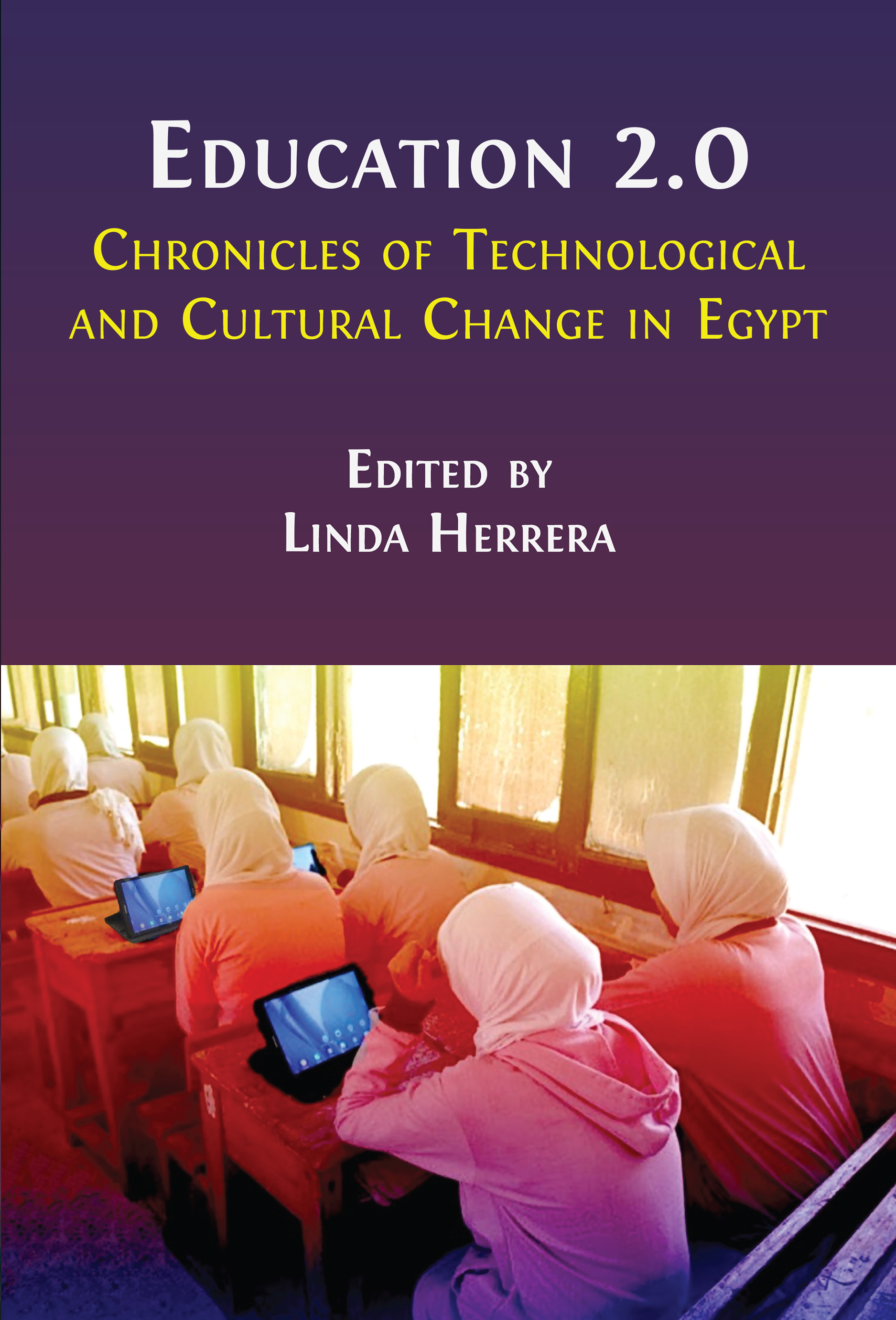
18. Motivations for the Digital Transformation of Education: Interview with Ahmed Daher
Linda Herrera and Hany Zayed1
©2025 L. Herrera, H. Zayed & A. Daher, CC BY-NC 4.0 https://doi.org/10.11647/OBP.0489.18
Abstract
Ahmed Daher, Deputy Minister of Information and Communication Technology, has been at the forefront of the Ministry of Education and Technical Education’s digitalization change strategy. He explains its four main components: it facilitates different approaches to teaching, studying, and learning; it enables learners and teachers to access different resources through online platforms; it constitutes a mega infrastructural project to connect all schools and classrooms; and it has a business and enterprise side since it generates demand for new goods and services and contributes to the economy. He emphasizes that technology is not an end in itself, but a means of getting people to where the government wants them to go.
Keywords
digital identity, electronic assessments, equity, gaming, impact, mega projects, operations, tablets, Samsung
1. Role in the Ministry

Fig. 18.1 Tarek Shawki (Minister of Education) demonstrates how to use a smartboard in a classroom as Ahmed Daher (far right) looks on. 20 February 2019, Port Said, Wikimedia Commons, CC BY-SA 3.0, https://commons.wikimedia.org/wiki/File:Shawki-Daher-SmartBoard-FB-Feb20-2019.webp#/media/File:Shawki-Daher-SmartBoard-FB-Feb20-2019.webp
LH As the Deputy Minister of Information and Communication Technology, what are your main responsibilities?
AD2 I am heading the ICT (Information and Communication Technology) in the education sector. I am overseeing at least four different parts. My appetite just opens when there is innovation. First, I have a project to connect all the districts and the governorates. There are 50,000 schools with technology labs, and there is an ICT curriculum that is being taught. We are also distributing tablets to all students in Grade 10. I have to ensure there is an administrative process in place for all the ICT related parts (see Fig. 18.1). Second, I am working on the Learning Management System (LMS) which is part of the Egyptian Knowledge Bank (EKB). Third, there are a lot of activities involved in moving our administrative building to the New Administrative Capital and I am supporting the digital transformation of the Ministry itself. Fourth, I am pitching the Ministry the idea of having something like a ‘smart card’ or a digital identity for all teachers and K-12 students. This smart card would have all the information about the tablet and what it accesses, and a system for tracking and tracing electronic books to not have leakage. There are several projects along these lines.3
LH That is a big portfolio. Do you work with a large team at the Ministry?
AD Well, yes and no. I have a big team yes, in numbers, but not all of them are qualified to do the work. In my office I have 900 people, and I have 56,000 people reporting to me. Sixty of them are good, the rest are normal. They do not have the qualifications to do the technical things I need. I am trying with them.
LH Before taking this position with the Ministry, what kind of experience did you have?
AD I received my M.A. and Ph.D. from the Department of Computer Engineering of the Military Technical College (MTC) in Egypt. I was on the teaching staff there until retiring from the Egyptian Army in 2012 as Lieutenant Colonel. That is when I joined the president’s office at the Arab Academy for Science Technology and Maritime Transport (AASTMT) responsible for strategies and projects. I also worked for Siemens Egypt for six years and have been involved in mega projects in the Middle East with Intel, IBM, Microsoft, Fujitsu, and Oracle. So, I do have different faces. I have worked between the government and the private sector.
2. Distributing and Tracking Tablets
LH Everyone in Egypt is talking about the tablets. Can you tell us about the Ministry’s decision to distribute tablets to all students in high school starting in Grade 10. At the other end, what happens to these electronic devices after students leave high school?
AD Let us start with the fact that the tablet is for free. Students do not pay money for it. They only pay the insurance part to cover damages. We are introducing a new system that requires this piece of technology for educational purposes. Due to social economic factors, we could not put the burden on students to pay for the tablet. As Dr. Tarek has explained, we are paving the way for a new electronic exam system which requires using the tablet. Also, the Egyptian Knowledge Bank (EKB) gives students the opportunity to access things they have never been able to access before; these were the triggers for the tablet. When a student takes the tablet, it is his (or hers) to use during the three years of high school, grades 10, 11, and 12.
LH How are the tablets distributed around the country?
AD They come from the airport to a storage area. We do a routine check for paperwork and then have batches that go to specific governorates. Each governorate distributes them to the district, and the districts deliver them to the school. The student must come to the school to sign some papers and then he (or she) can take the tablet.
LH After the student takes the tablet, is that the end of it?
AD Not exactly. That is what happens on the logistics part. But there is something else on the cloud-based side. A serial number is assigned to a student and then the tablet is activated. We install a piece of software to secure the device and ensure it can be controlled by the Ministry itself.
LH Do you mean there is a way to track the student activity on the tablet through the serial number?
AD Yes, exactly. There is a piece of software that allows me, or anyone with the password, to see a map of all the activities happening on the tablets throughout Egypt. It is also important to have a policy that governs all the aspects of technology to serve the objectives of the business you are delivering. We have what we call Mobile Device Management (MDM). We put software inside the device that controls it. If students misuse the devices, we have a technology solution for this. During the three years when they are in custody of this tablet, we have control over it. We can turn it into a brick so it cannot be used, we can track it using GPS, we can push the applications that we have onto it. We can allow access, and we can deny access. This is what we did last year. We are still experimenting with which apps to open and which ones to close, because we are talking about teens. We are tracking patterns of how they use the tablet for things other than education.
LH With students in the millions, that is an enormous amount of data. How can you manage or monitor it?
AD Well, there is a software and a system for that. I have assigned people for each governorate. We are also recruiting a team from Samsung to help to offload the activities, especially during pressured times like during exams.
AD Physically, it is distributed over several data centers with the main control in the data center in 6 of October city.
LH What kind of user behavior or data are you interested in tracking?
AD The part of the EKB I work on is the Learning Management System (LMS). The LMS is inside the EKB, and it is where we have publisher content from Wolfram, Britannica, and others. We want to see what learning materials they are using and how many of them are using the tablets. Last year, Grade 10 students downloaded twenty-eight terabytes of data from the tablets in the period leading up to exams. The downloads were spread across 500,000 tablets.
HZ Are students using the EKB actively during other times of the semester?
AD It depends on whether you are putting things in front of them. When the teacher tells them to go and seek information using resources on the EKB, they will use it. But for the new style of assessment in high school (with different sorts of questions and electronic trial exams) they did not know how to study and had to figure it out. At first, we faced a lot of resistance. They were complaining a lot about the new system. They would say, ‘What have you done? We do not know how to study. You are unfair (ظلمة). You ruined education’. But we were stubborn and waited to see how they would cope with it. We saw students logging on and entering the LMS. We are following the change management part. We, I mean Dr. Tarek, myself, and two or three other colleagues, do things that make people angry. But then they follow up and learn something.
HZ Will students have to turn in the tablets when they graduate?
AD No, after the three years, students can do whatever they like with it. When they receive the tablet, it is brand new. We are providing them with a high-quality tablet from Samsung, which won the tender from among five other contenders. They are high-quality end products with good support in the country. In Egypt, people try to extend the use of electronics for as long as they can. After high school they can use it for other purposes, or just sell it, or do whatever they would like. It is their property.
LH Have you considered using the tablet to teach students about electronic waste and the impact on the environment, or repurposing the devices for other uses?
AD From a project perspective, we are not concerned about the recycling of the tablets.
3. National Planning and Operations
LH You rolled out the tablets at scale across the country. In the planning phase, did you carry out a test rollout to a smaller group? How did that work?
AD We did it at the national level, and this is the hard way. Basically, there are two ways we could have approached it. We could have had a controlled environment, maybe within a governorate or a school. After you study the results, you do the rollout. Before coming to the Ministry, I used to work in mega projects where we did pilots and applied what we learned. Even with the best design on paper, in the end, there are still risks, problems, and things you could not have foreseen. We still had to come up with ideas to overcome problems in real time. When you test something in a very controlled environment, you will miss a lot of the dynamics. You will not understand community dynamics in regions that are different from one another. You will not anticipate reactions which come from people with different mindsets, with different political and social influences. Another reason we did not pilot is because it can take up to six years to finally get to the point where you do the national rollout. So, we rolled out tablets in the craziest way, on a national scale. Yes, maybe we made mistakes, but this was a calculation we made. We knew some unforeseen things were going to happen. Our objective was to get the tablets in the hands of students. We knew that if we delayed it, it might not happen. We gained experience about things we never knew existed out there. We withstood a lot of pressure last year, but we kept moving along.
LH As the person overseeing the national rollout of tablets, what have you learned?
AD I have learned that operations are more important than doing the design and implementation. You can have a perfect design with all the partners contributing their part, you can have all the money you need, but the operation part is very important. There are dynamics with the people involved that you need to handle from the start, from the angle of technology, business, and psychology. That is the people part.
LH How do you handle the psychology, the ‘people part?’
AD I will explain. We have different stakeholders. The technical people are trying to govern everything. The different companies work in their specific part of the system. In the schools, we have representatives, the techy guys who are solving tech issues in the classroom and dealing directly with students and teachers. Then you have the parents, because technology is a buzz thing, and everyone has an idea about how to deal with it. When we announced that we would provide students in Grade 10 with tablets, everybody was talking about the tablets being our great innovation in education. Can tablets be an innovation in education? No. Putting a tablet in the hands of the students is only one piece of a larger strategy for transformation. From our understanding, transformation is about people, process, and content. We are getting into high tech and using pieces of technology with the right process and aims. People like to talk about the ‘impact of technology’ but I think this is missing the point.
4. The ‘Impact’ of Technology
LH Why don’t you like people to focus on the ‘impact of technology?’ What do you prefer as an alternative way to talk about this digital transformation?
AD The ‘impact of technology’, is something we find in a lot in research. Actually, this is not the thing that should be measured. The educational change is what should be measured. You need to see what we are doing with the technology. We are planning to make the classroom a ‘connected classroom’, and this is not just a buzz word. We want to replace the blackboard in the classroom with an active panel, or a smartboard. There is a computer inside this panel, which is connected to the EKB. We are doing this as part of another pillar, the content pillar. Then there is the teacher pillar. With the EKB the teacher can access the LMS. The LMS contains not only the Study Guide and Lesson Plan but a lot of content we are adding related to the subjects. The content comes from publishers all over the world. We choose it according to our curriculum framework. What is the impact of using this type of technology? It is not just about the ease of using or accessing the resources. It is about how we are changing the role of the teacher. The impact is that we will be changing the role of the teacher more into a mentor, a coach.
Another example is when students bring the tablet into their homes, does this change their learning or impact their literacy? Last year during examinations, there were open book exams using the tablets. I sent our PR guys to shoot video in urban and rural areas in seven places, North Sinai, Arish, Matrouh, Monoufia, Port-Said, Luxor, and Cairo. We directly asked the students about how they were using the tablet. Were they sharing it with their siblings? Were they doing Google searches? From this we wanted to learn how the tablet is impacting their literacy, including their ICT literacy. They also talked to the IT guys and teachers at the schools about any problems they faced. A teacher in the countryside talked about how he used the smartboard and interactive screen. Then a student talked about how the exam on the tablet was stressful the first day, but he got used to it by the third day. They also did interviews in students’ homes. In one village home they had a very small and old TV, and the phone was not even a smart phone. Now, they have this type of high-tech device. We interviewed the father and asked him what he thought about this new system. He talked in a very good way about the need to be patient. We love that. There is an impact, yes.
HZ Do the students in these more remote places have access to the Internet?
AD Yes, we supply them with a sim card with a very cheap tariff for the data.
LH When you introduce something new into an environment, there are a lot of unpredictable things that can happen, which is why we need to research them. Take the teacher for instance. With these new technologies, whether apps, a Knowledge Bank, or devices, there are real concerns about teachers being replaced, bypassed.
AD But the kids have already been learning or discovering new things outside of the formal education system. With the tablet, we are following a pattern that has already been happening. The information they are getting is not just from parents or their community, it comes from online. When we were preparing for the tablets, people kept saying that students need training. I agreed and thought that within the student population, about 20% would be from very poor environments and would not even have access to the Internet or mobile phones. When I started visiting schools, I saw that almost all of them, even the poorest students, have mobiles. For the few who do not own phones, they have access to Internet cafés.
I will tell you something that surprised me. I went to a small village in a very distant area in Beni Suef, a very poor area. I sat with a group of very cute kids in Grade 4. I asked them a tricky question. I play games online, so I asked them, ‘Does anyone here play FIFA?’4 Three of them, a small gang, told me ‘Yes! We play it at Mohamed’s shop’. They are using technology at this age, even if it is just games. They learn from the games. I have a son who is ten years old. He learns English from playing games. We have to understand how these kids are learning. It is not only through their schoolbooks and their teachers, but in many different ways. The point is that we are not trying to put something totally new. It is maybe new for us, but it is not new for the kids. What we need to understand is how to measure their cognitive understanding through these technologies. We have to learn the pros and cons of having technology in the classroom. France recently banned the use of mobile phones inside the schools.5
LH Some schools like the Waldorf schools (based on the educational philosophy of Rudolph Steiner) do not want kids to use any screens in the early grades and have a very cautious and incremental approach to technology.6 This is to say there are different educational and pedagogical approaches to technology in education.
5. Localizing Industry
AD There is another dimension I want to raise about ‘impact’ which is the impact to industry itself. In a two-year period, we spent roughly fifteen billion EGP in Egypt. We put this money directly into the market, into companies. The local companies made about three billion EGP, which is a lot for Egypt’s ICT sector. To do the ICT upgrade in schools which required installing cables, the network, things like that, we worked with five hundred companies. This work has had an impact on local business. For example, when I was in Mansoura, I heard a guy say, ‘When I asked the electrician to fix my lamp, he said he could not do it, he was just working on the school project’. So, this is another impact. This is a mega project that has affected the economy in certain ways and brought innovation with it. We should look at what we are doing from this angle. Another important thing we are doing is trying to localize the production of the tablet in Egypt. We have over twenty million students and if you do the math, millions will need tablets over the next five years. We thought we could have facilities right here in Egypt to manufacture them. This will bring jobs, innovation, and opportunities to industry, specifically the ICT sector in Egypt.
LH When do you expect local production of tablets in Egypt to begin?
AD We put out a tender and are talking now to Samsung. The Chinese were on the table, but they withdrew their proposal, they were not able to do facilities in Egypt. We will finalize an agreement by the end of this year or the beginning of next year (2020)7 (see Fig. 18.2).

Fig. 18.2 Prime Minister Mostafa Madbouly (center) visits Samsung Factory in Beni Suef, Egypt, 18 May 2024, Wikimedia Commons, CC BY-SA 4.0, https://commons.wikimedia.org/wiki/File:
Samsung_Factory_in_Egypt.jpg#/media/File:
Samsung_Factory_in_Egypt.jpg

HZ I am thinking of the ripple effects of education technology. In a recent interview, Dr. Tarek talked about how he wanted the Ministry to build five technical schools to train people who could work in manufacturing, whether in the Samsung factory or somewhere else.8
AD Exactly. There are a lot of jobs and different roles. They are not just in manufacturing. We will also have jobs in maintenance and support. And not only for the tablet (as hardware), but the software of the tablet. There are different local companies that can help in developing applications. In high school alone (Grades 10-12) we have about three million students, not to mention the teachers. Small entrepreneurs and companies can come up with ideas for apps that we can install on the tablets of the high school students and teachers. And once we introduce tablets to middle school (Grades 7-9), it will increase the opportunity. I mean, it is like you have unexplored land with a lot of opportunities for building.
6. New Business Models for Private Tutoring
LH Are these new tools and electronic resources in the hands of the students having an effect on the private lesson industry?
AD We made a study and found that between 1.6 billion USD to 1.8 billion USD are being spent every year on private tutoring and associated costs. This includes the lesson itself, the external books, and the cost of transportation. This is money that we do not control and that does not help the country. It would be very hard to close all the centers or stop whatever means students are using to educate themselves. Instead, we can take a share of this sum and make sure the tutoring is taking the right approach. Private tutors should be teaching students to understand, not to memorize. They should help to make these kids good candidates in the workforce. Dr. Tarek came up with this idea of trying to regulate the private lessons by being a part of it.
So, even though we are not trying to overcome this phenomenon of private tutoring, we need to find some ideas to disrupt all of that. We will provide the private tutoring ourselves. We will innovate a marketplace and use the technology we are already providing. What we are doing now is building studios. We are developing something like an iTunes for lessons. This is like an app where a teacher, using high-tech tools, will give a single lesson in a given subject. The teacher will be equipped with the methodologies from the new framework, the content from our LMS, and the technology so that every student that has a tablet can access this right away. Instead of paying 100 LE per lesson, he will pay something like 5 pounds or 10 pounds per lesson. The video lessons will be on a platform like Netflix.
HZ Will you have a subscription model?
AD We might offer a subscription or a package per lesson. We can leave it up to them. We predict that up to 50% of the population will opt for these services. And we will split the revenue with the teacher who does the lesson. Teachers in different governorates can participate, so this is a way to distribute the revenue. The main part now is that we are using the technology, we have the platform, we have the LMS, we have the tablets, we have the studios, and our own studios (see Chapter 22 in this volume).9 Teachers can film their lessons in our state-of-the-art studio. This is how we bring lessons of high quality production to the masses. What we still need to do is develop the apps, an app like Netflix.
LH A problem with this model might be that it will bring a new kind of competition between teachers.
AD No, this is not a problem. What this will do is to kill private tutoring. The competition is a way to see who is good based on the ratings, who the people are buying more. You should be qualified to enter the marketplace. And you need training and certificates for that. So, this helps to solve another problem, the teacher problem that we have in Egypt. We need to filter the good ones from the bad ones. We need to find ways to try to increase teachers’ poor salaries. We need to have incentives in a decent way.
LH This leads us to the EKB project, which is open and free of charge to all Egyptians. But it is not a free project since the government has to pay for subscriptions from over thirty publishers. How does that work?
AD The EKB has its own business model. The secret to making this work has to do with the negotiations with the publishers who put their content there. This is the magic here. This is an integrated innovative model from the business and legal perspective because we are dealing with copyrighted material. It is hard dealing with British, American, Indian, and other publishers using one quote, and I am talking economics here, I am talking the business side, not the technical side. This is very hectic, and all the credit should go to Dr. Tarek because he managed to do this by himself (see Chapter 4 in this volume). And I need to point out the big difference between the EKB and other ‘free’ services. It is not Google Scholar, for example, where you can search for a paper and access to it. And it is not Wikipedia. It is also not the Khan Academy, which is totally different from the EKB. I used to be a researcher and faced a lot of barriers to just access documents, scholarly articles, because there was no EKB when I was doing my research.
LH What was your area of research?
AD Computer engineering, artificial intelligence. I spent a lot of money to do this kind of research. So, for a researcher the EKB is good. However, it is not only meant for researchers. It needs to be advertised for what it is, and how it is different from sites like Wikipedia or Google Scholar. We are working on that.
HZ Are you planning to expand the EKB to be like an Arab Knowledge Bank or an Africa Knowledge Bank?
AD From a technical point of view it is possible, but from the business side it is more difficult. We need knowledge really, but this also needs investment. I am sorry to say that many countries do not see the value of the Knowledge Bank. Dr. Tarek has negotiated very good deals for subscriptions, but other countries would have to pay the publishers to access them. That is one thing. The other thing is that some countries think it is okay to just have Google or Microsoft. Or they are satisfied with having the Internet to access things like Khan Academy. Some people think they can get their knowledge from Facebook and do not need something like the Knowledge Bank. When you talk to highly educated people and researchers, they understand that the Knowledge Bank offers a different standard. But others do not understand its value and do not realize that they need this.
7. Postscript
Ahmed Daher continued to lead digital solutions in Egyptian education. From 2021-2025 the MOETE developed VibeOps, a ‘100% Egyptian-designed AI-powered infrastructure management platform that […] exemplifies Egypt’s commitment to technological sovereignty and digital independence’ (Daher 2025a) (see Fig. 18.3). Under his leadership, the Ministry also launched ‘Faheem: An Intelligent Framework for Adaptive and Personalized Learning’, an initiative designed to ‘revolutionize K-12 education in Egypt with adaptive AI, inquiry-based learning, and a robust knowledge graph-based platform, all aligned with the national curriculum and global educational standards’ (Daher 2025b and Daher and the Faheem Team 2025).

Fig. 18.3 The Resilience of Egypt’s Education Digital Ecosystem,
Wikimedia Commons, CC BY-SA 4.0, https://commons.wikimedia.org/w/index.php?
title=Special:ListFiles/EducationMENA&ilshowall=1#/media/File:
Digital_Egypt_2025.jpg

7. Bibliography
Ahram Online. 2021. ‘Egypt Contracts Samsung to Localise Tablet Industry’, 4 March, Abram Online, https://english.ahram.org.eg/News/405308.aspx
Daher, Ahmed. 2025a. ‘When Resilience Meets Innovation: A Testament to Egyptian Technology Excellence’, LinkedIn, https://www.linkedin.com/in/ahmed-daher-ad2023/recent-activity/all/
Daher, Ahmed. 2025b. ‘I’m thrilled to announce that Faheem: An Intelligent Framework for Adaptive and Personalized Learning, a passion project I’ve led with the talented Faheem team, is nearing launch and will soon be available on iOS and Android stores!’ LinkedIn https://www.linkedin.com/feed/update/urn:li:activity:7320980166162178048/
Daher, Ahmed, and Faheem Team. 2025. ‘Faheem: An Intelligent Framework for Adaptive and Personalized Learning (Leveraging AI to Transform Education in Egypt)’, Cairo, https://www.scribd.com/document/890382658/Faheem-AI-Framework-for-Personalized-Adaptive-Learning-1745656104
Le Figaro. 2018. ‘Les téléphones portables seront interdits dès la rentrée scolaire, Par Camille Calvier et AFP agence’, 31 July, Le Figaro, https://www.lefigaro.fr/actualite-france/2018/07/30/01016-20180730ARTFIG00201-les-telephones-portables-seront-interdits-des-la-rentree.php
Ministry of Communication and Information Technology (MCIT). 2022a. ‘ICT Minister Opens ICT, Post Projects in Beni Suef; Inspects Samsung Tablet Factory MCIT’, 24 January, MCIT, https://mcit.gov.eg/en/Media_Center/Press_Room/Press_Releases/65954
Ministry of Communications and Information Technology (MCIT). 2022b. ‘ICT Minister Celebrates Graduation of WE Schools Students from ‘Samsung Innovation Campus’, 26 December, MCIT, https://mcit.gov.eg/en/Media_Center/Press_Room/Press_Releases/66713
Ministry of Education and Technical Education (MOETE). 2023. ‘The Arab Republic of Egypt Education Sector Plan 2023-2027’, https://www.globalpartnership.org/node/document/download?file=document/file/2023-09-education-sector-plan-2023-2027-egypt.pdf
Neumann, Robert. 2024. ‘Media Education in Waldorf/Steiner Schools’, Perspective, 9, https://doi.org/10.3389/feduc.2024.1365149
State Information Service (SIS). 2024. ‘The New Republic “Ten Years of Development”’, Government of Egypt, https://sis.gov.eg/Story/192297/The-New-Republic-“Ten-years-of-development”?lang=en-us
UNESCO. 2023. Technology in Education: A Tool on Whose Terms? (Paris: United Nations Educational, Scientific and Cultural Organization), https://www.unesco.org/gem-report/en
UNESCO. 2024. ‘Celebrating the Partnership between UNESCO, the Ministry of Education and Huawei in Egypt’, 1 April, UNESCO, https://www.unesco.org/en/articles/celebrating-partnership-between-unesco-ministry-education-and-huawei-egypt
1 This chapter combines two interviews: the first conducted by Linda Herrera with Ahmed Daher in September 2018, and a second one conducted by Linda Herrera and Hany Zayed on 30 October 2019.
2 Ahmed Daher is Deputy Minister of Education and Technical Education for Information and Communication Technology (2019- present as of 2025). For more information on Ahmed Daher’s professional background, see his LinkedIn page https://eg.linkedin.com/in/ahmed-daher-ad2023 which lists his professional positions.
3 The Ministry of Education and Technical Education’s initiatives towards digital transformation are part and partial of the Egyptian government’s plan, overseen by the Ministry of Communication and Information Technology (MCIT), for ‘Digital Egypt’. This entails ‘laying the foundations for the transformation of Egypt into a digital society’. See the MCIT website for details: https://mcit.gov.eg/en/Digital_Egypt#. See also the Education Sector Plan 2023-2027, section on ‘Digital Transformation and Innovation (MOETE 2023: 82-87). By 2024, a total of 9,246 laboratories were equipped, 36,210 smart screens provided, and 27,439 classrooms upgraded in 2,476 general secondary schools (SIS 2024).
4 FIFA Soccer is an online multiplayer sports game produced by Electronic Arts (EA). See https://www.ea.com/games/fifa
5 In September 2018, the French government banned students from using mobile phones in schools. The ban was applied from kindergarten to Grade 9 (Le Figaro 2018).
6 The Waldorf/Steiner schools delay children’s use of electronic media and digital tools according to their developmental stage, based on cognitive development theory of Lev Vygotsky and others (Neumann 2024).
7 In February 2022, Egypt signed an agreement with the Korean owned Samsung Group for a total investment of $30 million ‘to localise the production of tablet devices required for the Egyptian educational process’ by building a Beni Suef factory (MCIT 2022a). Tablets would have a ‘Made in Egypt’ seal (Alahram Online 2021). As of 2024, the Samsung factory includes production lines for televisions, mobile phones, and tablets, producing 6 million units annually. Samsung International aims to make Egypt a regional center for production and export for the Middle East, Europe and Africa (‘Made in Egypt’ Facebook page, https://www.facebook.com/photo/?fbid=871487585013538&set=a.660240456138253).
8 By 2022, seven WE Schools for Applied Technology from Samsung Innovation Campus in coding and programming were functioning, under the auspices of the Ministry of Communications and Information Technology (MCIT) with the Central Administration for the Development of Technical Education and funded by Telecom Egypt as part of its social responsibility initiative. These school represent Egypt’s first ICT vocational schools, with six-month training programs. They are located in Cairo, Giza, Alexandria, Suez, Dakahlia, and Minya (MCIT 2022b).
9 UNESCO announced the opening of ‘The Educational Content Studio’ on 1 April 2024 at the Professional Academy of Teachers. The studio is part of the UNESCO-Huawei Technology-enabled Open Schools for All Project (UNESCO 2024). See also UNESCO’s Global Education Monitoring Report on Technology in Education which addresses ‘the use of technology in education around the world through the lenses of relevance, equity, scalability and sustainability’ (UNESCO 2023).