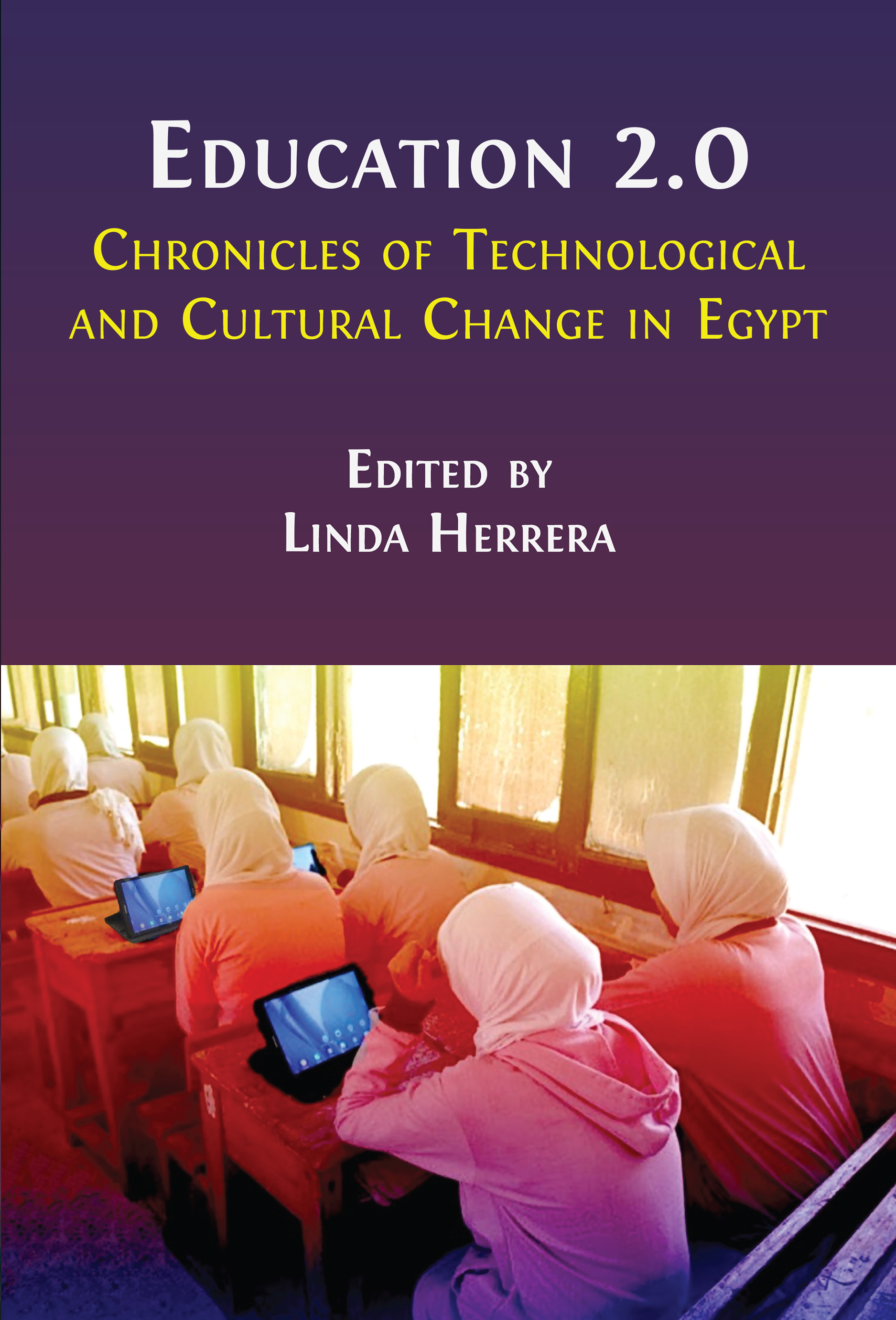
7. Envisioning a New Curriculum for the Primary Stage:
Interview with Nelly El Zayat
Linda Herrera1
©2025 Linda Herrera & Nelly El Zayat, CC BY-NC 4.0 https://doi.org/10.11647/OBP.0489.07
Abstract
Nelly El Zayat served as Advisor to the Minister of Education on Early Childhood Education and Educational Policy. She recounts how the advisory team initially started from a blank page to brainstorm what they considered the ideal attributes of graduates of Egypt’s education system. The new curriculum for the primary years incorporated elements from the International Baccalaureate, UNICEF’s Life Skills framework, and updated methodologies for teaching the Arabic language. Advisors worked with a range of partners from the private sector, international organizations, and the national curriculum center to develop the new books. Racing against time, and while juggling many commitments, they managed to launch the first set of new Education 2.0 books in the fall of 2018.
Keywords
curriculum development, curriculum framework, International Baccalaureate, life skills, private sector, textbook production, UNICEF
1. Becoming Advisor to The Minister of Education

Fig. 7.1 A meeting in the office of the Minister of Education and Technical Education. Nelly El Zayat, Tarek Shawki, Deena Boraie, Cairo, 2018. Photo courtesy of Nelly El Zayat.
LH What was the process of becoming a member of the Minister of Education’s advisory team?
NZ2 Speaking for myself, I had met Dr. Shawki maybe two or three times when he was Chair of the Specialized Presidential Council for Education and Scientific Research, before he became Minister of Education. He was aware that I had been working in international education for more than twenty years. I worked on advising and scholarship management, and still do that. I went back to graduate school (Harvard University Graduate School of Education) and studied International Educational Policy. I also started my own company, Newton Education Services. He called to ask if I would be interested in joining his team, and we had a long conversation. I resisted a little bit at first (chuckles). I told him I would love to, but I did not think logistically it would work. I have my own company, I live far away, and I have two young children. I am a very hands-on mom, very involved with my kids. So, everything was against me doing this job. I decided against it. He was very nice and said, ‘I respect that you are involved with your kids, I want you to stay involved. I do not need you to come in every day. I need you to deliver. I need you to get done what we need done. It doesn’t matter where you are physically’. I decided to come on board. The reality of that first year was that I ended up going downtown to the CCIMD (Center for Curriculum and Instructional Materials Development) office almost every day. We would also sometimes meet Dr. Tarek at his office in the ministry (see Fig. 7.1). But at least in principle, he did not really care about having a fixed working time from nine to five, but in getting the work done.
LH You have many years of experience working in the education field, but working on a national reform is a different kind of engagement. What is it like to work at this level?
NZ This offer to join the advisory team came at a good time because I was looking for a role that has to do with policy and a more strategic outlook on education. I was very… I want to use the right word... I felt very honored with the trust to do something like this. This is big. This is something that affects the whole country, it is not a small pilot. First, I learned that what we covered in classrooms at Harvard, or the research I did there, or whatever, has nothing to do with what is happening here on the ground. There is so much to learn here. This was the biggest, most important lesson. This idea of doing something for the whole of Egypt is meaningful. All of us as Egyptians, we walk down the street and think of the many things we want to change, or how things should be done differently. We talk about how the government needs to do this and that. To have the opportunity to actually do something was very, very special. I cherish that a lot. I feel I am fortunate to be here at this time.
2. Brainstorming for a New Education Framework
LH You joined Dr. Tarek’s team of advisors at the start of the Education 2.0 reform. Can you talk about the beginning. What did you all want to accomplish?
NZ The metaphor that Dr. Tarek always used was: ‘We are lucky. We can start with a blank sheet of paper. You can think and say anything’. And really, we were not restricted by anything. We could think anything we wanted. We could imagine the ideal system. Yes, we knew there were restrictions on the ground, but it was motivating for the team to be free to imagine whatever we wanted in the very beginning. We all started by brainstorming with Dr. Tarek to imagine what the best system for Egypt would look like. We threw in ideas that were based on research that each of us had done, personal experiences, a mixture of things. Next, we started to be more structured.
LH What ideas came out of the early brainstorming sessions?
NZ Everybody wanted to move away from rote learning, memorization, and the teacher centered system of class lectures. We agreed that we needed more interaction that would build the child’s personality so she could contribute positively to society. We even brought up the concept of ‘followership’. We talk a lot about what it means to be a leader, and this is important, but it’s also important to consider what it means for people to choose the right leader and be creative with whatever set up they are in. We all had a rough idea of the sort of person we wanted to graduate from that system. We wanted this person to have leadership skills, be innovative, creative, be thinkers, be independent, that sort of thing. These were the ideas, the starting points where we first began. Then we started moving to actionable items by thinking roughly about a curriculum framework. Dr. Deena Boraie (Senior Advisor), Dr. Nawal Shalaby (Director of CCIMD), and I started on that.
LH How did you structure your ideas into a curriculum framework? What did that involve?
NZ First, Dr. Tarek hired Dr. Nawal Shalaby to be the Director of CCIMD, the Center for Curriculum and Instructional Material Development. We had to explain to Dr. Nawal that we wanted to really transform the curriculum and start from a blank page. This was all new and surprising to her at the time. But once she got on board, we basically moved all our meetings and operations to CCIMD. We started by meeting with Dr. Nawal on her own and then started meeting with her team of thirty-five staff members. We explained the concept of trying to create a completely new system starting with a curriculum framework that would embody its philosophy and the ideas. (see Chapter 13 in this volume). They began researching different curriculum frameworks and education systems from across the world and pulled together their findings. We reviewed systems like the IB (International Baccalaureate), the British System, the American System, everything. We tried to see what would and would not make sense for us.
Something happened which I think was an important turning point. Nermine Noamany, who heads the International Partnerships at the Ministry, introduced us to Esmat Lameiy, who runs a private French I.B. international school called ‘Oasis’,3 as well as a public Ministry of Education school that follows the IB. Their students graduate with an IB degree. There are two schools like this in Egypt, and Ms. Lameiy runs one of them. She came in to meet us with Dr. Tarek to explain how they manage and run that school, how they work with the parents and set the fees. They pay something like 5,000 or 6,000 pounds EGP per year (roughly $300 in 2018). This interesting model inspired us a lot.
We thought ok, here is an Egyptian public school that was able to move to the IB and parents accepted it, or eventually they were educated on it somehow. We met several times with the school director to learn what they did in the school, the curriculum they followed, that sort of thing. What we learned inspired this current Education 2.0 system and the curriculum frameworks that we eventually put together. We did not reinvent the wheel, but we also did not copy and paste the IB. We needed it to make sense for the Egyptian context.
LH Apart from the IB, did you borrow from other systems or ideas for the new Education 2.0 framework?
NZ Yes, we also met at the time with UNICEF who shared the Life Skills and Citizenship Education (LSCE) framework with us. These are twenty-first-century life skills, your usual suspects like critical thinking, problem solving, empathy, resilience, skills like that. There are twelve of them. Because of the Egyptian context, we added two more skills that we thought were important for Egypt: accountability and productivity (see Chapter 10 in this volume).
LH Why did you consider ‘accountability’ and ‘productivity’ especially important for the Egyptian context?
NZ The rationale was, you know, we suffer from accountability issues here in Egypt as a society. People tend to not be accountable. They say, ‘This is someone else’s fault’, or ‘This was not my responsibility’, etc. So, we thought that if we bring in accountability from the early years, people will have more of that skill as they leave the system. And the same for productivity. This is the idea of being efficient and using your resources wisely, something that is much needed in Egypt, obviously. So, these were the reasons for adding those two skills to the framework.
LH How did you decide what content to include in the curriculum, knowing it was for all Egyptian schools?
NZ In the framework we have a pillar which we call ‘Al Qadaya’ or ‘the issues’ that are relevant to Egypt. For example, there are environmental issues. Water is a big topic in the curriculum. There are issues that are related to non-discrimination, development, globalization. For instance, in Kindergarten and Grade 1, there are lessons in social studies like: ‘I am Egyptian’. This is what the Egyptian flag looks like. But I am also part of Africa, and also part of the world. These have certain meanings and values. But obviously, the issues will become more complex as they grow older. We even have lessons in the curriculum that cover topics like female circumcision. We try to really discuss in various ways throughout the fourteen years, issues that are important for Egypt as a country and important for these students as Egyptian citizens. And we are trying to be more systematic about the curriculum.
From what I understand, curricular decisions in the past were more ad hoc. For instance, the Minister of Tourism would call the Minister of Education and ask him to include a lesson on, for example, King Tut, or whatever. It was not part of a scope or sequence of lessons in the curriculum framework or anything. So, they would add a lesson on King Tut in the reading and comprehension book (kitab el qira’a) but it was not connected with anything else. The same could happen with the Minister of Environment who wanted a lesson on this and that. This is why we tried to sort out these issues in the framework, to incorporate all of these priorities in a planned way. We said we were not going to be adding random stuff to the curriculum, it had to make sense.
LH The framework is supposed to cover the entire arc from KG1 to Grade 12, is that right?
NZ Yes. The idea is those skills and those adjectives that describe the graduate of the system are supposed to be consistent throughout the duration of the education system from KG1 to Grade 12. So, yes, in some years or in some lessons, there is emphasis on certain skills. Obviously, you cannot cover every skill in every lesson, but eventually, yes, they are supposed to be covered across the years of education—ideally, in every year. This is still a work in progress. The curriculum framework has been put in place but specifying grade level curriculum components are happening as we go. Right now, we are done for the most part with the Grade 3 curriculum, which will be rolled out this coming September (2020). After that, we will work on Grades 4, 5, 6, and 7, so it is really evolving.
3. Working on the New Textbooks
LH Can you describe the process of working on new textbooks from scratch?
NZ We started with KG1, KG2, and Grade 1 and worked our way up. The reason we worked on three grades at once was because kindergarten is not compulsory in Egypt, and most families start sending their kids to school in Grade 1, the first year of primary. We wanted to make sure we included Grade 1 in that first wave of Education 2.0. The ideal situation would have been to start with KG1 but we had to do all three years. I worked very closely on all of the steps: the framework, the grade level framework, and the textbooks for each grade level. CCIMD led the process, and this was intentional. We wanted to make sure that CCIMD took the lead on the frameworks and books to always send the message, ‘This is a homegrown curriculum. This is made in Egypt’. It is not something we bought off the shelf from somewhere else. But we could not do this alone. We needed partners to help build the capacity inside CCIMD because when we started, the team there were not ready to do something like this. They needed support to come up with the frameworks and all the subjects.
NZ The earliest partner on board was UNICEF. They trained the team at CCIMD on Life Skills and how to integrate them into the curriculum. Then, we had two other partners (from the private sector) starting with Discovery Education, a US based company, and Nahdet Misr Publishing Group, an Egypt based company. They took a deep dive into the actual subjects being taught in each grade.
Discovery advised on the Arabic language subject, even though it is not their language. They were training CCIMD on how to create a curriculum for a language, whatever the language, and what you need to do to teach children literacy. They gave them extensive training and did the same for math. Discovery also worked on the multidisciplinary subjects, which include language, math, science, and social studies. The kids in KG1, KG2, in Grade 1 and now Grade 2, have an Arabic book and a multidisciplinary book. They also have an English book because they take English as a stand-alone subject. In Grade 1, they also have a religion book. So, we were dealing with all these textbooks.
One of the things Discovery did was to explain how necessary it was to have specific windows for literacy and numeracy in the curriculum and in the student’s daily schedule (see Chapter 14 in this volume). Initially, we were enthusiastic about the idea of multidisciplinary learning without different subjects. We wanted to bring back the one teacher per classroom, like a homeroom teacher, and that is still the case. But when Discovery came on board, and I think this was an important addition, they said that no, we really need to carve out time specifically for literacy and numeracy because these are two very essential skills that the children must have. With their support, we had to quickly go back to the drawing board to see how to build that into the curriculum and make sure there is enough literacy and numeracy focused lessons (see Fig. 7.2).

Fig. 7.2 Deena Boraie, Nelly El Zayat, and Nawal Shalaby with the first batch of Education 2.0 books, Cairo, 2019. Photo courtesy of Nelly El Zayat.
LH How did you choose Nahdet Misr to work with you on developing a new methodology for teaching Arabic? Was there a competition?
NZ Nahdet Misr is an Egyptian company that has been in education since the 1930s. They are the makers of the Al-Adwaa books, what we call the external books (kutub kharijiyya). This is the exact opposite of what we are trying to do. Al-Adwaa is not a ministry-provided textbook but a copy of the book that includes a large number of questions to prepare students for the tests. I think Nahdet Misr quickly understood that we wanted interesting, engaging, topics to teach kids Arabic. They came up with this amazing concept of teaching the letters of the alphabet out of sequence in a way that would help kids create words as soon as possible. They would still start with the first two letters ‘Alef, Beh’ (A and B), but then add a letter out of sequence ‘Alef, Beh, Meem’ (A, B, and M), and then introduce the words ‘Ab and Om’ (Father and Mother) quickly. I think the next letter was ‘feh’ (F) so they have ‘Fam’ (mouth). By introducing new letters out of sequence instead of learning all the letters in order at once, kids could quickly create words and sentences. Dahlia Fouad, the director of their academic department, and Dalia Ibrahim, the company’s CEO, were both heavily involved in this. I think the actual Arabic work was done by Dahlia Fouad (in collaboration with Edupedia) (see Chapter 15 and Chapter 16 in this volume). I think it was a really good move to bring in Nahdet Misr as an Egyptian partner because this is an Egyptian curriculum.
But then what happened was that other book publishers like Selah El Telmeez and El-Moasser, that also produce external books used for test preparation, were asking: ‘What about us? What are we going to do?’ They were worried that they would not have a chance to do any books since the 2.0 system covers all the years to Grade 12. They asked to meet with the minister, and he explained that this was not a monopoly, contracts were yearly, and if someone had better things to offer, the ministry would come to an agreement with them. The Minister explained that they could still do the external study-guide books for the later years. But as the new system was getting rid of traditional tests through Grade 3, these companies had to rethink their business model of providing external books oriented towards tests. The first major test would be in Grade 4. He suggested that they could maybe do games that support the activities in the classroom for the multidisciplinary books. He met with them several times because they felt threatened.
4. Managing Time Pressure
LH Dr. Tarek became minister in 2017, and the new books for KG1, KG2, and Grade 1 were rolled out in September 2018. Can you walk us through the timeframe?
NZ We started to work on the curriculum mid-to-end of August 2017, and then all through that year. The new system was supposed to be in schools September 2018, so we only had a year to do the curriculum framework, the three grade level frameworks for KG1, KG2, and Grade 1, and the textbooks. In fact, we had less than a year, because books had to be finished by May or June and sent to the printers. We also had to train teachers over the summer so that they would be ready for September. We basically had eight or nine months to finish everything.
We were all working around the clock. I remember Dr. Nawal, Dr. Deena, and I were working during Ramadan. We would be on a conference call, all of us with our computers. The call to prayer would come and I would go quickly to get something to eat or drink because we would be fasting. We might still be on the call at 1:00 a.m. or 2:00 a.m. We were literally working around the clock. Some of the CCIMD team, specifically men, used to spend the night at the Center. And, the women would come early, very early. They would go home only for a few hours and come back. It was really, literally, working around the clock. Everybody was highly involved and knew that we really did not have time.
Initially, the partners were skeptical and felt we could not get this done. But there was no other option. Discovery Education and Nahdet Misr also worked around the clock. We would be on calls with members of the team in Discovery in the US at crazy times. It would be after midnight for them, early morning in Egypt. I think this also initially shocked the partners. But there was no time to be shocked. We said, ‘Yalla, we have to move’.
LH Why did you have to implement the new curriculum and books so fast? Could you not have waited for the following year?
NZ The President asked to have a new system in place as soon as possible. The Minister was appointed in 2017 and bargained for a one-year extension and promised him to have the beginnings of a new system in place September 2018. So, this is how we got this timeline.
LH Was the curriculum framework being developed at the same time the teacher training was being designed?
NZ Sort of... Discovery also did the Teacher’s Guides and mapped the lessons from the textbooks. The Teacher’s Guides were a big and necessary part to start the teacher training. We were trying to have them both ready at the same time. We had to train all the teachers (of KG and Grade 1) in all of the governorates, a total of 128,000 teachers.
LH How did you manage the different types of partners? Discovery is a private company, UNICEF is a UN organization, CCIMD is a government organization, Nahdet Masr an Egyptian publishing company. Who was managing all of these parts?
NZ Maybe the only plus of having a tight timeline was that there was no time for drama or politics or issues with management, because we were all running. I would give the most credit here to Dr. Nawal Shalaby because she had to orchestrate the process and manage the different experts. There are experts in different subjects, in curriculum design, et cetera. It took some time to convince the CCIMD team about the new system. I think that was more challenging than managing the partners, to have the team at CCIMD be open to people telling them basically, ‘No, forget about what you have been doing for your career, this is how we want to do it now’. I think Dr. Nawal handled that really, really well. And then Dr. Deena and I were involved. We were liaising between the partners and CCIMD. But I think that if it was not for Dr. Nawal’s open mindedness and the big picture view, none of this would have worked.
5. Multitasking
LH You have two young children, your own company, and responsibilities as an advisor. How do you manage your time? What does the day in the life of Nelly El Zayat look like?
NZ In the beginning it was crazy, and this work was taking priority over my other work. It was competing with my family (laughs). Like I said, we were all working literally round the clock. But on the very personal level I felt like I was finally able to contribute and do something meaningful for the education system in Egypt. I really believed in what we were doing. There are moments in this job, at the Ministry, where you do certain things because you have to, or because that is the way it is, or whatever, like any job. But this part of working on the new curriculum framework and books, I really enjoyed, though it was exhausting. I felt that I was doing something meaningful. This was a priority for me at the time. Now, CCIMD is running with it. The team there came a very long way. They learned a lot and we (the advisors to the Minister) are not as involved as we were in the beginning.
At the time, we were reading every word that was written in every book, we were looking at every picture, we were sending comments about everything. For example, the names of the children in the stories, the character names in the book. We would point out if a name is not very Egyptian, or if names are only Muslim. We were going into specific details. I have friends whose children are in Grade 1 or Grade 2 who are taking these new books. They tell me how amazing the books are. How they are a big shift from their older kids’ books. And I see it even with my own children. My eldest has the old Arabic books and my little one will get the new books. So, I see that there is a huge difference, really, not because I worked on them, but because they really are very different.
LH At this juncture, two years into the reforms, how do you see change? Do you think there is a difference on the ground?
NZ I think that because the change is happening with the younger children, the feedback from those families has been, as far as I can tell, generally positive. But it has not taken the public space that it deserves… yet. This is partly because the early grades are not considered high stakes like the stuff that happens in high school. People are more focused on that because it affects their future immediately, whereas what is happening with the younger kids, we get just very scattered individual feedback. The Ministry has not done enough to tell people what is happening in the classrooms of the early grades. This will hopefully, eventually come, but right now, there needs to be more light on it.
6. Education 2.0 Resources
Center for Curriculum and Instructional Materials Development (CCIMD). 2018. ‘General Curriculum Framework for General and Technical Education, Arab Republic of Egypt’ (Arabic), Education 2.0 Research and Documentation, https://drive.google.com/file/d/1WCpwmqi1byu2dniIZ7NlaEUHC4A4hjG9/view
Center for Curriculum and Instructional Materials Development (CCIMD). 2018. ‘Curriculum Framework Kindergarten: Life Skills and Citizenship Education, 2018-2019’ (English), Education 2.0 Research and Documentation, https://drive.google.com/file/d/1kMWLZ-BDtIJoLX0lAia_aO7SGyQhNoWI/view
Center for Curriculum and Instructional Materials Development (CCIMD). 2018. ‘Curriculum Framework for First Primary: Life Skills and Citizenship Education, 2018-2019’ (English), Education 2.0 Research and Documentation, https://drive.google.com/file/d/1X57_pIsyFKvD3ETMYCBgXqQgX1n8pIE8/view
Center for Curriculum and Instructional Materials Development (CCIMD). 2019. ‘Curriculum Framework for Second Primary: Life Skills and Citizenship Education, 2019-2020’ (English), Education 2.0 Research and Documentation, https://drive.google.com/file/d/1zZ9x5NJ7hlXVDdIrk2DmhNCF296MEWXP/view
Center for Curriculum and Instructional Materials Development (CCIMD). 2020. ‘Curriculum Framework for Third Primary: Life Skills and Citizenship Education, 2020-2021’ (English), Education 2.0 Research and Documentation, https://drive.google.com/file/d/1kTepP-tFU6MvNmhoiOwlXqvqgap6h7TU/view
Ministry of Education and Technical Education. 2018-2024. ‘KG1 and KG2 Books and Teacher’s Guides’, Edu 2.0, https://edu2-egypt.com/kg1-2
Ministry of Education and Technical Education. 2018-2023. ‘Grade 1 Books and Teacher’s Guides’, Edu 2.0, https://edu2-egypt.com/books-grade1
Ministry of Education and Technical Education. 2019-2023. ‘Grade 2 Books and Teacher’s Guides’, Edu 2.0, https://edu2-egypt.com/grade-2
Ministry of Education and Technical Education. 2020-2024. ‘Grade 3 Books and Teacher’s Guides’, Edu 2.0, https://edu2-egypt.com/grade-3
7. Companion Videos
Video 7.1 Deena Boraie and Nelly El Zayat: ‘Advisors to the Minister of Education’, Interview by Linda Herrera, Education 2.0 Research and Documentation Project, 17 June 2021, YouTube, https://www.youtube.com/watch?v=3nbxwZTgZW8
Video 7.2 Deena Boraie and Nelly El Zayat: ‘Developing a New Curriculum’, Interview by Linda Herrera, Education 2.0 Research and Documentation Project, 17 June 2021, YouTube, https://www.youtube.com/watch?v=86ZiLZuEi2k
Video 7.3 Deena Boraie and Nelly El Zayat: ‘Communication about the EDU 2.0 Reform’, Interview by Linda Herrera, Education 2.0 Research and Documentation Project, 17 June 2021, YouTube, https://www.youtube.com/watch?v=zl9CVV3fte0
1 This interview took place on 12 February 2020, in Cairo with a follow-up interview in 2022. Special thanks to the members of the Education 2.0 Research and Documentation team, Nairy AbdElShafy and Hany Zayed, who contributed to the first interview with background research and documentation.
2 Nelly El Zayat’s LinkedIn profile provides more information about her professional and education trajectory: https://www.linkedin.com/in/nelly-elzayat/
3 For more information on Esmat Lamei, see https://blogs.worldbank.org/en/team/e/esmat-lamei